Blog
Backward Compatibility Testing for APIs Explained

Abhilash
Published on






Table of contents
Lorem ipsum
Lorem ipsum
Lorem ipsum
Lorem ipsum
Lorem ipsum
A payments platform serving forty enterprise partners begins rejecting a thin slice of customer transactions. Nothing dramatic enough to light up a status page. The kind of failure that surfaces two weeks later in a support thread, when a partner asks why their conversion rate slipped half a percent. The cause is a single input validator that was tightened during an internal refactor, judged low-risk and merged late on a Friday.
No schema change, no contract test failure, no alert. The endpoint still accepts strings. It has simply stopped accepting strings containing accented characters, and a partner whose customers are spread across Europe starts quietly losing sign-ups.
Incidents of that shape used to be rare. They are now the operating reality of any enterprise running APIs at scale, and the pressure is rising as AI assistants and coding agents take on more of the implementation work. Backward compatibility testing has moved from a hygiene task to the discipline that keeps the contract honest while the implementation changes faster than anyone can document it.
What is Backward Compatibility Testing for APIs
Backward compatibility testing for APIs verifies that an updated version of an API keeps working for consumers built against earlier versions, without those consumers having to change their code.
The underlying principle is that the consumer should not pay the cost of the provider's evolution.
The discipline draws on several activities rather than one. Schema diff, contract testing, recorded traffic replay, consumer-driven contracts, and end-to-end journey verification each catch a different category of break. A mature programme combines them and treats no single technique as sufficient on its own.
It sits close to, but is not identical with, API regression testing, which asks whether existing behaviour still holds after a change, whereas backward compatibility asks specifically whether older consumers can keep working unchanged.
Why Backward Compatibility Became a Strategic Concern
The cost of breaking an API used to be a short apology and a hotfix. That cost has climbed for three reasons, and the combined effect pushes the question up the organisation.
1. Consumer Multiplication
A modern API serves web clients, mobile clients, partner integrations, internal services, and increasingly AI agents acting on behalf of users. A breaking change cascades across a surface the provider cannot fully see.
2. Contractual Exposure
Partner agreements and enterprise service levels now reference API stability in writing. A break becomes a contractual incident rather than a purely technical one.
3. Velocity Asymmetry
The team shipping the API moves faster than the consumers downstream can absorb change, and that gap widens with every quarter that AI-assisted development accelerates output.
The practical result is that backward compatibility has become a platform-level concern that quality assurance inherits by default.
What Counts as a Breaking Change
A breaking change is any modification that forces existing consumers to update their own code to keep working correctly.
The patterns below are the ones that turn up most often in production incidents.
Removing an endpoint: Consumers calling it start receiving 404 responses.
Renaming an endpoint or path segment: Hard-coded paths in consumer code stop resolving.
Removing a response field: Consumers parsing that field receive null or nothing.
Renaming a response field: Consumers reading the old name see an empty value.
Changing a field type: A move from string to number, or scalar to object, is rejected by consumer parsers and type systems.
Changing a field's meaning without renaming it: Consumers receive valid-looking data that now means something different.
Making an optional request field required: Calls that omit the field start failing validation.
Adding a new required header or parameter: Existing calls fail authorisation or validation.
Tightening input validation: Restrictions on length, format, or character set turn previously accepted inputs into 400 responses.
Changing HTTP status codes for existing scenarios: Consumers branching on status codes mishandle the response.
Restructuring error responses: Error-handling logic misreads failures.
Changing authentication or scopes: Tokens that worked yesterday no longer authorise the same call.
Tightening rate limits or quota windows: Consumers within the old limits start receiving 429 responses.
Changing pagination structure or default page size:Iteration logic breaks or returns incorrect totals.
Changing default sort order: Consumers relying on order receive different results.
The list is not exhaustive, and the common thread is simple. Any change that alters the observable behaviour of an existing call, without the consumer having asked for it, is a breaking change.
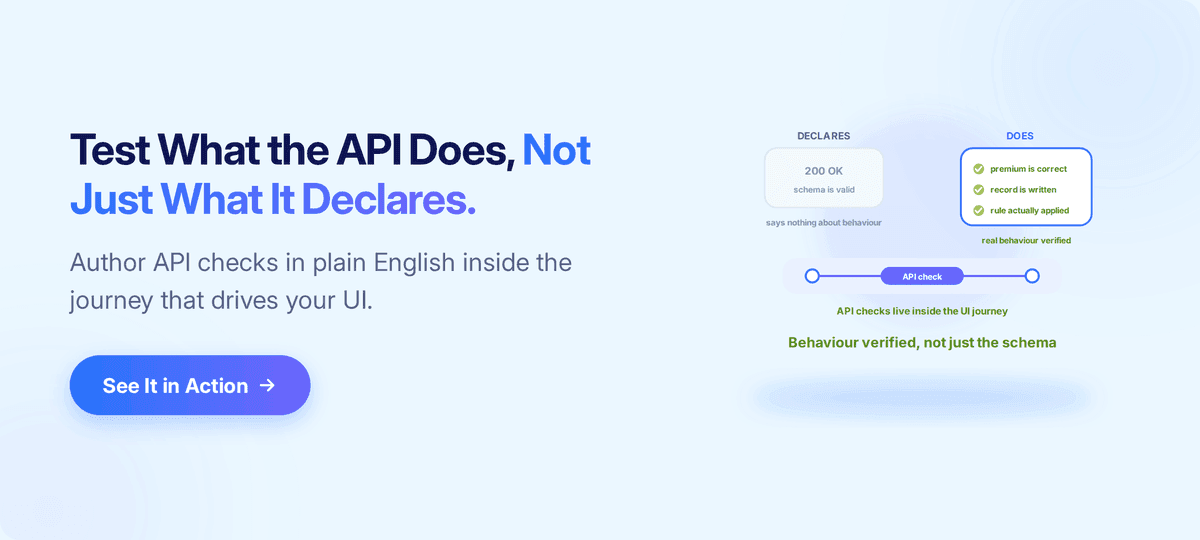
Schema diff will not catch validation tightening when the changed constraint is absent from the API specification, or is present but not updated to reflect the change. When the tightening is expressed in the spec, namely a shortened maximum length, a new pattern, or a narrowed enum, modern diff tools can flag it.
When it lives only in the implementation, only tests that exercise realistic inputs tend to surface it.
What Counts as a Safe Change
Several changes are usually safe to make without consumer impact, though the caveats are where teams get caught out.
Adding a new endpoint: Existing consumers carry on calling existing endpoints, with no caveat worth noting.
Adding a new optional request parameter: Consumers that omit it keep the default behaviour, provided that default behaviour genuinely stays the same.
Adding a new response field: Most consumers ignore fields they do not recognise, though strict consumers with closed parsers can break on it.
Adding a new HTTP method on an existing path: Existing methods keep working, as long as the new method does not change resource state in surprising ways.
Relaxing input validation: Previously rejected inputs now succeed, which is safe only if downstream systems can handle the wider input space.
Making a previously implicit value explicit: Consumers receive more data rather than less, though strict consumers may still reject the extra field.
The caveats carry real weight. Saying that adding a response field is safe assumes tolerant parsers. Many generated clients ignore unknown JSON fields, but clients configured to reject unknown properties may break when response fields are added. The safe defaults are not safe in every consumer environment, which is exactly why testing across realistic consumer profiles stays essential.
The Four Dimensions of API Compatibility
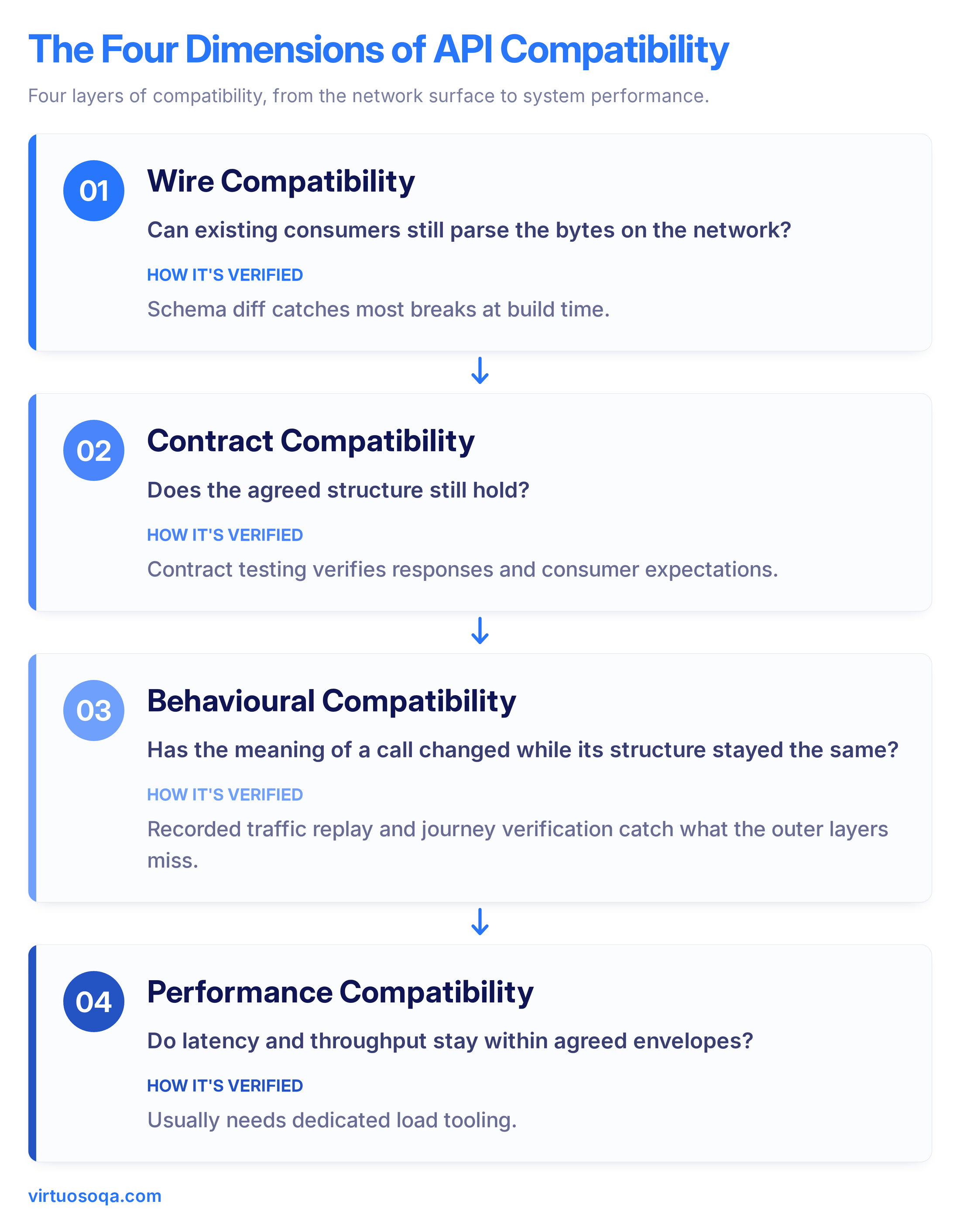
A complete view of backward compatibility separates four dimensions. Each is verified by a different technique and each fails in its own way.
1. Wire Compatibility
Can existing consumers still parse the bytes on the network. Format changes, encoding shifts, serialisation library upgrades, and field type changes all show up here, and schema diff catches most of them at build time.
2. Contract Compatibility
Does the structural agreement between provider and consumer still hold. The contract is usually expressed in OpenAPI, JSON Schema, Protocol Buffers, or GraphQL SDL, and contract testing checks that responses match the agreed structure and that consumer expectations match what the provider actually returns.
3. Behavioural Compatibility
Has the semantic behaviour changed even when structure and wire format are identical. Validation tightening, default-value shifts, ordering changes, idempotency changes, and side-effect changes all live here, and it is the hardest dimension to test and the one most often missed. Establishing it well overlaps heavily with API functional testing, namely asserting on real inputs and expected outputs rather than shape alone.
4. Performance Compatibility
Do latency, throughput, and resource usage stay within agreed envelopes. A response that arrives correctly but five seconds late is still a breach for any consumer with a timeout, and this dimension usually needs dedicated load tooling rather than the functional techniques covered below.
A Worked Example of a Subtle Validation Tightening
Consider an API for creating customer records. The original request looks like this.
The original validator on name accepts any non-empty string up to 100 characters. The API is used by partners across Europe, and the real customer base includes names with accented characters, diaereses, and ligatures.
A refactor lands during a sprint focused on input hardening. The new validator restricts name to ASCII characters only, and the commit message describes it as tightening input validation for safety. The OpenAPI specification is unchanged, the schema is unchanged, the contract tests pass, and the deployment clears CI without incident.
In production, a small percentage of customer creations begin returning 400, namely the ones containing characters outside ASCII. Consumers see no change in any specification. The provider's monitoring shows nothing unusual because the error rate is low. The partner with the largest European customer base notices first, and the incident chain starts from there.
The change is a breaking behavioural change. The schema is intact and the contract is intact, but the behaviour is not. The techniques that would have caught it are recorded traffic replay against the new version using payloads sampled from real production traffic, behavioural test cases that deliberately exercise the input space the original validator accepted, and end-to-end journey verification using partner-style customer data.
The example is the whole argument in miniature. Schema and contract testing handle structural breaks, and behavioural testing handles everything else.
API Versioning Strategies and Their Trade-offs
Versioning is the mechanism for introducing breaking changes safely, and the strategy you pick has long-term consequences for compatibility, discoverability, and consumer experience.
1. URL Versioning
The version sits in the path, as in /v1/customers and /v2/customers. It is the most visible option and the easiest for consumers to reason about, at the cost of resources losing stable identifiers across versions, which complicates caching and resource modelling.
2. Header Versioning
A custom header such as API-Version: 2 selects the version. URLs stay stable, but the version becomes invisible in browser tools and basic logs, which raises debugging friction that most operations teams feel on their first major incident.
3. Media Type Versioning
The Accept header carries a versioned content type such as application/vnd.example.v2+json. It is the cleanest option in theory and the least adopted in practice, because it leans on HTTP semantics that few consumer toolchains expose well.
4. Date-Based Versioning
Each consumer pins to a specific date in a header or query parameter. It gives consumers fine-grained control and decouples the provider's release cycle from consumer migration, at the cost of maintaining many active versions over time.
A pragmatic default for most enterprises is URL versioning for major versions, combined with strictly additive evolution inside each major version. The combination keeps consumer disruption low and the documentation manageable.

How to Build a Backward Compatibility Testing Programme
A working programme layers five techniques, each catching what the others miss. No single one is sufficient, and running all five during pre-release verification substantially reduces the risk of shipping a compatibility break.
1. Schema Diff
Compares two versions of an API specification and flags structural changes. The OpenAPI, JSON Schema, and Protocol Buffer ecosystems all have mature diff tooling, and it is the cheapest layer to run, catching wire compatibility breaks at build time.
2. Contract Testing
Verifies that the provider's actual responses match the agreed structure and that consumer calls match what the provider expects. Tools such as Pact and Spring Cloud Contract have made the technique standard practice, with the contract kept as a versioned artefact alongside the code.
For the mechanics of schema, status code, header, and field-level validation, see our page on API contract testing.
3. Consumer-Driven Contracts
Invert the model so that each consumer publishes the subset of the contract it actually depends on, and the provider verifies against the union of all consumer contracts before release. The approach captures expectations consumers encode in their tests and is especially valuable when several internal teams share one API.
4. Recorded Traffic Replay
Captures real production traffic, anonymises the sensitive parts, and replays it against the new version. It catches the behavioural changes that schema and contract tests cannot see, including validation tightening, default shifts, and subtle response variations.
5. End-to-End Journey Verification
Exercises the API as part of the customer journey it serves, from the UI through the API to the database and back. It catches the cases where a structurally compatible change still breaks a real user flow, and it is where behavioural fidelity is established most reliably.
Backward Compatibility Testing in CI/CD
Verification has to live inside the development workflow to stay effective. Three patterns are now common in mature engineering organisations, each matching a technique's cost to a sensible cadence.
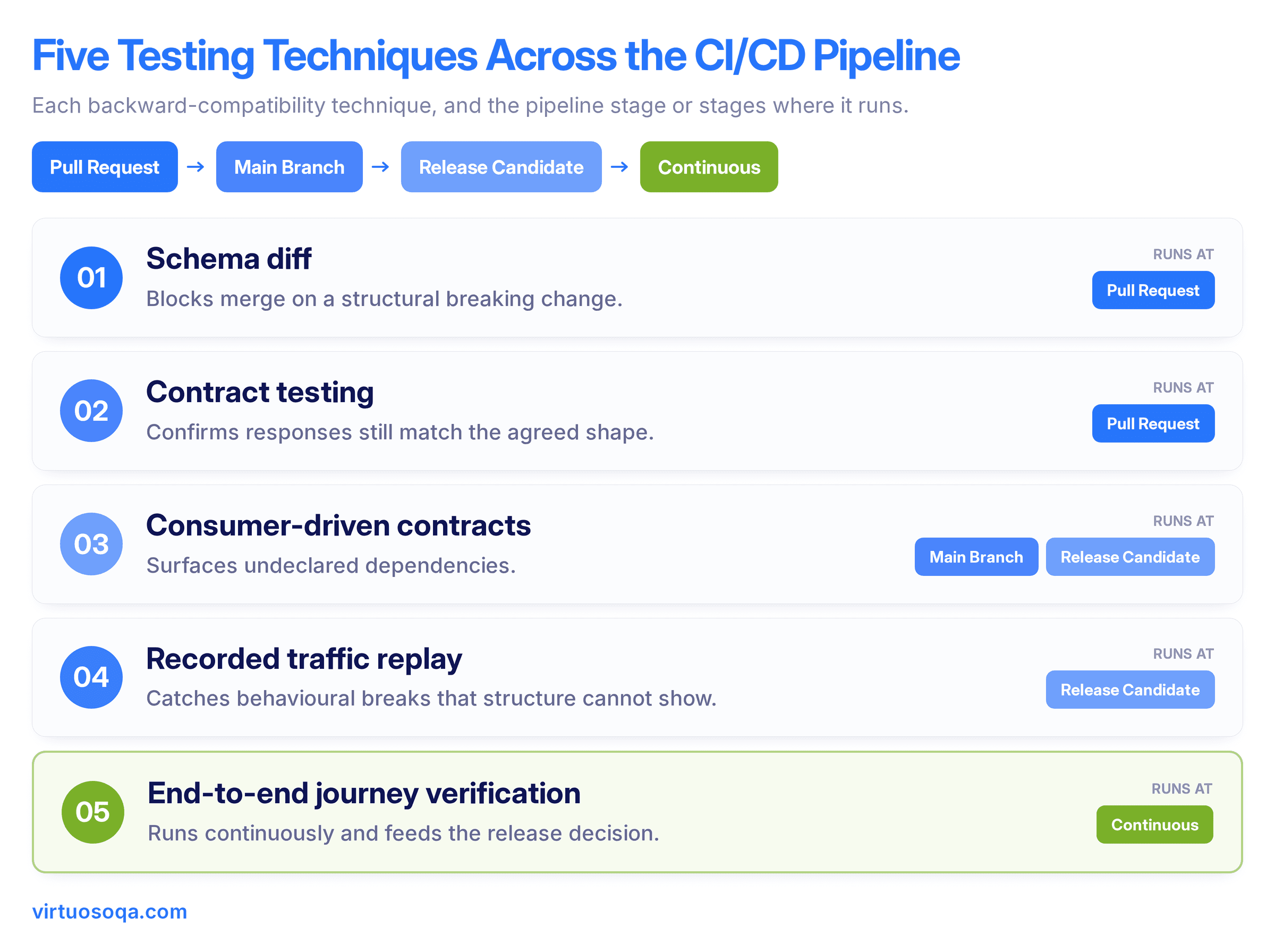
Every pull request: Schema diff and contract tests run on each PR. A structural breaking change blocks merge until it is reverted, paired with a version bump, or explicitly approved as a managed break.
Main branch and release candidates: Consumer-driven contracts and recorded traffic replay run here, reflecting the higher cost of running them relative to the cheaper structural checks.
Continuously against production-like environments: End-to-end journey verification runs on a cadence that matches the release cadence rather than the commit cadence, and its results feed the release decision directly. The journey layer can catch breaks that the structural layers do not show, before deploy.
The AI-Generated Code Problem for API Compatibility
The arrival of AI-assisted code generation introduces failure modes that the compatibility playbook should plan for. The recurring risk is that agents optimise for locally correct code while having little visibility of the consumers downstream, and the patterns below are worth watching for rather than treating as inevitable.
Agents may not know which fields are load-bearing: A refactor that looks clean inside the provider's repository can break a partner integration, and it can pass review because the code itself looks correct.
Agents can lean toward defensive validation: The same instinct that adds null checks can add input tightening, and the accented-names scenario above is the kind of case where an agent improves the code by its own measure while breaking the contract by the consumer's.
Agents can refactor across boundaries: A change that looks local can shift behaviour at the API surface if the agent follows a code path the reviewer did not anticipate, in which case schema diff catches the structural part while the behavioural drift slips through.
The implication is a recommendation rather than a law, namely that compatibility verification is worth moving closer to behaviour and further from structure alone. The contract remains necessary but is not sufficient on its own, and exercising the customer journey continuously across versions is a sensible bar to aim for as code velocity rises.
From Contract Verification to Journey Verification
A useful way to frame the shift is the move from contract verification to journey verification. Contract verification answers whether the API still meets its declared shape. Journey verification asks the harder question of whether the customer experience still works.
The two are complementary rather than competing. Contracts give clarity, journeys give confidence, and a team running both layers on every release is better placed to absorb AI-assisted velocity without exporting the risk to its consumers. A reasonable way to think about it is that the contract is a snapshot while the journey is a living asset, so a verification approach that keeps the journey honest is one that tends to hold up as code velocity rises.
How Virtuoso QA Approaches API Verification
Most compatibility programmes stall at the point where structural checks pass but behaviour has quietly moved, which is precisely the gap that opens wider as AI writes more of the code. Verification needs to sit where consumers actually feel breakage, namely inside the journey rather than alongside it.
Virtuoso QA is an AI-native platform that verifies APIs as part of the customer journey they serve. API calls, payload assertions, header checks, and response validations are authored in plain English through Natural Language Programming, inside the same journey assets that exercise the UI, the API, and the database in one place.
GENerator, the platform's agentic generation engine, builds API verifications from existing assets and from Swagger or OpenAPI specifications, so coverage scales at the pace engineering ships.
Self-healing keeps those verifications aligned as endpoints, payloads, and authentication change, which reduces maintenance rather than removing it, and its proposed repairs run at approximately 95% user acceptance.
Every AI action is proposed for review, executed by a deterministic engine, and recorded, so the autonomy stays governed. Enterprises including London Market Group and AerCap use the platform to keep customer-critical workflows verified as code velocity rises.

Common Pitfalls in API Backward Compatibility Testing
Several patterns show up in almost every programme that has not yet been course-corrected. Naming them is usually enough to start fixing them.
1. Treating the OpenAPI Specification as the Source of Truth
The specification is a declaration and the behaviour is the truth, so programmes that verify only against the spec miss the behavioural breaks that matter most.
2. Skipping Consumer-Driven Contracts Because They Feel Heavyweight
They capture the expectations consumers encode in their tests, and teams that skip them lose an early signal on the dependencies those consumers have written down.
3. Relying on Synthetic Test Data
Synthetic data lacks the long tail of real production inputs, and recorded traffic replay with proper anonymisation is what catches what synthetic data misses. There is a place for functional testing with fake API data, namely early development and edge-case construction, but it does not substitute for realistic production traffic in compatibility work.
4. Ignoring Partner-Style Consumer Profiles
Different consumers may have different parsing, validation, and error-handling behaviours, so a suite that exercises only one consumer profile can miss breaks that another consumer would surface first.
5. Treating a Version Bump as a Substitute for Compatibility
A major version bump eventually requires consumers to migrate if support for the older version is withdrawn, so its cost should be weighed against the cost of preserving compatibility, with the default favouring preservation.
6. Running No Deprecation Policy
A programme without a published, enforced deprecation policy leaves consumers guessing. The Sunset HTTP header, defined in RFC 8594, gives a standard way to signal the date after which a URI is expected to become unavailable.
The Future of API Compatibility
Several directions look plausible, and they point the same way rather than being settled fact.
Verification moves closer to the pull request: Schema diff, contract testing, consumer-driven verification, and journey verification compress into the workflow, with results surfaced before merge rather than during release.
Compatibility becomes a continuous signal: Production traffic, journey monitors, and consumer feedback loops could feed a live compatibility view that teams watch the way they now watch uptime.
The customer journey becomes the canonical artefact: Contracts are likely to stay on as documentation while journeys, kept current by usage signals and refreshed by agentic generation, take on more weight in how compatibility is judged.
Teams that build these habits early are better placed for what follows. Teams that wait may find themselves explaining more compatibility incidents to partners whose patience for them has thinned.
Related Reads
Frequently Asked Questions
What Is the Difference Between Backward and Forward Compatibility
What Counts as a Breaking Change in an API
How Do You Test API Backward Compatibility
Can Backward Compatibility Testing Be Automated
How Does Virtuoso QA Test API Backward Compatibility