Blog
Requirements Traceability Matrix: Types, Example, Template

Abhilash
Published on

Table of contents
Lorem ipsum
Lorem ipsum
Lorem ipsum
Lorem ipsum
Lorem ipsum
A requirements traceability matrix maps requirements to the test cases, code modules, and deliverables that implement and verify them. The artefact has existed for decades, but its importance has risen sharply in the past two years for a structural reason. When requirements change weekly, code refactors daily, and tests are AI-generated, the only way to keep verification aligned with customer intent is to maintain that alignment continuously.
The static spreadsheet RTM is dead. The living RTM, maintained as a live graph inside the test platform, is now the operational form of risk-based testing.
This guide covers what an RTM is, the three types of traceability, the anatomy of a modern matrix, a fully worked example you can copy, how to build one, the compliance standards that demand it, how it adapts across methodologies, and why the living RTM has replaced the spreadsheet.
What is Requirements Traceability Matrix (RTM)?
A requirements traceability matrix is a structured artefact that records the relationships between requirements and the work products that satisfy them.
The work products typically include design elements, code modules, test cases, and release deliverables, though the matrix can extend further depending on the project.
The artefact answers four questions a project cannot answer well without it.
Which requirements have been implemented?
Which requirements have been verified?
What will be affected if a given requirement changes?
What requirement does a given test case actually serve?
The matrix is not paperwork. It is the operational evidence that what the business asked for has been built, and that what has been built has been tested. A project without an RTM produces tested software that has no proof of correspondence to the requirements it was meant to satisfy.
The label "matrix" is historical and slightly misleading. The early form of the artefact was a literal table, whereas the modern form is closer to a directed graph maintained inside a test management platform, with each requirement connected to many work products and each work product traceable back to its origin requirement. The structure matters and the format does not.
The Benefits of a Requirements Traceability Matrix
Before the mechanics, it is worth being explicit about what a well-maintained RTM delivers, because the benefits are what justify the discipline.
Complete test coverage, because every requirement is linked to the test cases that verify it, so an uncovered requirement is visible rather than hidden.
Impact analysis on change, because when a requirement moves, the matrix shows every test, module, and deliverable affected, rather than the team rebuilding that map from memory.
Scope control, because each deliverable ties back to an approved requirement, which surfaces out-of-scope work early and prevents scope creep.
Audit-ready compliance evidence, because the matrix is the documented proof that each regulated requirement was implemented and verified.
Risk-based prioritisation, because the matrix is what lets a team rank verification effort by business criticality rather than testing everything or guessing.
Faster, safer decisions, because a single source of truth replaces scattered tribal knowledge about why each piece of work exists.
Why RTM Has Become More Important, Not Less
A counterintuitive observation runs through current enterprise QA practice, which is that RTM has become more valuable as software has become more dynamic, not less.
The intuition runs the other way. Agile, continuous delivery, and AI-assisted coding all favour speed over documentation, so the instinct is to retire heavyweight artefacts in favour of lighter ones, and RTM looks heavyweight. That instinct misreads the underlying mechanics, because three forces have actually raised the value of traceability sharply.
The first is requirement volatility. Requirements no longer settle into a finished state before development begins, they evolve through the project, and without traceability the team cannot tell which tests still verify the current requirement and which verify a version that has been superseded.
The second is code velocity. AI coding assistants and modern continuous delivery pipelines push code through the system faster than human review can keep pace, and without traceability the team cannot tell which tests must be revalidated when a particular module changes.
The third is the cost of getting it wrong. Modern enterprise software powers customer-facing transactions with direct revenue exposure, so a missed requirement is a missed customer outcome, and a test that no longer reflects the requirement it was written for is a silent confidence killer.
Traceability turns each of these from a blind spot into a surfaced signal, and the RTM is the spine that lets a team answer "what is affected" without rebuilding the dependency map from scratch every time something changes.
The Three Types of Traceability and Why the Asymmetry Matters
An RTM supports three directions of traceability, and the distinction matters more than competing guides tend to suggest.
1. Forward Traceability
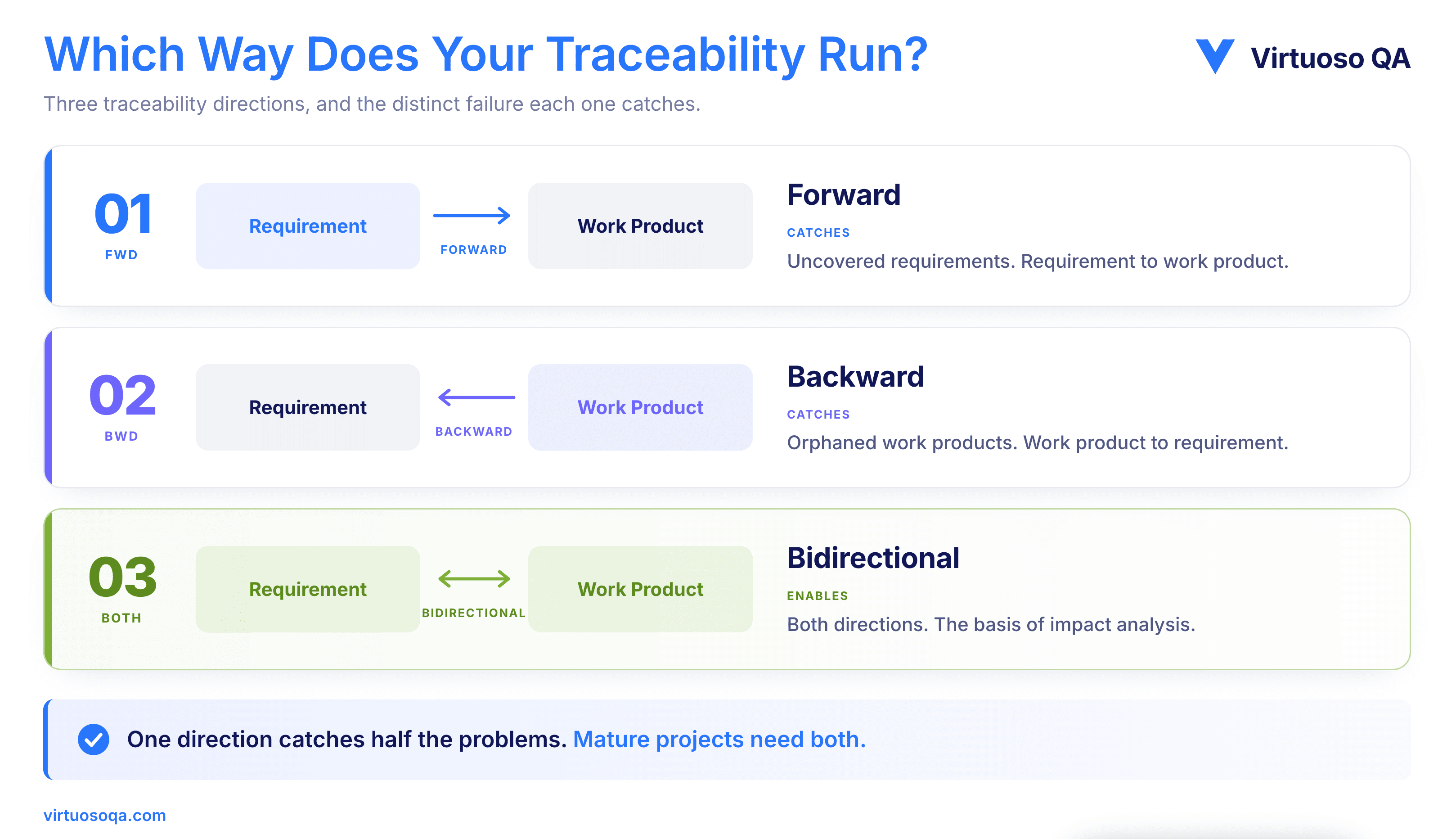
Forward traceability maps from requirement to work product, so that for each requirement the test cases, code modules, or design elements that satisfy it can be located.
The question it answers is whether each requirement has been implemented and verified, and without it a team cannot prove coverage, because a requirement that exists without an associated test case is a coverage gap by definition.
2. Backward Traceability
Backward traceability maps in the opposite direction, from work product back to requirement, so that for each test case, code module, or design element the originating requirement can be located.
The question it answers is whether each piece of work serves a recognisable requirement, and without it the team cannot identify orphan work products, meaning test cases that verify behaviour no requirement asks for, code modules that exist for reasons no one remembers, and design elements whose purpose has been lost to staff turnover.
3. Bidirectional Traceability
Bidirectional traceability is what most mature projects actually need, because the matrix supports navigation in both directions at once, from requirement to all related work products, and from any work product back to its requirement.
It is the basis of impact analysis, since when a requirement changes the team can identify every test case, code module, and design element affected, and when a test case fails the team can identify the requirement at risk.
The asymmetry is the point most guides miss. Forward traceability catches uncovered requirements, backward traceability catches orphaned work products, and the two directions catch genuinely different problems, so a team that maintains only one direction misses half the failure modes.
The cost of maintaining both is meaningful but contained, and it is the only mechanism that keeps an enterprise project honest about what has been built, what has been tested, and what is at risk when change arrives.
The Anatomy of a Modern Requirements Traceability Matrix (RTM)
The columns of a traditional RTM were designed for the project structures of the 1990s, whereas the columns of a modern RTM reflect what enterprise software now actually needs to track.
A practical modern RTM carries the following fields for each requirement.
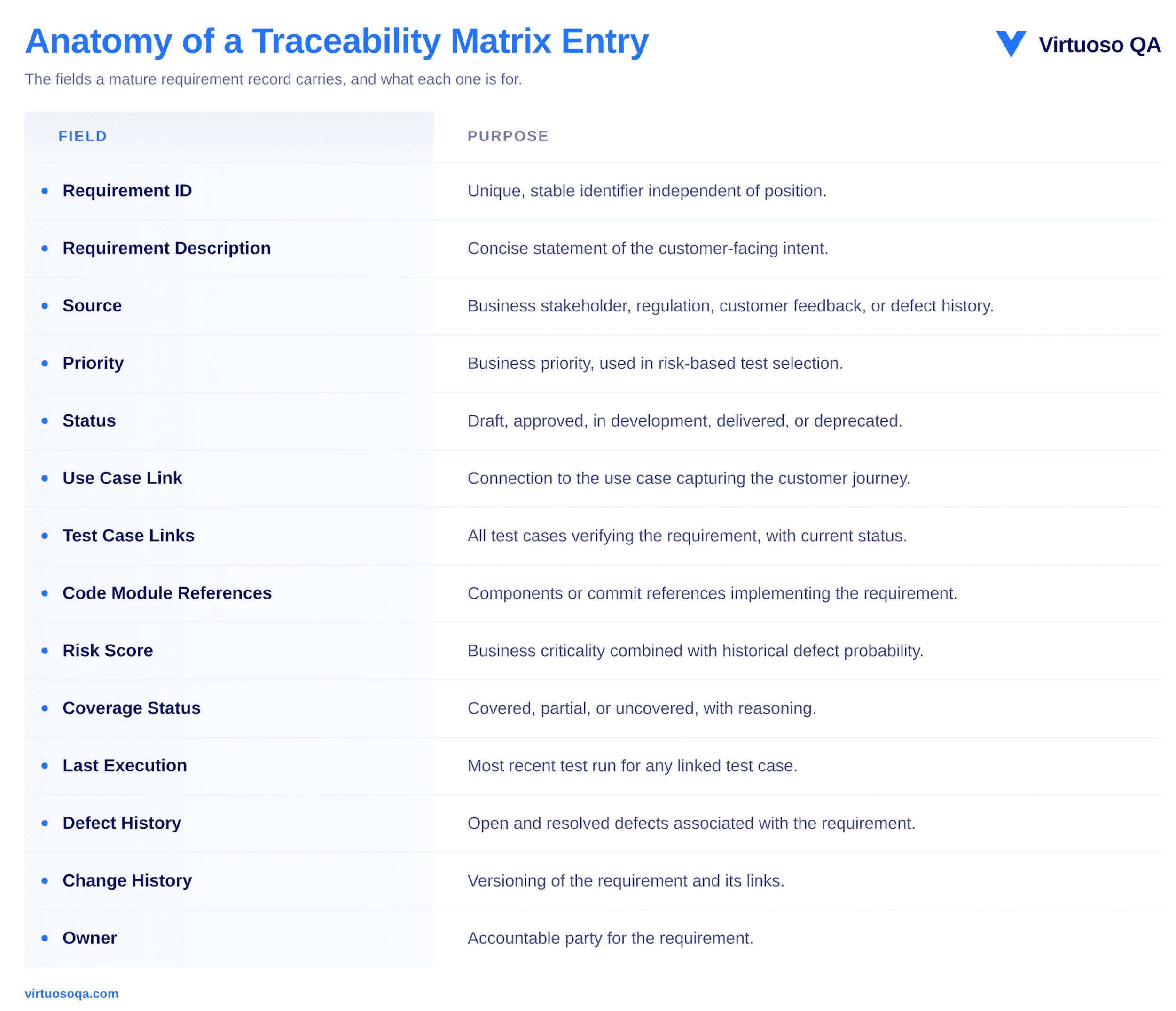
The list is longer than a 1990s template because the questions a modern project needs to answer are larger. A requirement that is "covered" in 2026 has to be covered in a way the team can trust, by current tests, against the current implementation, with risk-weighted prioritisation reflected in execution frequency.
The fields above do not all live in one literal spreadsheet column anymore. In a well-instrumented test platform, the relationships are maintained as graph edges in a live database, with views into the data presented as matrices, dashboards, or reports depending on the audience.
A Worked Example of a Requirements Traceability Matrix
A populated example makes the structure concrete.
The matrix below shows a slice of an RTM for the checkout and payment area of an e-commerce application, with the most commonly used fields. A real RTM carries more columns, but this is the readable core most teams start from.
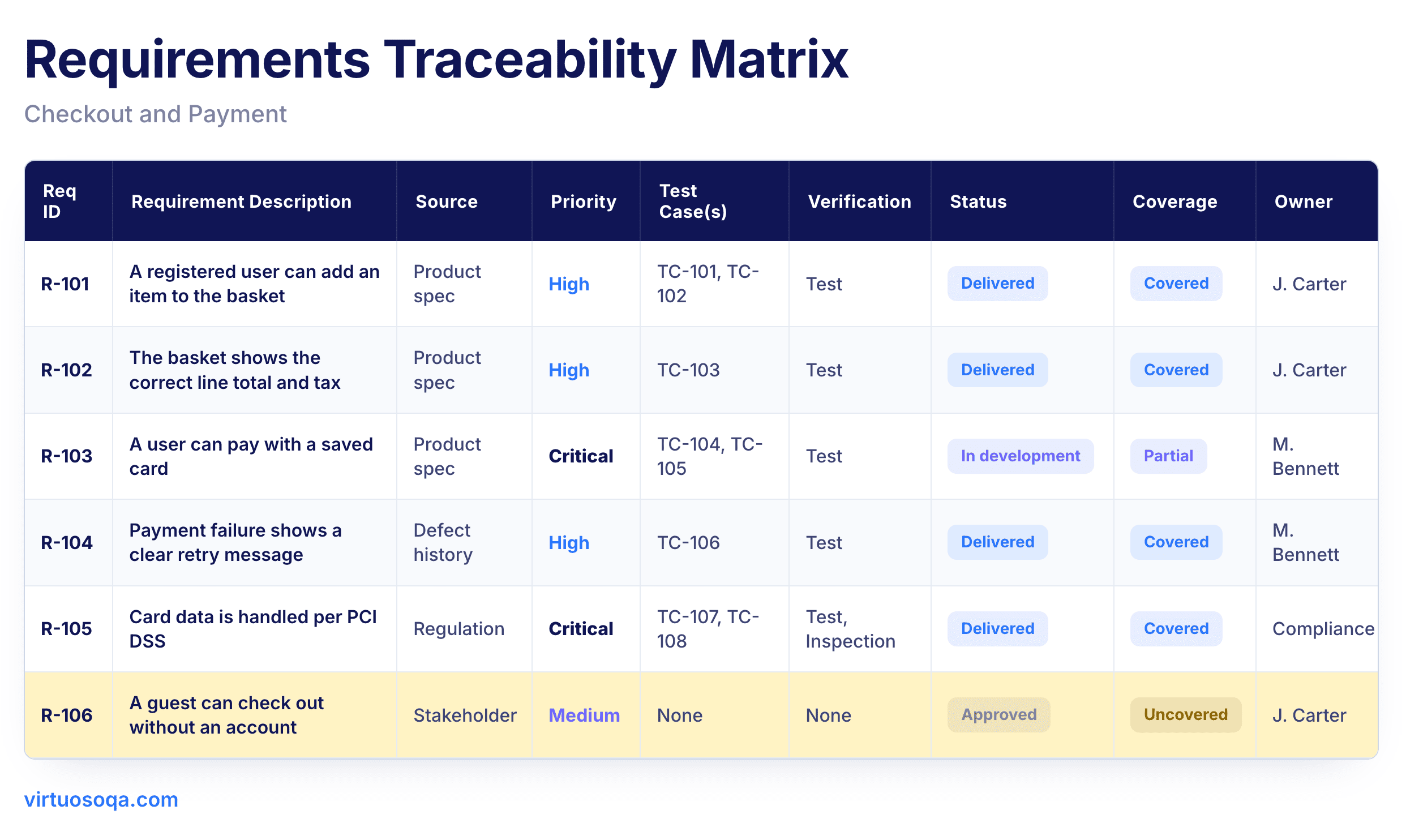
Read the example as a diagnostic rather than a record. Requirement R-106 has no test case linked and a coverage status of uncovered, which is exactly the gap an RTM exists to surface, since the requirement is approved and owned but nothing yet verifies it.
Requirement R-103 is partial, because it is still in development with only some of its tests in place. Requirement R-105 carries two verification methods because a regulated requirement often needs both an automated test and a documented inspection.
The value is not the neat rows, it is the two lines that are not neat, because those are the risks the team can now see and act on.
How to Build a Requirements Traceability Matrix: The Five-Stage Process
A practical process structures the work, and five stages move a project from no traceability to a working RTM.
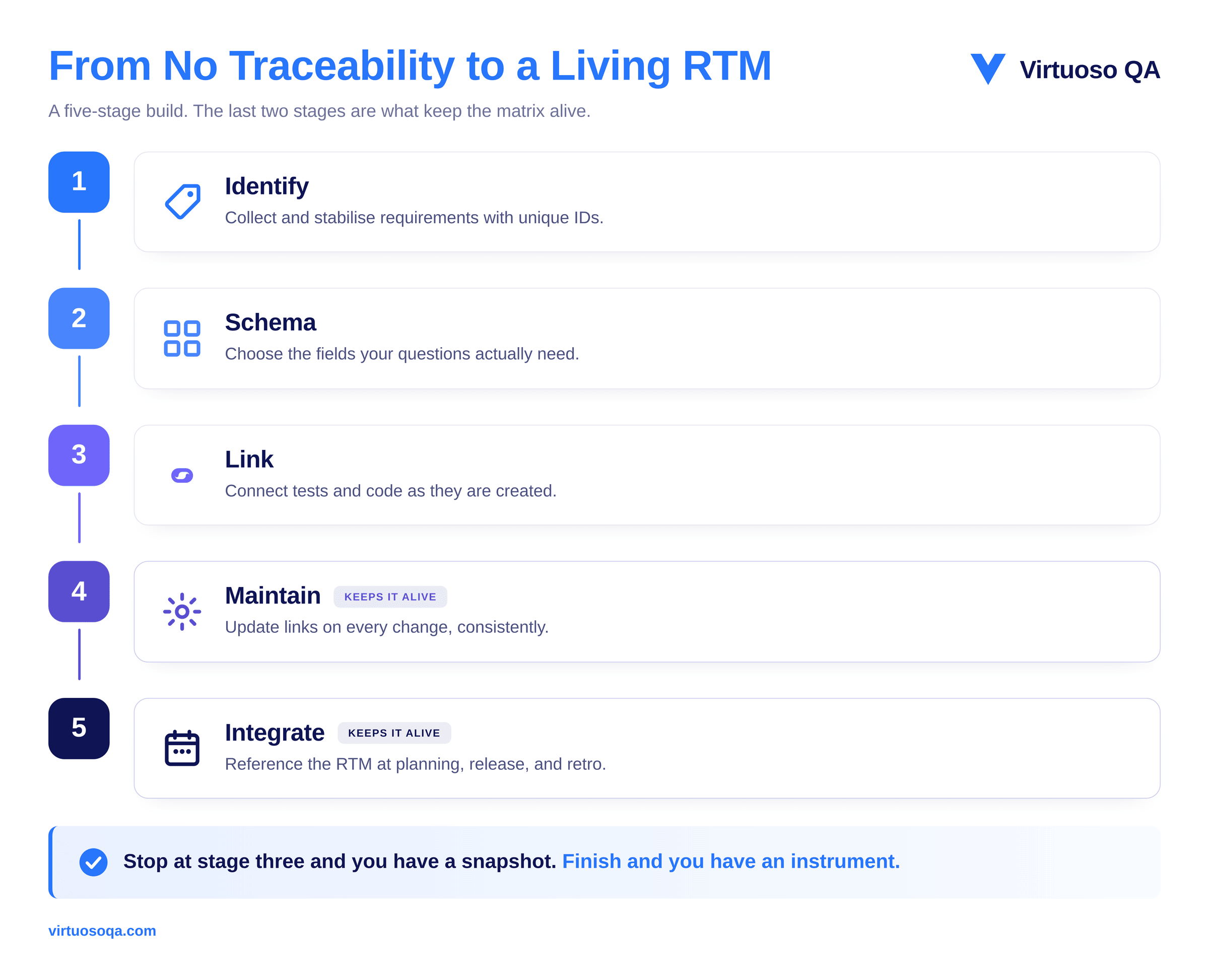
1. Identify and Stabilise Requirements
Collect requirements from all sources, including product specifications, user stories, regulatory obligations, customer feedback, and defect reports, then assign each a stable, unique identifier and capture its source, priority, and owner.
2. Establish the Schema
Decide the fields the RTM will carry, reflecting the questions the team will actually need to answer rather than the questions a generic template suggests, since different industries weight different fields more heavily.
3. Populate Work Product Links
For each requirement, link the test cases, code modules, and design elements that satisfy it, and do the work in parallel with the work products themselves, so tests link to requirements as they are written and code links to requirements as it is committed.
4. Establish Maintenance Discipline
Define the points at which the RTM updates, so that when a requirement changes the links update and when a test case is added or retired the links update. The discipline is not the volume of work but the consistency of it.
5. Integrate into the Project Rhythm
Reference the RTM at sprint planning to confirm coverage of selected stories, at release planning to confirm coverage of the release scope, and at retrospectives to surface coverage gaps the project did not catch in time.
Who Uses an RTM
An RTM is not solely a QA artefact, which is part of why it endures. Systems and test engineers use it to confirm coverage, project managers use it to track scope and progress, business analysts use it to keep delivery tied to intent, and compliance and audit leads use it as the evidence trail regulators expect.
The shared single source of truth is what keeps those groups aligned, since each reads the same graph from a different angle rather than maintaining a private version of the truth.
The Static RTM Is Dead, and the Living RTM Has Replaced It
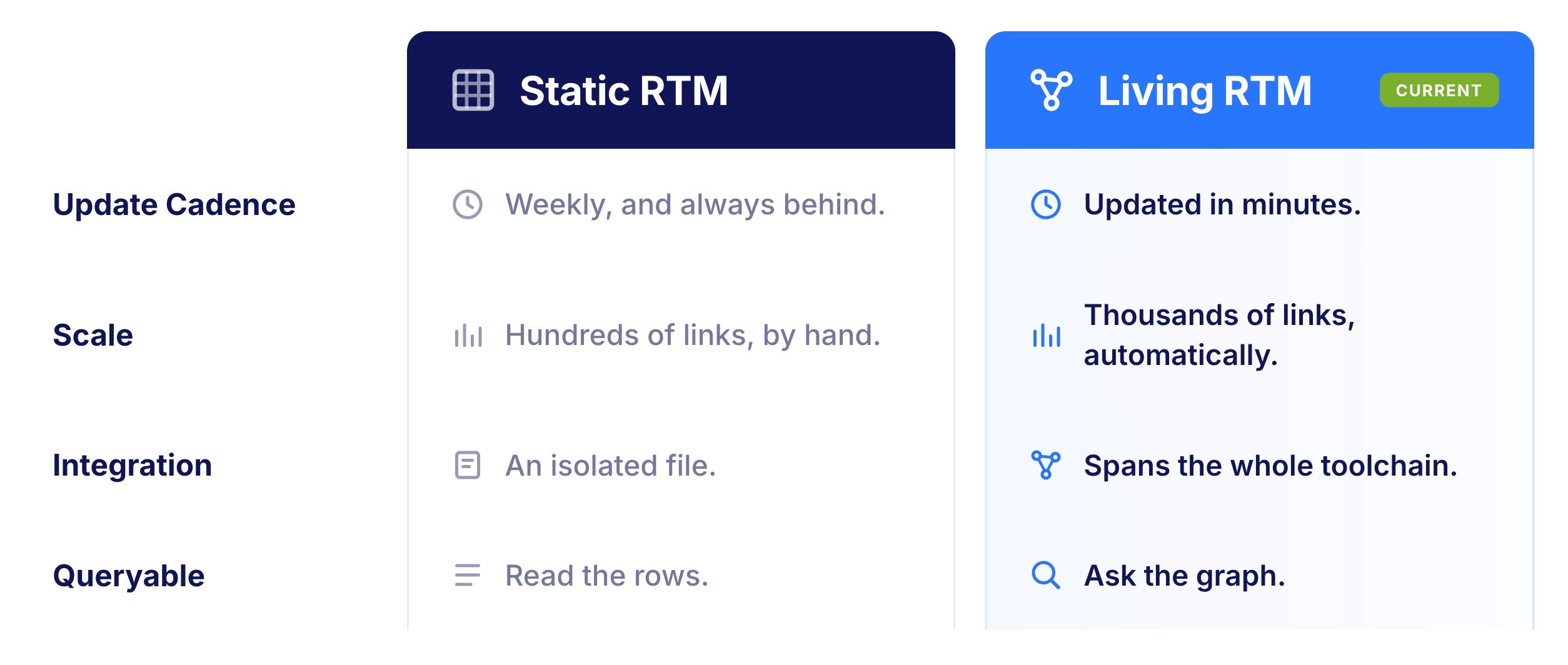
A practical observation has divided enterprise QA teams over the past two years, which is that the traditional static RTM, maintained as a spreadsheet by a designated owner, cannot survive in modern enterprise development. Three forces have broken it.
Volume: Requirements that ran into hundreds for a traditional waterfall project now run into thousands for a continuously delivered enterprise platform, and manual maintenance of thousands of bidirectional links is not feasible.
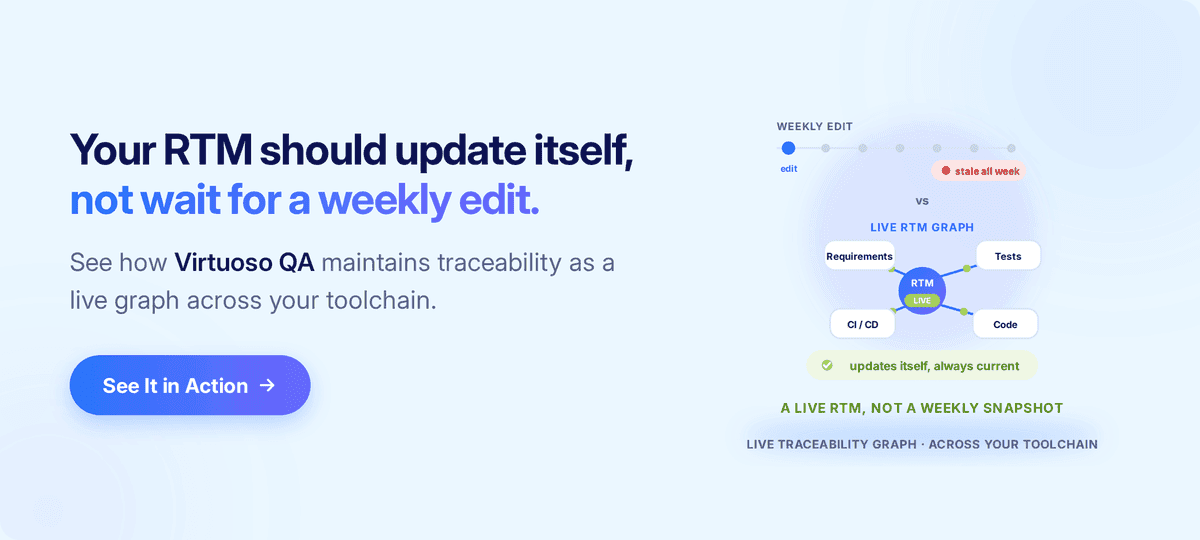
Velocity: Spreadsheets maintained on a weekly cadence cannot keep pace with daily code changes and intra-day requirement clarifications, so the static RTM is always one cycle behind reality.
Integration: A spreadsheet RTM cannot integrate with the CI/CD pipeline, the issue tracker, the test execution platform, or the product analytics system, so the data lives in isolation, and isolated data degrades quickly.
The living RTM addresses each of these directly. Requirements live in the requirements management system, test cases live in the test management platform, code modules live in version control, and defects live in the issue tracker, while the RTM is the graph that connects them, maintained automatically as each underlying record changes.
Three operational properties define it.
1. It is Continuously Updated
New requirements appear in the graph when they are added to the source system, retired requirements are marked as such without losing their history, and the latency between source change and RTM update is measured in minutes, not weeks.
2. It is Queryable
Stakeholders ask questions of the graph rather than reading rows of a spreadsheet, and the answers return immediately.
For example:
Which requirements have no test case linked to them?
Which tests still check behaviour the requirement has since dropped?
What would be affected if a particular requirement changed?
3. It is Integrated
The graph reaches across the toolchain, so a requirement change in the requirements system triggers test impact analysis in the test platform, and a test failure in the execution platform surfaces against the requirement at risk, with the information flow automatic rather than manual.
The living RTM is the form RTM has taken in the enterprises that have not retired the discipline. The static RTM has been retired in those organisations, and the living RTM has replaced it because it can keep pace.
RTM as the Foundation of Risk-Based Testing
Risk-based testing is the discipline of prioritising verification effort based on business risk. A complete regression on every change is too slow, a blind subset is too risky, and risk-based selection chooses the subset that protects the business while accepting the residual risk on the rest.
The mechanism that makes it possible is the RTM, because without traceability between requirements and tests the team cannot answer the questions risk-based selection requires.
Which requirements are most critical to the business?
Which test cases verify those requirements?
Which test cases have failed historically against them?
Which requirements have been touched by recent code changes?
Which tests must run on the next release to cover the highest-risk requirements?
Each question is a graph traversal across the RTM. A team with a living RTM can answer them in seconds, and a team without one cannot answer them at all.
The connection is direct, because risk-based testing is RTM-powered testing, and teams that aspire to risk-based test selection without first establishing a working RTM are starting at the wrong end of the problem.
RTM Across Methodologies
The RTM adapts to whichever development methodology a team runs, which is part of why it has outlived so many process fashions.
In Waterfall projects, requirements are defined in detail upfront and the matrix tracks them in a linear progression through design, development, testing, and deployment, serving as a key document at each phase-gate review so nothing is lost in the handoffs between stages.
In Agile projects, the RTM becomes a living artefact rather than a heavy upfront document, linking user stories to acceptance criteria and test cases, evolving with each sprint, and feeding sprint planning by showing which backlog items still lack coverage.
In hybrid and regulated Agile environments, the matrix carries the audit trail that pure Agile tends to under-document, which is how teams reconcile iterative delivery with the evidence a regulator expects.
Across all three, the core function is unchanged, since the matrix always answers what has been built, what verifies it, and what is at risk when it changes.
RTM and Regulatory Compliance
For many organisations, compliance is the reason an RTM exists at all, because in regulated industries traceability is not best practice but a mandate. Teams in aerospace, defence, medical devices, automotive, and similar sectors must prove to regulators and auditors that every requirement was implemented and verified, and the RTM is the documented evidence that proof rests on.
Several standards require or strongly imply traceability, including ISO 9001 and ISO 13485 for quality management in manufacturing and medical devices, FDA 21 CFR Part 11 for electronic records in regulated industries, DO-178C for airborne software, ISO 26262 for automotive functional safety, and IEC 62304 for medical-device software. In each case, the RTM maps requirements to the test cases and results that verify them, which gives an auditor a direct line of evidence rather than a pile of disconnected documents.
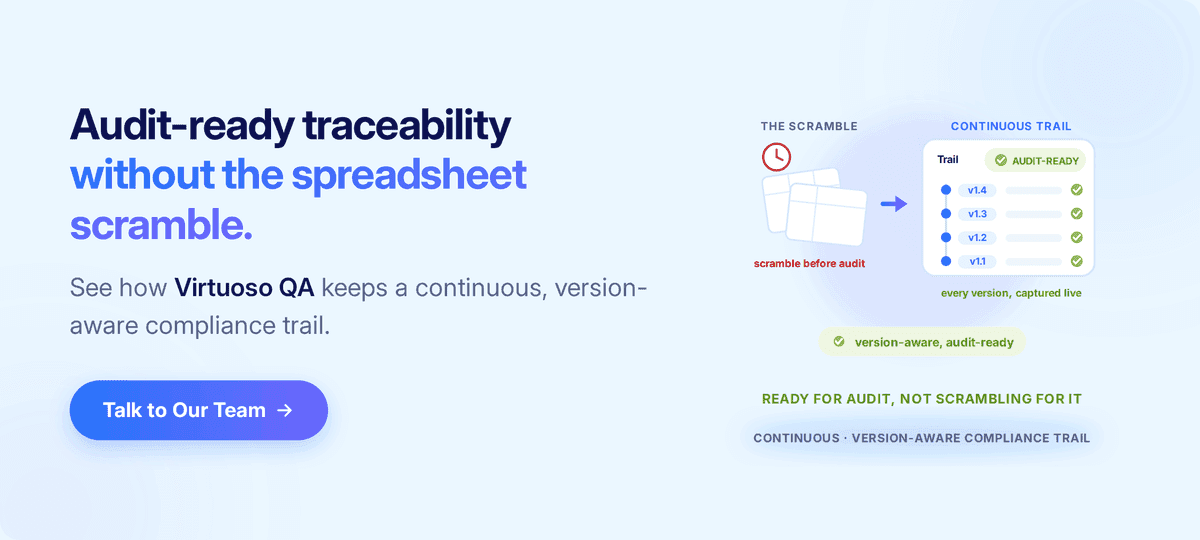
The living RTM matters more here, not less, because audit evidence that is a cycle behind reality is a liability. A continuously maintained graph means the compliance trail reflects what was actually delivered at each release, with version-aware links showing exactly which requirement version a given test verified, which is precisely what an auditor asks for and precisely what a static spreadsheet struggles to produce.
Specialised Matrices: Compliance and Risk
Two tailored forms of the RTM are worth knowing, because they answer narrower questions that general traceability does not foreground.
A compliance matrix is an RTM focused on regulatory standards, mapping each clause of a regulation directly to the requirements that satisfy it and the test cases that verify them, which gives auditors a clean, clause-by-clause line of evidence rather than asking them to infer it.
A risk matrix links potential risks to the requirements that mitigate them, so the team can ensure each significant risk has a designed, implemented, and tested countermeasure. It supports analyses such as Failure Modes and Effects Analysis and can carry a risk priority number that captures the severity and probability of each risk. Both are the same underlying graph viewed through a particular lens, which is exactly what a living, queryable RTM makes cheap to produce.
Specialised Matrices: Compliance and Risk
Two tailored forms of the RTM are worth knowing, because they answer narrower questions that general traceability does not foreground.
A compliance matrix is an RTM focused on regulatory standards, mapping each clause of a regulation directly to the requirements that satisfy it and the test cases that verify them, which gives auditors a clean, clause-by-clause line of evidence rather than asking them to infer it.
A risk matrix links potential risks to the requirements that mitigate them, so the team can ensure each significant risk has a designed, implemented, and tested countermeasure. It supports analyses such as Failure Modes and Effects Analysis and can carry a risk priority number that captures the severity and probability of each risk.
Both are the same underlying graph viewed through a particular lens, which is exactly what a living, queryable RTM makes cheap to produce.
Common RTM Failures and Countermeasure
Pattern recognition accelerates diagnosis when an RTM stops working as intended, and six failure modes recur across organisations.
1. Link Drift
A requirement changes but the associated test cases are not updated, so over time the linked tests verify a version of the requirement that no longer exists.
The countermeasure is automated linking.
2. Orphan Work Products
Test cases proliferate without backward links to requirements and code modules accumulate without traceable purpose, so over time the estate contains meaningful proportions of work whose justification has been lost.
The countermeasure is periodic orphan audits.
3. Coverage Illusion
Every requirement has a test case linked, the test exists and runs, but it is too shallow to actually verify the requirement, so the matrix shows a green tick the team should not trust.
The countermeasure is coverage-depth criteria beyond the mere presence of a test.
4. Version Mismatch
Requirements, test cases, and code modules all have versions, and without explicit version tracking the links resolve to current state, which may not be what was delivered at a particular release.
The countermeasure is version-aware links.
5. Process Detachment
The RTM exists and is maintained but is never consulted at any decision point, so planning, triage, and impact analysis all happen without reference to it, and it becomes documentation rather than instrument.
The countermeasure is decision-point referencing.
6. Single Ownership
One person maintains the RTM, then leaves or moves on, and the RTM degrades and collapses.
The countermeasure is distributed ownership across the team.
RTM in the AI-Coded Era
AI-assisted coding and AI-generated test cases have made RTM both harder and more important at the same time.
It is harder because the volume of generated work products has risen while human review capacity has not, so code modules and test cases enter the system at a pace that outstrips manual linking, and without automated traceability the RTM falls behind immediately.
It is more important because the failure modes of AI-generated work are subtle. An AI-generated test case may look plausible, claim to verify a requirement, and not actually verify it, and an AI-generated code module may implement what looks like a feature without serving the requirement it claims to address. The RTM is the mechanism that surfaces these mismatches when human reviewers cannot catch them all.
The pragmatic posture is to lean into automation. AI-assisted authoring populates draft links between requirements and work products, human reviewers verify the links rather than create them from scratch, and the combination produces a current RTM at the pace of AI-generated work, with human judgement applied where it matters most.
Where Virtuoso QA Fits
Virtuoso QA maintains traceability as a live property of the test estate, not as a separate spreadsheet exercise.
Native links from authoring: Test cases authored through Natural Language Programming carry their links to requirements, use cases, and journeys natively, so the traceability exists rather than being reconstructed later.
Traceable agentic generation: Agentic test generation links draft test cases to the requirements and product signals they were generated from, so traceability exists from the moment the test case is created, which is exactly what the AI-coded era demands.
Requirement-aware failures: AI Root Cause Analysis identifies the requirement at risk when a test fails, not just the test that failed.
Healing that preserves links: Self-healing absorbs minor interface changes without breaking the traceability links beneath them.
A graph across the toolchain: CI/CD integrations with Jenkins, Azure DevOps, GitHub Actions, and GitLab connect the execution layer to the issue tracker and requirements system, so a change in any layer triggers the appropriate impact analysis in the others, and the matrix becomes a live graph queryable in real time.
The combination is continuous verification applied to traceability itself, where the mechanism that keeps verification aligned with customer intent is continuously verified rather than periodically reconstructed.

Related Reads
Frequently Asked Questions
Is an RTM Still Relevant in Agile?
How Do I Create a Requirements Traceability Matrix?
What Columns Should an RTM Contain?
Which Compliance Standards Require Traceability?
What Is the Difference Between an RTM, a Compliance Matrix, and a Risk Matrix?