

Blog
What is ERP Software Testing: A Working Guide for Enterprises

Published on
August 7, 2026

ERP software testing is the structured validation of an Enterprise Resource Planning system against the business processes it is configured to run.
An ERP system is rarely just software. It is the operating ledger of the business. Orders, invoices, payroll, inventory, procurement, financial close, sales pipeline, hiring, and revenue recognition all flow through it. A defect in an ERP is rarely a polite inconvenience. It is a stuck invoice run, a delayed payroll, a broken month-end close, or a customer who cannot place an order because the credit check failed silently.
The stakes show up in the numbers. Gartner predicts that by 2027, more than 70% of recently implemented ERP initiatives will fail to fully meet their original business case goals, and as many as 25% will fail catastrophically. Testing is not the only reason projects miss, but inadequate testing of the deep customisations a business actually runs on is one of the most common and most preventable.
ERP software testing is the discipline that prevents those outcomes. Done well, it is the difference between a confident go-live and a six-figure remediation programme three weeks later. What follows is a working page, namely a precise definition, the categories of testing that matter most, the platforms where the work happens, the challenges teams actually hit, and how AI-native test automation is changing the economics of the work itself.
ERP software testing is the structured validation of an Enterprise Resource Planning system against the business processes it is configured to run. The work covers the standard functionality the ERP ships with, the customisations layered on top, the integrations that connect the ERP to surrounding systems, and the end-to-end business journeys that cross all three.
A general consumer web application can be tested largely against the user interface and the immediate business logic behind it. ERP testing operates at a different altitude. A single Order to Cash journey may pass through twenty screens, eight tables, three integrations, two approval workflows, and a tax engine before the invoice posts, and every one of those layers is a potential failure point. The testing has to validate the journey as a whole, not just the parts.
ERP testing therefore combines several traditional testing types into one coherent practice, namely functional, integration, regression, user acceptance, data migration, customisation, security configuration validation, and upgrade testing. The work is continuous in cloud ERPs, where the vendor pushes new releases on a fixed cadence whether or not the customer is ready.
Several characteristics make ERP testing structurally harder than testing a typical web application, and anyone treating it as a larger version of the same problem is set up to under-spend, under-test, and underestimate the risk.
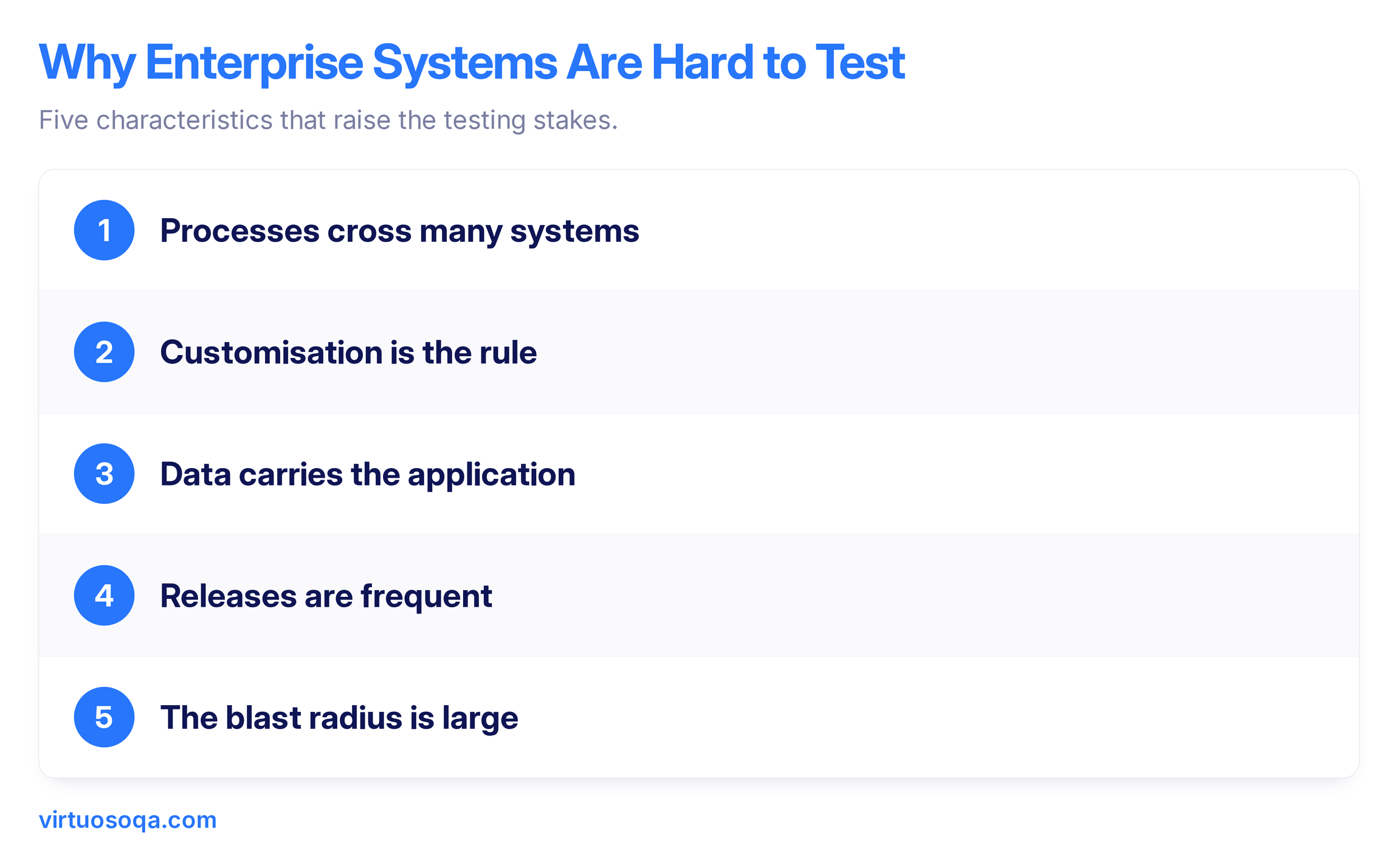
A purchase order is created in the ERP, validated against budget controls, approved through a workflow, transmitted to a supplier portal, matched against goods received, paid through accounts payable, and reconciled in the general ledger.
Each step is its own system, often its own vendor, sometimes its own database, so the testing has to follow the journey, not just the screen.
Few enterprises run vanilla ERP. Industry workflows, regulatory variations, country tax codes, custom approval matrices, and bespoke reports are layered onto every implementation, and the configured behaviour is what the business actually uses, so it is where most defects hide.
In an ERP, data is not just an input, it is the application. Customer master records, chart of accounts, employee hierarchies, product catalogues, pricing conditions, and supplier records define how every transaction behaves, which makes test data management the central engineering problem rather than a side concern.
Modern cloud ERPs release quarterly or more often, so regression testing is a perpetual programme rather than a project that ends. Customers who cannot keep up either skip releases, losing security and compliance updates, or absorb production defects the testing would have caught.
When a consumer app breaks, individual users lose a feature. When an ERP breaks, finance closes late, payroll misses a cycle, the supply chain pauses, and the audit trail develops a gap. The cost of failure is measured in revenue, regulatory exposure, and reputational damage, and the testing must reflect that.
ERP testing is best organised around the business process families the system supports. These are the structural backbone of any implementation, and they are the journeys testing must cover end to end. Coverage by screen count or feature inventory is a misleading metric, and coverage by business journey is the one that protects revenue.
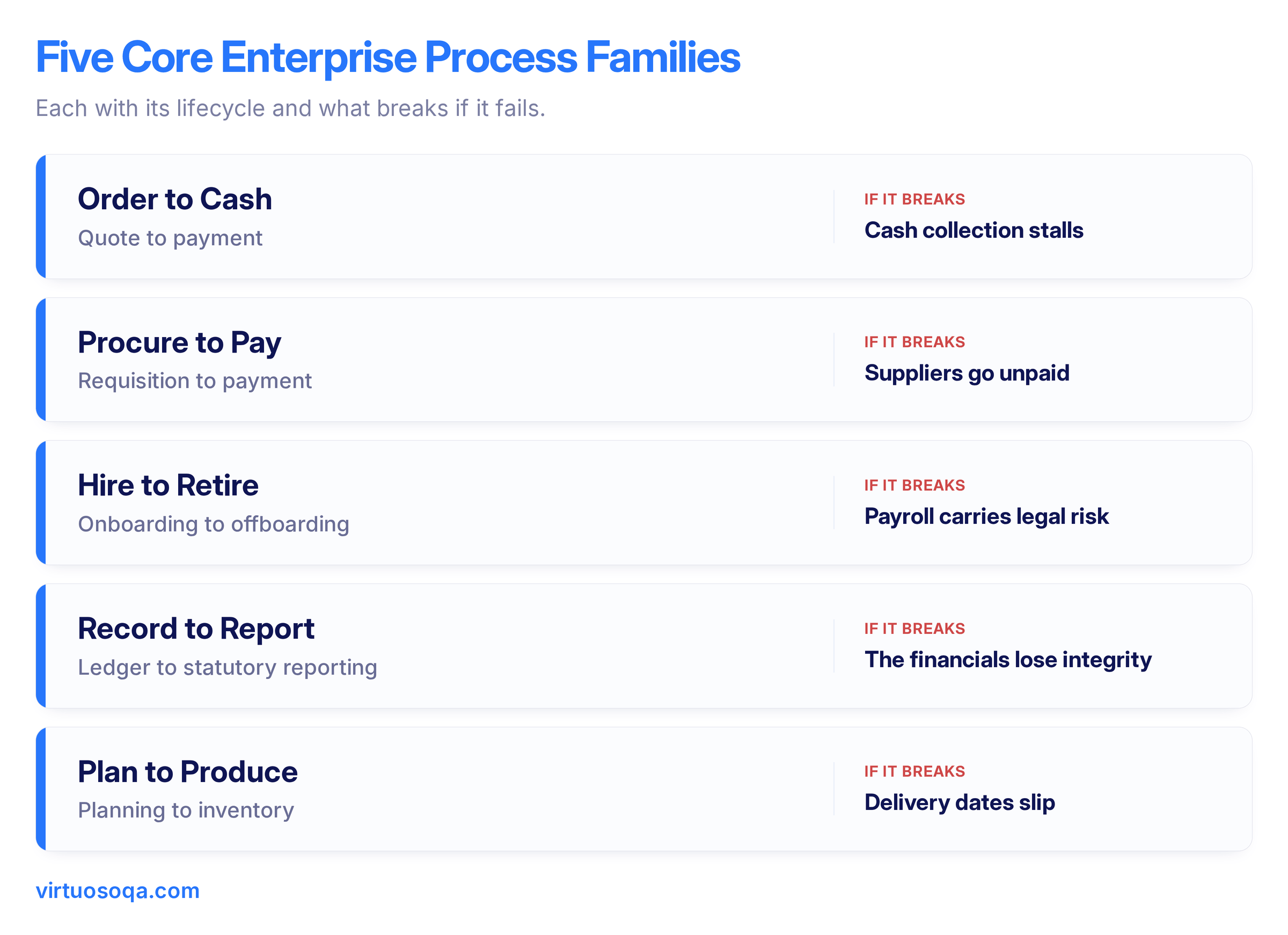
The revenue lifecycle, namely quote, order capture, credit check, fulfilment, shipping, invoicing, payment receipt, revenue recognition, and reconciliation. Failures here delay cash collection and distort revenue reporting.
The procurement lifecycle, namely requisition, approval, purchase order, goods receipt, invoice match, payment, and accounts payable closure. Errors create unpaid suppliers, duplicate payments, and audit issues, and three-way match logic is a perennial source of subtle defects.
The employee lifecycle, namely recruitment, onboarding, position management, compensation, performance, time and attendance, payroll, expenses, and offboarding. Payroll defects carry legal and union implications other failures rarely do.
The financial close lifecycle, namely general ledger postings, intercompany reconciliations, accruals, depreciation, tax provisions, consolidation, and statutory reporting. Defects here threaten the integrity of the financial statements themselves.
The manufacturing lifecycle, namely demand planning, production scheduling, materials requirements, work orders, shop floor execution, quality, and inventory updates. Defects ripple through working capital and customer delivery dates at once.
Every ERP testing programme should map its coverage against these families explicitly, because a programme that can show journey coverage across all five is defensible in a way that a screen count never is.
Abstract process descriptions undersell how much an ERP journey actually touches, so it helps to walk one through.
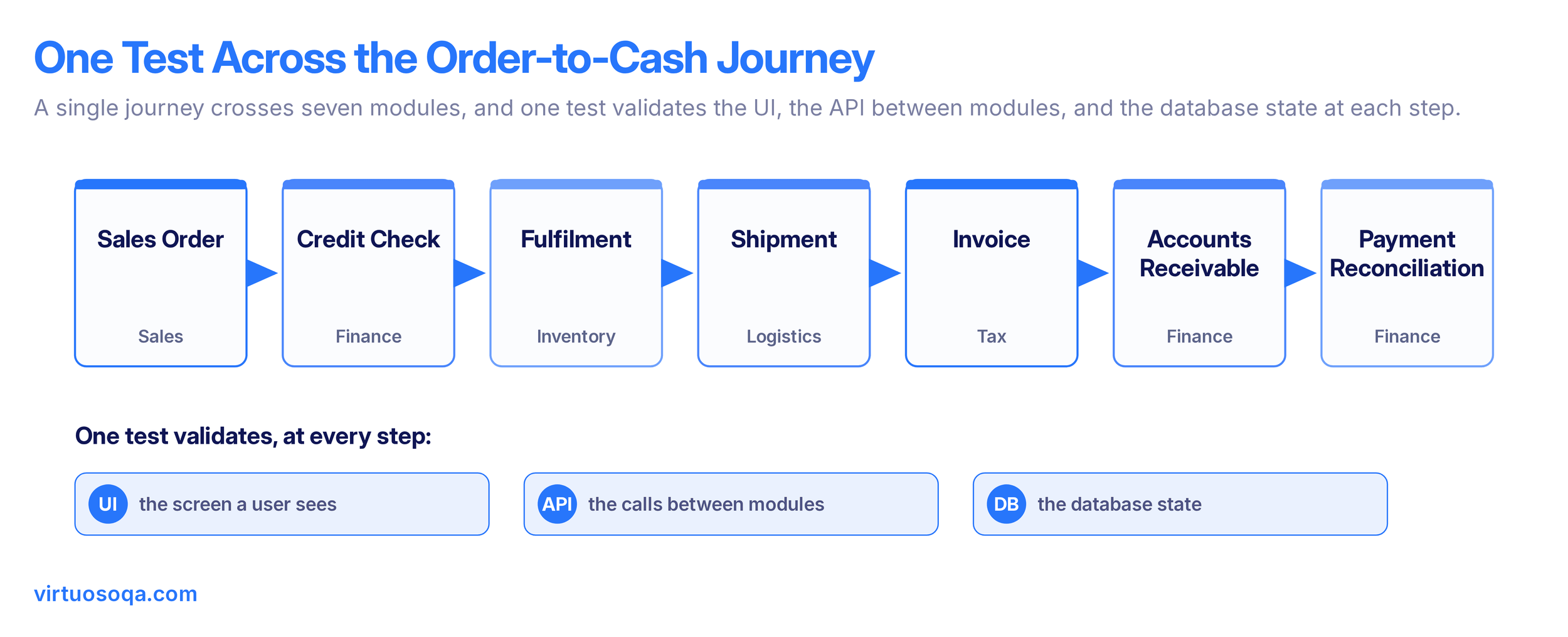
Consider a single Order to Cash test for a manufacturer selling into three countries.
A single test of that journey validates the UI actions the user takes, the API calls between modules, and the database state at each step, namely that inventory actually decremented, that the tax posted at the right rate, and that the receivable matches the invoice.
Testing only the screens would confirm the order looked right and miss that the tax engine applied the wrong country rate, which is exactly the class of defect that reaches production and costs six figures to unwind.
A complete ERP testing programme covers several distinct testing types, each protecting a different layer of the system. Treating any of them as optional is how production incidents happen.
Validation that individual ERP functions behave as configured, namely creating a sales order, posting a journal entry, approving a requisition, or running payroll. Functional testing is the floor of an ERP programme, not the ceiling.
Validation that the ERP communicates correctly with the systems around it, namely CRM, e-commerce, banking, supplier portals, tax engines, document storage, and data warehouses. Integration defects are the most expensive to find late, because they often surface only when real cross-system volume hits.
Validation that previously working functionality still works after a change. Given the release cadence of cloud ERPs and the constant flow of configuration adjustments, regression is a perpetual cost, and automation is the only way to keep up.
Business validation that the ERP supports actual operating processes. UAT is where the gap between configured behaviour and intended behaviour gets exposed, and the teams that get value treat it as a structured discipline with traceable evidence rather than a final ceremony.
Validation that data moved from a legacy system is complete, accurate, and reconcilable. Failed migrations create defects that look like functional bugs but are actually data quality issues.
Validation of the workflows, fields, forms, and logic added to the vanilla ERP for this implementation. Customisation testing is often where the deepest defects live, because vendor documentation does not cover it and reference test packs miss it.
Validation that an upgrade or patch does not break configured behaviour, run reliably and repeatably every quarter for cloud ERPs.
Validation that role-based access controls produce the right permissions. Segregation-of-duties violations created during configuration are a common audit finding and are catchable through systematic testing.
The types and the process families describe what to test. The sequence below describes how a programme actually runs, from first analysis to release. It is written as a working order of operations rather than a rigid gate, since mature teams run several of these steps continuously rather than once.
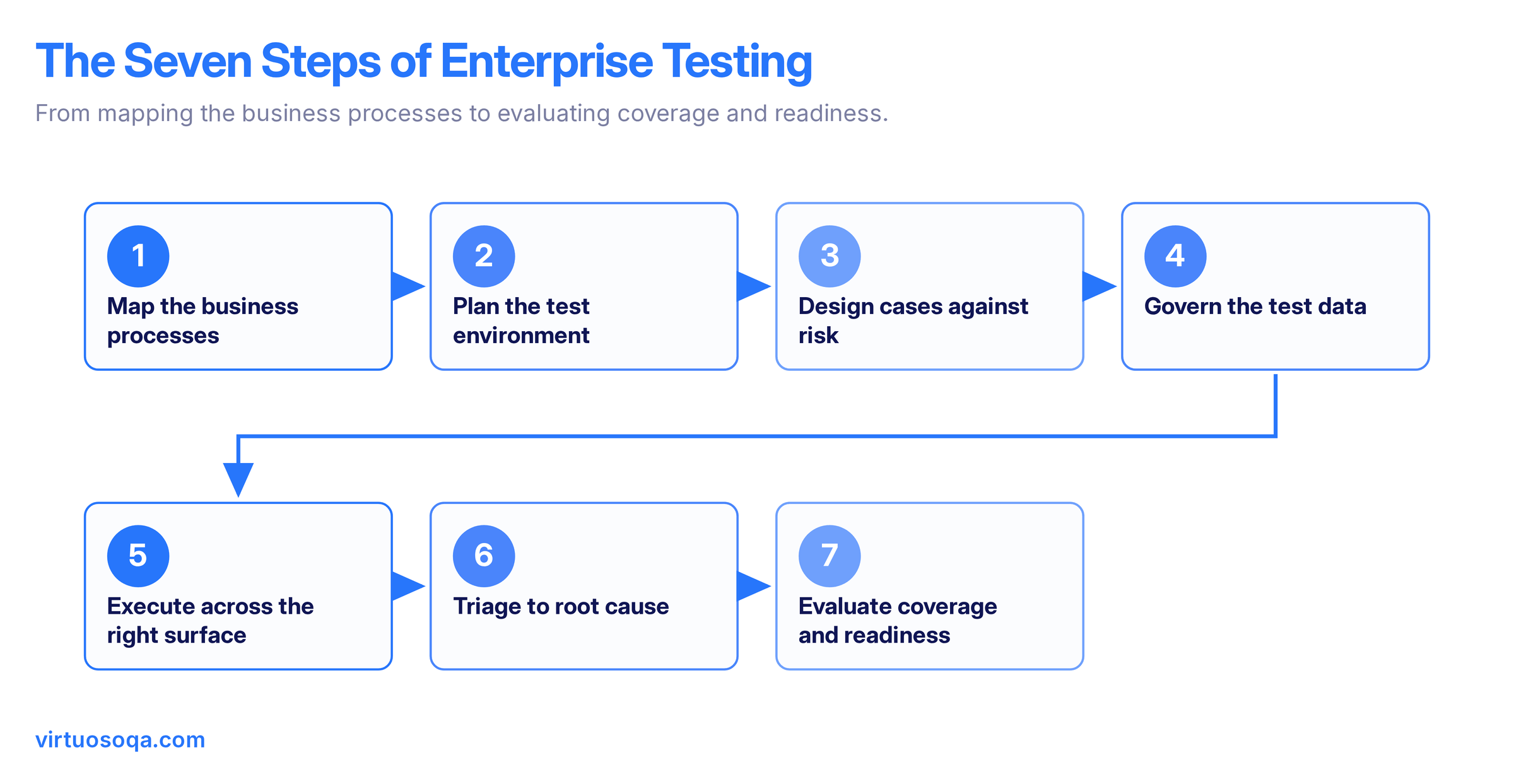
Before any test is written, document the end-to-end journeys the ERP runs, namely the process families and the specific variants by country, currency, and segment. Coverage decisions follow from this map, so a programme that skips it ends up testing screens rather than journeys.
Stand up an environment that mirrors production at the configuration level, namely the same module configuration, integrations, roles, and version. Environment drift, whether schema, API version, or feature flag, is a leading cause of tests that pass in one environment and fail in another.
Build cases that cover positive paths, negative paths, and the cross-module interactions the process map exposed, prioritised by business impact rather than ease of writing. Each case traces back to a requirement so coverage holds up under audit.
Prepare master data, boundary inputs, and exception scenarios that reflect real operating conditions, with sensitive data masked or synthetic. Because data effectively is the application in an ERP, this step carries more weight than it would in general software testing.
Run the suite across the interfaces, integrations, and data layers a journey touches, automated where the work repeats and manual where human judgement is the test. Cross-module transactions matter more than isolated screen checks.
When a test fails, establish whether the cause is a genuine defect, a configuration gap, an integration failure, or drifted data, then fix and revalidate. Diagnostic evidence captured at the moment of failure is what keeps triage from becoming a half-day investigation.
Track journey coverage, open defects by severity, and the process families still short of their bar, and make the go-live decision against that evidence rather than a raw pass rate.
The discipline that separates programmes that hold from programmes that drift is running these steps continuously rather than as a one-off phase before go-live. On a quarterly cloud release cycle, the map, the data, and the regression suite all need refreshing every cycle, which is why a step-by-step process only works when it sits on automation that can absorb constant change.
Different ERP platforms create different testing demands. The high-level disciplines are the same, and the shape of the work is not.
The deepest customisation tradition in the ERP world, with Fiori, GUI transactions, BAPIs, IDOCs, and country-specific localisations all inside scope. S/4HANA Cloud releases on a quarterly cadence, so SAP customers carry a permanent regression workload.
See our deeper page on SAP S/4HANA testing.
Oracle Cloud ERP, Oracle EBS, and the broader stack present a mix of modern web interfaces and legacy forms behaviour, and integration testing with Oracle databases, Fusion services, and middleware is often the dominant challenge.
More in our page on Oracle software testing.
Spans Finance and Operations, Sales, Customer Service, Field Service, and Supply Chain Management, with major waves twice a year and continuous improvements between. Programmes that cannot absorb that cadence accumulate technical debt fast.
For more info, see our page on Microsoft Dynamics 365 test automation.
The dominant cloud ERP for mid-market customers, where SuiteFlow, SuiteScript, and the SuiteCloud platform make customisation accessible, which makes testing the customised state essential.
Shaped by its release cadence and its strict separation between configuration and code, so Business Process Framework changes, Workday Studio integrations, and reporting layer changes all need systematic validation.
More in our page on Workday HCM test automation.
Where Salesforce holds the customer master, the quote-to-cash flow, and the service organisation, it becomes part of ERP testing scope, with three releases a year plus continuous org-level configuration change creating the same regression challenge.
See our page on Salesforce testing.
The pattern is consistent across platforms. The vendor is shipping faster, the customer's configuration depth keeps growing, and manual testing cannot keep pace. Automated testing cannot keep pace either, unless the automation strategy assumes constant change rather than periodic change.
Enterprises planning, running, or rescuing ERP testing programmes tend to meet the same set of challenges, and naming them clearly is the first step to solving them.
The disciplines below separate ERP testing programmes that deliver from those that drift, and none of them are platform-specific.
Map every test to a process family and a critical journey within it, because coverage by journey is what prevents revenue loss.
ERP processes move between interfaces, web services, and back-end tables, so tests that combine UI actions, API calls, and database validations reflect the system as the user experiences it.
Allocate more depth to customised functionality than to vanilla, since the vendor's regression suite already protects the standard behaviour.
ERP interfaces change and field IDs shift, so locator strategies built on intent survive change where absolute paths do not.
Manual regression on a quarterly cloud release cycle is a guaranteed bottleneck, and automation is the only durable solution.
Tests written in plain language are tests business users can read, review, and contribute to, which turns process owners into quality partners rather than UAT bystanders.
Synthetic data, governed refreshes, and environment-aware data sets are the foundation of repeatable runs, and test data debt is the silent killer of ERP automation programmes.
Tests run on every meaningful change, not on every release, and CI/CD integration is what makes that possible.

ERP testing was always labour intensive. AI is not eliminating that labour so much as changing where it is spent and what it produces.
The cumulative effect is a structural shift. Teams that adopt AI-native testing properly automate a high share of regression, recover a meaningful part of their testing budget, and absorb vendor release cycles without falling behind, though the exact gains depend on the estate and should be measured rather than assumed.
Composable Testing is one of the more consequential changes in enterprise application testing of the past decade, and the premise is simple. Every common ERP business process has been built and tested somewhere already, so there is little reason to rebuild Order to Cash from scratch for every implementation.
Composable libraries package those tests as reusable, configurable assets. An implementation that would have taken many hundreds of hours of authoring becomes a fraction of that in configuration, and testing can start early in the project rather than late.
For ERP specifically, the libraries cover the journeys that matter most, namely Order to Cash, Procure to Pay, Hire to Retire, Record to Report, and the platform-specific variants for SAP, Dynamics 365, Oracle, and the rest. Customers configure for their setup, layer in the customisations that make their implementation theirs, and inherit the rest. The Dynamics 365 composable library is the most developed of these, shipping more than 200 ready-to-run tests across Finance and Operations and Sales and Service.
ERP testing is where the maintenance problem is at its worst, because customisation depth, frequent vendor releases, and cross-system journeys combine to break suites faster than a team can repair them. Virtuoso QA is an AI-native platform built for that reality, and a few specifics matter for ERP in particular.
Every AI action is proposed for review, executed by a deterministic engine, and recorded, so the autonomy stays governed. The platform runs across a broad cross-browser grid and integrates with CI/CD pipelines including Jenkins, Azure DevOps, GitHub Actions, GitLab, CircleCI, and Bamboo.


Try Virtuoso QA in Action
See how Virtuoso QA transforms plain English into fully executable tests within seconds.
