Blog
Preconditions in Test Cases: What They Are, How to Write

Abhilash
Published on

Table of contents
Lorem ipsum
Lorem ipsum
Lorem ipsum
Lorem ipsum
Lorem ipsum
Most test cases fail in the middle. They start cleanly, get partway through their steps, then hit something the author assumed would be true but never verified. The user was already logged out. The cart still held items from a previous run. The currency was set to the wrong locale. The test fails, the team chases it as if the application is broken, and an hour later someone finds that the precondition was wrong, not the assertion.
Preconditions are where most of that wasted effort lives. They are also where most QA writing gives the topic three sentences and a vague example before moving on. This page treats them seriously, namely what they are, why they decide whether a suite is reliable or flaky, the five categories every programme needs to handle, the patterns that make preconditions easy to write and automate, and the role AI now plays in setting and verifying them.
What is a Precondition in a Test Case
A precondition in a test case is a state, configuration, or condition that must be true before the test can begin. The precondition is not part of the test itself, it is the platform the test runs on.
A test for "user can update profile photo" depends on several preconditions, namely that a user account exists, the user is logged in, the application is on the profile page, and an image file is available to upload. None of those are what the test validates. They are what must already be true for the validation to be possible.
The cleanest definition is that a precondition is a verifiable assumption the test depends on but does not test. If the assumption fails, the test cannot run. If the test does not verify the assumption, it cannot report meaningfully, since a failure could mean the application broke or simply that the ground beneath the test was never solid.
Why Preconditions Matter More Than They Look
Preconditions look administrative. They are not, because several properties of a healthy test suite stand or fall on the discipline applied to them.
1. Test Independence Depends on Them
A test that relies on the residue of a previous test cannot run in isolation, cannot run in parallel, and cannot be debugged cleanly. Explicit preconditions break the dependency.
2. Flakiness Lives in Them
Most flaky tests are not flaky at all, they are tests with implicit preconditions that sometimes hold and sometimes do not. Making the preconditions explicit and verifying them turns a flaky test into a deterministic one.
3. Triage Time Depends on Them
When a test fails, the first question is whether the precondition held. Tests that verify their own preconditions answer that instantly, and tests that do not consume hours of investigation.
4. Coverage Decisions Depend on Them
A test case without clearly stated preconditions cannot be matched to a requirement cleanly, so traceability falls apart and the team ends up reconstructing the link under audit pressure.
5. Automation Depends on Them
An automated test that cannot establish its own preconditions in a clean, repeatable way breaks every time the environment shifts. Precondition discipline is the foundation of automation reliability.
The Five Categories of Preconditions
Most QA writing treats preconditions as a single undifferentiated concept. In practice a complete programme handles five distinct categories, each with its own writing pattern and its own failure mode.
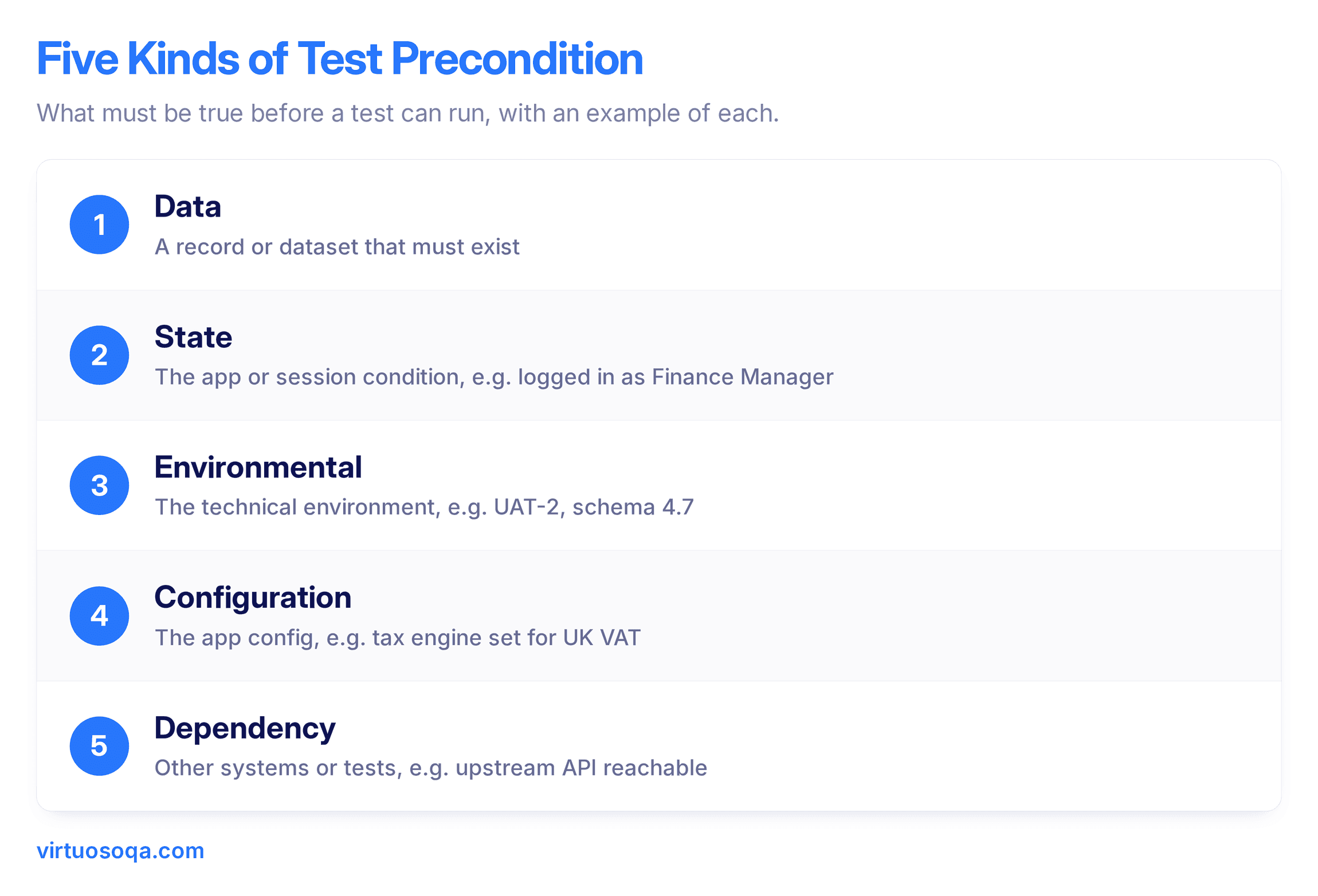
1. Data Preconditions
The records, datasets, and parameters that must exist, namely "a customer record with status Active exists" or "a CSV with three columns and 100 rows is available."
The most common category and the most common source of flakiness, since they depend on test data management rather than application behaviour.
2. State Preconditions
The condition the application or session must be in, namely "the user is logged in as a Finance Manager" or "the user is on the Approvals dashboard." Obvious in manual testing but the single largest source of failure in automated suites, where navigation, session timeouts, and authentication drift all work against them.
3. Environmental Preconditions
The technical environment the test runs against, namely "the environment is UAT-2," "the database is at schema version 4.7," or "feature flag X is enabled." These catch the failures caused by running the right test in the wrong environment, easy to overlook and expensive to debug.
4. Configuration Preconditions
The application configuration that must be set, namely "the tax engine is configured for UK VAT" or "the approval matrix includes a finance approver step." Especially important in ERP and enterprise testing, where the configured behaviour is the behaviour the customer actually experiences.
5. Dependency Preconditions
The other systems, services, or test results that must be in place, namely "the upstream credit check API is reachable" or "the user-creation test passed earlier in the run." The category most likely to surface in integration testing, where the test depends on infrastructure or other tests being in known states.
A complete precondition list for a single test usually touches three to five of these categories, and coverage of all five across the suite is the mark of a mature programme.

Anatomy of a Well-Written Precondition
A precondition that holds up under scrutiny shares the same characteristics regardless of category.
Specific: "User is logged in" is weak. "User is logged in as a Procurement Manager with multi-factor authentication enabled" is specific enough to act on.
Verifiable: A precondition that cannot be checked is an assumption, not a precondition. The well-written version includes how the condition is verified, even where the verification is implicit.
Atomic: Preconditions that bundle several conditions into one line obscure failures. Each condition gets its own line, so a failure points to the precise gap.
Independent of execution order: The precondition does not depend on what ran earlier. If a session must exist, it says so. If data must exist, it specifies what data in what state.
Automatable: The precondition can be set up by code, API, or fixture, not only by a tester clicking through the application. Automatable preconditions are the foundation of reliable runs.
Free of over-specification: Conditions that do not affect the outcome are excluded. The precondition states what matters, not the entire application state.
How to Write Preconditions Step by Step
A practical writing pattern keeps preconditions consistent across a large suite.
1. Identify What the Test is Actually Validating
A test "should log in successfully" validates the login mechanism. A test "should update profile photo" validates the photo update.
The boundary between what is tested and what is preconditional flows from this question.
2. List Every Assumption the Test Makes
Walk through the steps, and at each one ask what must already be true. The answers are preconditions.
3. Categorise Each Assumption
Assign each to one of the five categories, since the category dictates the writing pattern.
4. Rewrite Each as a Specific, Verifiable, Atomic Statement
Convert "user is on the right screen" into "the user is logged in as a Sales Manager and is on the Quotes dashboard with the Q2 filter applied."
5. Confirm Each Can Be Set up Automatically
If a precondition cannot be created by code, API, or fixture, decide how it will be handled, since anything depending on manual intervention undermines automation.
6. Check the List Against Test Independence
Read the preconditions assuming the test runs first in the suite, last, in parallel with five others, and on a freshly provisioned environment. Any assumption that does not hold in all four cases needs revision.
Example of a Weak vs Strong Preconditions
The pairs below show the difference between principles and concrete examples.
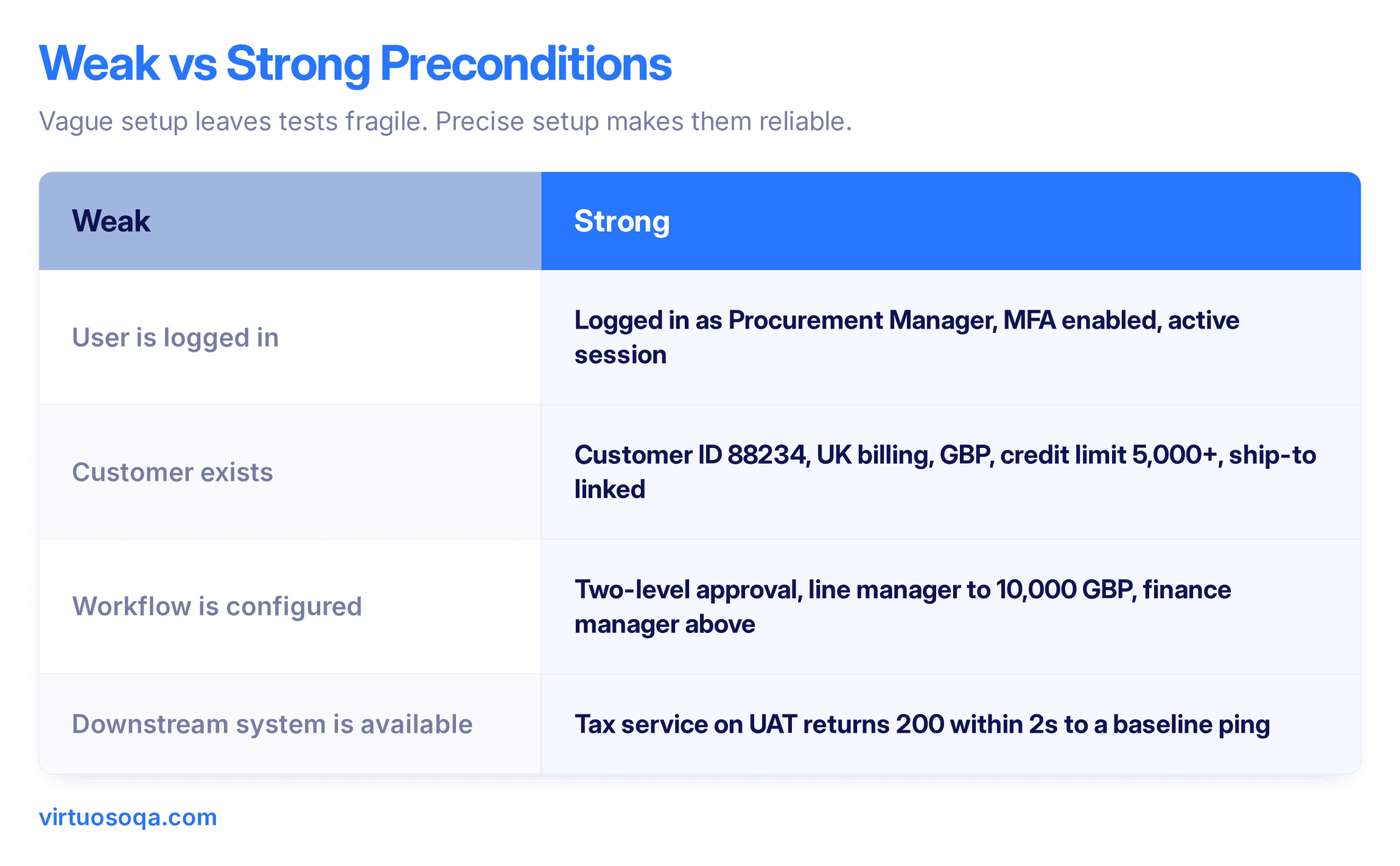
Login Test
Weak: "User is logged in."
Strong: "A user account exists with email procurement.lead@example.com, role Procurement Manager, and active status, and the user has authenticated through the standard login flow within the current session."
Related Read: 100+ Login Page Test Cases - Functional, Security & API Testing
Order Creation Test
Weak: "Customer exists."
Strong: "A customer record exists with ID 88234, billing address in the United Kingdom, currency GBP, credit limit not less than 5,000, and at least one ship-to address linked."
Workflow Approval Test
Weak: "Approval workflow is configured."
Strong: "The Purchase Requisition workflow is configured with two-level approval, namely line-manager approval up to 10,000 GBP and finance-manager approval above it, with both approver users existing and active."
Integration Test
Weak: "The downstream system is available."
Strong: "The downstream tax calculation service is reachable on UAT at endpoint /tax/v2/calculate and responds with status 200 within two seconds to a baseline ping."
The strong versions are longer because they specify what actually matters. A test author who writes the strong version once saves the team hours of debugging across the lifetime of the test.
Common Mistakes When Writing Preconditions
Several mistakes appear so often that they amount to a pattern library for making automation unreliable.
1. Treating Preconditions as Setup Steps
Setup steps are the actions that establish a precondition, and the precondition is the resulting state. Confusing the two blurs the test boundary.
2. Carrying State Across Tests Implicitly
Test 1 logs in, Test 2 assumes the login is still active, and the dependency stays invisible until Test 2 runs in isolation and fails. Explicit preconditions in every test prevent this.
3. Bundling Preconditions
"User is logged in, on the dashboard, and has three saved searches" is three preconditions in one line, so a failure report cannot say which was missing.
4. Listing Every Possible State
Preconditions that do not affect the outcome are noise. A profile-photo test does not need to specify the user's notification settings.
5. Writing Preconditions Only in Human Language
A precondition that cannot be set up by code depends on manual intervention every time, and automation collapses under that weight.
6. Skipping Verification
Stating a precondition without verifying it leaves the test exposed to environmental drift, so the test should at least check the precondition holds before proceeding.
7. Repeating Preconditions Without Abstraction
If thirty tests need the same five preconditions, those belong in a shared fixture or composable library, not duplicated thirty times.

Preconditions, Postconditions, Assumptions, and Setup Steps
The vocabulary here is loose, and four related concepts get conflated. Separating them makes test design considerably tidier.
Preconditions: The state that must be true before the test runs, namely the platform the test stands on.
Postconditions: The state expected to be true after the test completes successfully, namely the evidence of the test's effect.
Assumptions: Beliefs about the system the test does not verify. Assumptions are unsafe preconditions, and every assumption identified is a candidate to become a verified precondition.
Setup steps: The actions performed to establish a precondition. Setup is the verb, precondition is the noun, so the test sets up the state and the precondition is the state being set up.
A well-structured test case names all four where they apply, and the discipline pays back in clarity, debuggability, and audit readiness.
Preconditions in BDD and Gherkin
In Behaviour-Driven Development and the Gherkin syntax used by Cucumber, SpecFlow, and similar frameworks, preconditions appear in the Given clause.
The Given block is where preconditions live, and the structure forces authors to name them explicitly, so the cost of skipping a precondition becomes visible in the scenario itself rather than buried in a separate document.
For teams adopting BDD, the Given-block discipline is one of the most underrated benefits, since the vocabulary nudges authors towards the precondition discipline that less structured formats often neglect.
Preconditions in Automated Test Suites
In automated testing, preconditions move from the test-case description into executable code or configuration. A few patterns are common across mature suites.
Fixtures and setup methods: Framework hooks such as setUp, BeforeEach, or beforeAll establish preconditions programmatically, so the test body assumes they hold because the fixture has set them.
Test data builders: Builder patterns construct the data a test needs in a single expressive call, so "create a customer with credit limit 10,000 and currency GBP" replaces a long sequence of manual inserts.
API-driven setup: Where possible, preconditions are established through the application's own APIs rather than UI navigation, which is faster, more reliable, and less brittle to UI change.
Composable libraries: On platforms that support composable testing, common preconditions for major systems, namely an Order to Cash starting state or an employee onboarding state, come as pre-built reusable assets to configure rather than author from scratch.
Self-verification: Mature suites verify their preconditions before the main test runs, so a failed precondition reports a setup failure rather than a misleading test failure.
How AI Is Changing Precondition Management
Preconditions used to be an entirely human-authored concern. AI-native test automation has changed three things specifically, and the cumulative effect moves preconditions from a fragile, author-dependent discipline to a managed layer of the test architecture.
Automatic inference of preconditions: Autonomous test generation analyses application context and infers the preconditions a generated test will need, so a login state or configuration flag a human might forget is surfaced as part of the produced test.
Test data preconditions on demand: AI-driven test data generation produces the data a test needs in realistic, parameterised form, so "I need a customer with these characteristics" is fulfilled programmatically rather than by hand.
Self-healing for state preconditions: When the application changes and a state precondition breaks, namely a renamed button or a moved dashboard, self-healing absorbs the change so the precondition holds even when the path to it has shifted.
Plain-language authoring of preconditions: Natural-language authoring lets preconditions be expressed in the same vocabulary as the rest of the test, so business users and product owners can review and contribute to preconditions, not only assertions.
How Virtuoso QA Handles Preconditions
Virtuoso QA is built to make precondition management explicit and reliable, and several capabilities matter specifically for it.
Plain-English Authoring
Natural Language Programming lets preconditions be authored in readable language alongside the rest of the test, so state, data, and configuration setup is reviewable by the whole team rather than locked in code.
Inferred Preconditions
GENerator infers preconditions from application screens, requirements, and existing suites, surfacing them as part of the produced journey rather than leaving them to be remembered.
Data Preconditions on Demand
AI-driven test data generation supplies the data a test needs in realistic, parameterised form, with sensitive data handled appropriately.
Composable Preconditions
Composable libraries bring pre-built preconditions for major enterprise systems, so common setups for process families like Order to Cash and Procure to Pay come ready to configure.
Self-Healing for State
Self-healing absorbs the routine UI changes that historically broke state preconditions, keeping locators accurate as the application evolves, with proposed repairs running at approximately 95% user acceptance under human oversight.
Unified UI and API
API and UI actions sit inside a single journey, so API-driven preconditions and UI-based tests live together without crossing tool boundaries.
Related Reads
Frequently Asked Questions
How is a Precondition Different From a Setup Step
How Do You Write a Good Precondition
What is the Difference Between a Precondition and an Assumption
How Do Preconditions Affect Test Independence
Can Preconditions Be Automated
How Does AI Help With Preconditions