Automated Test Maintenance for Evolving Applications and Requirements
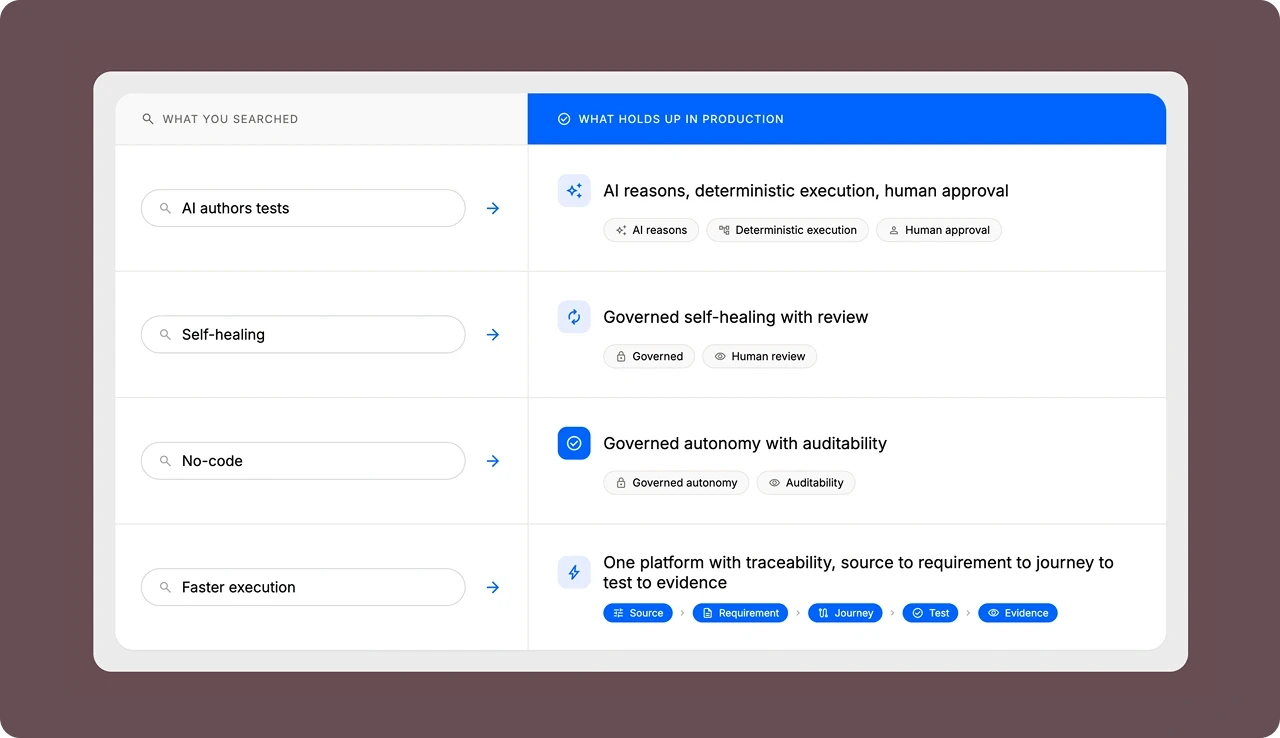
Automated coverage can become unreliable when the interface changes or the underlying requirement evolves. Virtuoso QA combines built-in self healing for common element changes with Touchstone’s ability to identify requirements and journeys affected by revised source documentation, keeping coverage aligned with both the application and approved behavior.
Automated Test Maintenance for Evolving Applications and Requirements
Automated coverage can become unreliable when the interface changes or the underlying requirement evolves. Virtuoso QA combines built-in self healing for common element changes with Touchstone’s ability to identify requirements and journeys affected by revised source documentation, keeping coverage aligned with both the application and approved behavior.
Automated Test Maintenance for Evolving Applications and Requirements
Automated coverage can become unreliable when the interface changes or the underlying requirement evolves. Virtuoso QA combines built-in self healing for common element changes with Touchstone’s ability to identify requirements and journeys affected by revised source documentation, keeping coverage aligned with both the application and approved behavior.
Used by the world's leading companies












Used by the world's leading companies
Used by the world's leading companies
Used by the world's leading companies
Why Test Maintenance Keeps Growing
Test maintenance is rarely one large task. It is a steady accumulation of broken locators, unclear failures and coverage that no longer reflects the latest requirement.
Small changes create constant repair work
A renamed button, regenerated identifier or updated page structure can break a test even when the user journey still works. Individually, these fixes are minor. Across a large suite, they create a backlog that takes time away from building new coverage.

Passing tests can verify outdated behaviour
When a business rule or specification changes, the existing test may continue to pass because nothing in the interface has broken. Teams can therefore receive a green result for behaviour that no longer matches what the business approved.

Every failure needs investigating first
A failed test does not immediately reveal whether the problem sits in the application, automation, test data or environment. Teams must establish the cause before taking action, repeating the same investigation across every release.

Why Test Maintenance Keeps Growing
Test maintenance is rarely one large task. It is a steady accumulation of broken locators, unclear failures and coverage that no longer reflects the latest requirement.
Small changes create constant repair work
A renamed button, regenerated identifier or updated page structure can break a test even when the user journey still works. Individually, these fixes are minor. Across a large suite, they create a backlog that takes time away from building new coverage.
Passing tests can verify outdated behaviour
When a business rule or specification changes, the existing test may continue to pass because nothing in the interface has broken. Teams can therefore receive a green result for behaviour that no longer matches what the business approved.
Every failure needs investigating first
A failed test does not immediately reveal whether the problem sits in the application, automation, test data or environment. Teams must establish the cause before taking action, repeating the same investigation across every release.
Why Test Maintenance Keeps Growing
Test maintenance is rarely one large task. It is a steady accumulation of broken locators, unclear failures and coverage that no longer reflects the latest requirement.
Small changes create constant repair work
A renamed button, regenerated identifier or updated page structure can break a test even when the user journey still works. Individually, these fixes are minor. Across a large suite, they create a backlog that takes time away from building new coverage.
Passing tests can verify outdated behaviour
When a business rule or specification changes, the existing test may continue to pass because nothing in the interface has broken. Teams can therefore receive a green result for behaviour that no longer matches what the business approved.
Every failure needs investigating first
A failed test does not immediately reveal whether the problem sits in the application, automation, test data or environment. Teams must establish the cause before taking action, repeating the same investigation across every release.
Break the Cycle of Endless Test Maintenance with Virtuoso QA
Touchstone, Virtuoso QA’s agentic capability, brings specialised agents into the maintenance workflow. Analyst assesses changes to business intent, Architect identifies the coverage affected, and Autopilot diagnoses and repairs failing journeys, with human review before proposed changes enter the suite.

Resolve changing elements during execution
Virtuoso QA’s self healing capability identifies elements using multiple attributes, intent and page context rather than a single stored selector. Common changes to identifiers, labels and page structure can be resolved during execution, with each adaptation recorded for review.

Classify failures before proposing repairs
The Autopilot agent analyses the latest failed execution to determine its likely cause. It proposes a journey repair when the application has changed but expected behaviour remains correct, and stops for human review when the evidence indicates a genuine defect.

Trace source changes to affected coverage
Touchstone’s Analyst agent compares revised Knowledge Base sources with the requirements generated from them. It distinguishes cosmetic edits from substantive changes and identifies the requirements that need to be reviewed.

Keep change propagation under human control
Once a requirement update is approved, the Architect agent identifies the journeys linked to it and proposes the necessary coverage changes. Each journey update remains separately reviewable, ensuring that no agentic change enters the suite without an explicit decision.

Protect shared assets and retain version history
Autopilot reports failures within shared library checkpoints rather than modifying assets used by multiple journeys. Agentic Directives apply organisational standards to proposed repairs, while version history preserves what changed, the decisions made and earlier asset states.

Reduce what needs maintaining in the first place
Journeys are composed from shared checkpoints, data tables and environments, so a step used across the suite is maintained once. A repair accepted on a shared component reaches every journey built on it.
Break the Cycle of Endless Test Maintenance with Virtuoso QA
Touchstone, Virtuoso QA’s agentic capability, brings specialised agents into the maintenance workflow. Analyst assesses changes to business intent, Architect identifies the coverage affected, and Autopilot diagnoses and repairs failing journeys, with human review before proposed changes enter the suite.
Resolve changing elements during execution
Virtuoso QA’s self healing capability identifies elements using multiple attributes, intent and page context rather than a single stored selector. Common changes to identifiers, labels and page structure can be resolved during execution, with each adaptation recorded for review.
Classify failures before proposing repairs
The Autopilot agent analyses the latest failed execution to determine its likely cause. It proposes a journey repair when the application has changed but expected behaviour remains correct, and stops for human review when the evidence indicates a genuine defect.
Trace source changes to affected coverage
Touchstone’s Analyst agent compares revised Knowledge Base sources with the requirements generated from them. It distinguishes cosmetic edits from substantive changes and identifies the requirements that need to be reviewed.
Keep change propagation under human control
Once a requirement update is approved, the Architect agent identifies the journeys linked to it and proposes the necessary coverage changes. Each journey update remains separately reviewable, ensuring that no agentic change enters the suite without an explicit decision.
Protect shared assets and retain version history
Autopilot reports failures within shared library checkpoints rather than modifying assets used by multiple journeys. Agentic Directives apply organisational standards to proposed repairs, while version history preserves what changed, the decisions made and earlier asset states.
Reduce what needs maintaining in the first place
Journeys are composed from shared checkpoints, data tables and environments, so a step used across the suite is maintained once. A repair accepted on a shared component reaches every journey built on it.
Break the Cycle of Endless Test Maintenance with Virtuoso QA
Touchstone, Virtuoso QA’s agentic capability, brings specialised agents into the maintenance workflow. Analyst assesses changes to business intent, Architect identifies the coverage affected, and Autopilot diagnoses and repairs failing journeys, with human review before proposed changes enter the suite.
Resolve changing elements during execution
Virtuoso QA’s self healing capability identifies elements using multiple attributes, intent and page context rather than a single stored selector. Common changes to identifiers, labels and page structure can be resolved during execution, with each adaptation recorded for review.
Classify failures before proposing repairs
The Autopilot agent analyses the latest failed execution to determine its likely cause. It proposes a journey repair when the application has changed but expected behaviour remains correct, and stops for human review when the evidence indicates a genuine defect.
Trace source changes to affected coverage
Touchstone’s Analyst agent compares revised Knowledge Base sources with the requirements generated from them. It distinguishes cosmetic edits from substantive changes and identifies the requirements that need to be reviewed.
Keep change propagation under human control
Once a requirement update is approved, the Architect agent identifies the journeys linked to it and proposes the necessary coverage changes. Each journey update remains separately reviewable, ensuring that no agentic change enters the suite without an explicit decision.
Protect shared assets and retain version history
Autopilot reports failures within shared library checkpoints rather than modifying assets used by multiple journeys. Agentic Directives apply organisational standards to proposed repairs, while version history preserves what changed, the decisions made and earlier asset states.
Reduce what needs maintaining in the first place
Journeys are composed from shared checkpoints, data tables and environments, so a step used across the suite is maintained once. A repair accepted on a shared component reaches every journey built on it.
Stop Fixing Tests and Start Scaling Coverage
Virtuoso QA moves maintenance from repair work to review work, so the time that went on fixing broken tests goes into covering what has not been tested yet.
Redirect engineering capacity towards new coverage
Self healing execution and reviewable repair proposals reduce repetitive triage and rework, allowing automation teams to focus on emerging requirements and higher risk business processes.

Keep coverage aligned with approved requirements
Links between requirement versions and journeys make it easier to identify coverage affected by a revised specification, reducing the risk of tests continuing to validate superseded behaviour.

Improve confidence in failed results
Reducing failures caused by routine interface change gives each remaining failure a stronger operational signal, helping teams prioritise investigation and remediation more effectively.

Assess the impact of change earlier
Assess the impact of change earlier Traceability from source documentation to requirements and journeys shows how widely a change may propagate before maintenance begins, supporting more accurate planning and release assessment.
Stop Fixing Tests and Start Scaling Coverage
Virtuoso QA moves maintenance from repair work to review work, so the time that went on fixing broken tests goes into covering what has not been tested yet.
Redirect engineering capacity towards new coverage
Self healing execution and reviewable repair proposals reduce repetitive triage and rework, allowing automation teams to focus on emerging requirements and higher risk business processes.
Keep coverage aligned with approved requirements
Links between requirement versions and journeys make it easier to identify coverage affected by a revised specification, reducing the risk of tests continuing to validate superseded behaviour.
Improve confidence in failed results
Reducing failures caused by routine interface change gives each remaining failure a stronger operational signal, helping teams prioritise investigation and remediation more effectively.
Assess the impact of change earlier
Assess the impact of change earlier Traceability from source documentation to requirements and journeys shows how widely a change may propagate before maintenance begins, supporting more accurate planning and release assessment.
Stop Fixing Tests and Start Scaling Coverage
Virtuoso QA moves maintenance from repair work to review work, so the time that went on fixing broken tests goes into covering what has not been tested yet.
Redirect engineering capacity towards new coverage
Self healing execution and reviewable repair proposals reduce repetitive triage and rework, allowing automation teams to focus on emerging requirements and higher risk business processes.
Keep coverage aligned with approved requirements
Links between requirement versions and journeys make it easier to identify coverage affected by a revised specification, reducing the risk of tests continuing to validate superseded behaviour.
Improve confidence in failed results
Reducing failures caused by routine interface change gives each remaining failure a stronger operational signal, helping teams prioritise investigation and remediation more effectively.
Assess the impact of change earlier
Assess the impact of change earlier Traceability from source documentation to requirements and journeys shows how widely a change may propagate before maintenance begins, supporting more accurate planning and release assessment.
Stop Fixing Tests and Start Scaling Coverage
Virtuoso QA moves maintenance from repair work to review work, so the time that went on fixing broken tests goes into covering what has not been tested yet.
Redirect engineering capacity towards new coverage
Self healing execution and reviewable repair proposals reduce repetitive triage and rework, allowing automation teams to focus on emerging requirements and higher risk business processes.
Keep coverage aligned with approved requirements
Links between requirement versions and journeys make it easier to identify coverage affected by a revised specification, reducing the risk of tests continuing to validate superseded behaviour.
Improve confidence in failed results
Reducing failures caused by routine interface change gives each remaining failure a stronger operational signal, helping teams prioritise investigation and remediation more effectively.
Assess the impact of change earlier
Assess the impact of change earlier Traceability from source documentation to requirements and journeys shows how widely a change may propagate before maintenance begins, supporting more accurate planning and release assessment.
Explore Related Virtuoso QA Capabilities
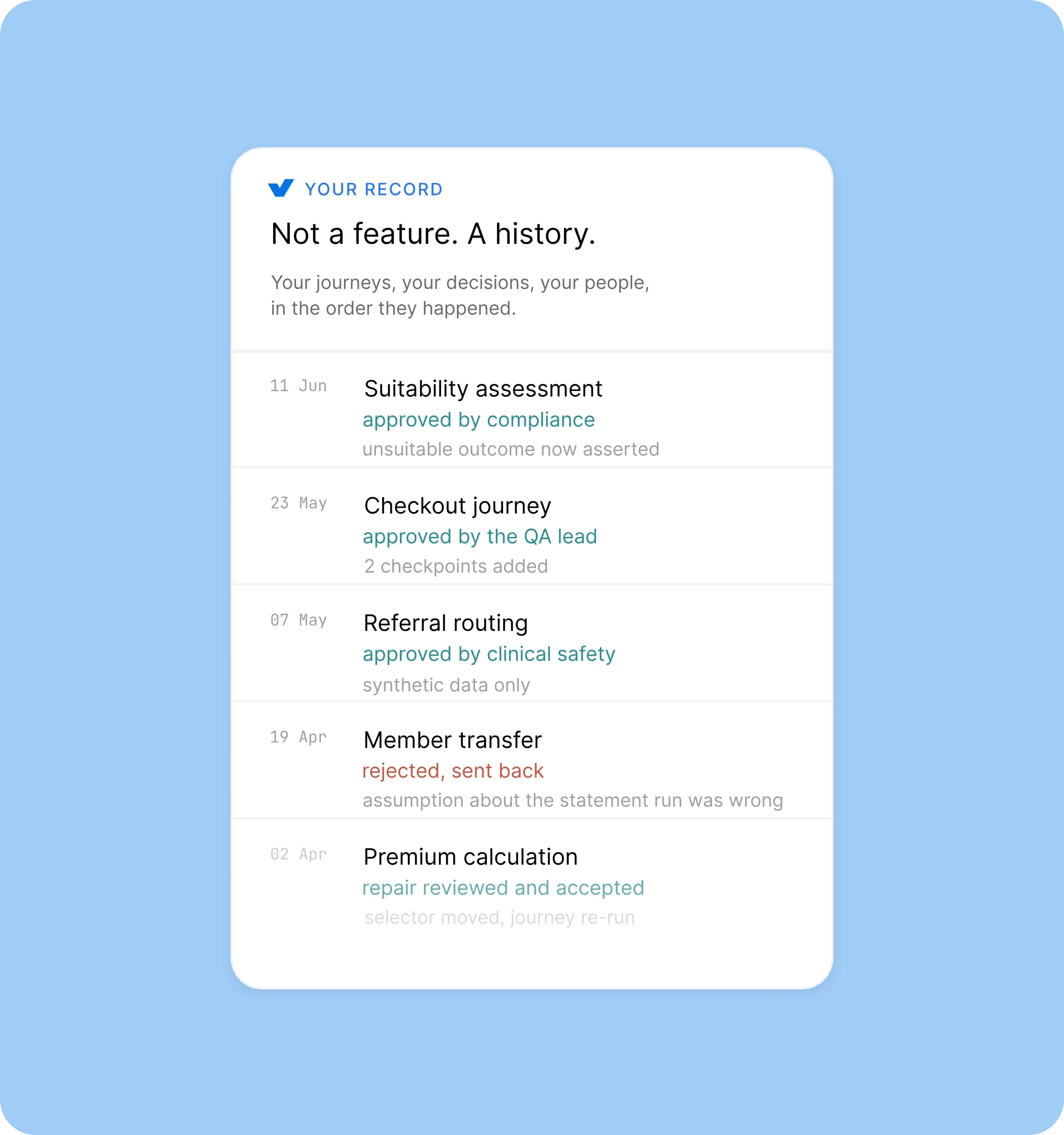
See how journeys and requirements are created
Plain-English authoring, plus requirements and structures generated from your documentation.
Run what was approved
Approved journeys execute in parallel on managed infrastructure, with no AI at runtime.
Explore Related Virtuoso QA Capabilities
See how journeys and requirements are created
Plain-English authoring, plus requirements and structures generated from your documentation.
Run what was approved
Approved journeys execute in parallel on managed infrastructure, with no AI at runtime.
Explore Related Virtuoso QA Capabilities
See how journeys and requirements are created
Plain-English authoring, plus requirements and structures generated from your documentation.
Run what was approved
Approved journeys execute in parallel on managed infrastructure, with no AI at runtime.
Al-native, proven in production.
10x
Faster execution
9x
Faster authoring
85%
Less maintenance
50%
Lower QA cost
Al-native, proven in production.
10x
Faster execution
9x
Faster authoring
85%
Less maintenance
50%
Lower QA cost
Al-native, proven in production.
10x
Faster execution
9x
Faster authoring
85%
Less maintenance
50%
Lower QA cost
Proven where quality and accountability matter
Recognized by independent analysts, trusted by enterprise teams, and built with the security controls required for critical software.

WAVE STRONG PERFORMER
Proven where quality and accountability matter
Recognized by independent analysts, trusted by enterprise teams, and built with the security controls required for critical software.
WAVE STRONG PERFORMER
Proven where quality and accountability matter
Recognized by independent analysts, trusted by enterprise teams, and built with the security controls required for critical software.
WAVE STRONG PERFORMER
Frequently Asked Questions
Practical answers on where a journey can start, what each step looks like and what your team approves before anything runs.
Can I author a journey without uploading any documents?
What does a Touchstone-generated requirement contain?
Will Touchstone duplicate requirements the project already holds?
Can I see what a directive will actually do before relying on it?
What is a journey structure, and what am I reviewing?
Frequently Asked Questions
Practical answers on where a journey can start, what each step looks like and what your team approves before anything runs.
Can I author a journey without uploading any documents?
What does a Touchstone-generated requirement contain?
Will Touchstone duplicate requirements the project already holds?
Can I see what a directive will actually do before relying on it?
What is a journey structure, and what am I reviewing?
Frequently Asked Questions
Practical answers on where a journey can start, what each step looks like and what your team approves before anything runs.
Can I author a journey without uploading any documents?
What does a Touchstone-generated requirement contain?
Will Touchstone duplicate requirements the project already holds?
Can I see what a directive will actually do before relying on it?
What is a journey structure, and what am I reviewing?

See what your next release looks like with Virtuoso
Book a walkthrough on your applications and your workflows. Bring a requirement, a user journey, or a brittle Selenium script, and watch the loop run on something you recognise.
See what your next release looks like with Virtuoso
Book a walkthrough on your applications and your workflows. Bring a requirement, a user journey, or a brittle Selenium script, and watch the loop run on something you recognise.
See what your next release looks like with Virtuoso
Book a walkthrough on your applications and your workflows. Bring a requirement, a user journey, or a brittle Selenium script, and watch the loop run on something you recognise.
AICPA
SOC

WAVE STRONG PERFORMER
@ Copyright 2026 SpotQA, Creators of Virtuoso QA
AICPA
SOC
WAVE STRONG PERFORMER
@ Copyright 2026 SpotQA, Creators of Virtuoso QA
AICPA
SOC
WAVE STRONG PERFORMER
@ Copyright 2026 SpotQA, Creators of Virtuoso QA