Automated Visual Testing Tool for Brand and Design Compliance
Automate visual testing against brand guidelines, design system rules and mandatory page elements. Touchstone, Virtuoso QA’s agentic capability, turns these standards into reusable checks that is executed across pages, browsers, viewports and locales, helping teams detect material visual defects without the noise of minor rendering variations.

Automated Visual Testing Tool for Brand and Design Compliance
Automate visual testing against brand guidelines, design system rules and mandatory page elements. Touchstone, Virtuoso QA’s agentic capability, turns these standards into reusable checks that is executed across pages, browsers, viewports and locales, helping teams detect material visual defects without the noise of minor rendering variations.
Automated Visual Testing Tool for Brand and Design Compliance
Automate visual testing against brand guidelines, design system rules and mandatory page elements. Touchstone, Virtuoso QA’s agentic capability, turns these standards into reusable checks that is executed across pages, browsers, viewports and locales, helping teams detect material visual defects without the noise of minor rendering variations.
Used by the world's leading companies











Used by the world's leading companies
Used by the world's leading companies
Used by the world's leading companies
Where Visual Testing Breaks at Enterprise Scale
Visual quality must remain consistent across complex digital estates, frequent releases and multiple markets. Manual review and image comparison remain useful, but neither provides complete assurance at enterprise scale.
Manual review cannot scale with the estate
Reviewers understand design intent, but limited release windows prevent them from checking every page, viewport and locale. Coverage becomes selective, allowing inconsistencies to reach production.

Pixel differences lack business context
Screenshot comparisons detect change, but cannot reliably distinguish harmless rendering variations from broken navigation, missing legal content or incorrect components. Teams must investigate the noise before identifying the risk.

Maintenance creates operational overhead
Every approved interface change requires baseline updates across affected pages, devices and locales. Without clear governance, the baseline library becomes expensive to maintain and less reliable as a release control.

Where Visual Testing Breaks at Enterprise Scale
Visual quality must remain consistent across complex digital estates, frequent releases and multiple markets. Manual review and image comparison remain useful, but neither provides complete assurance at enterprise scale.
Manual review cannot scale with the estate
Reviewers understand design intent, but limited release windows prevent them from checking every page, viewport and locale. Coverage becomes selective, allowing inconsistencies to reach production.
Pixel differences lack business context
Screenshot comparisons detect change, but cannot reliably distinguish harmless rendering variations from broken navigation, missing legal content or incorrect components. Teams must investigate the noise before identifying the risk.
Maintenance creates operational overhead
Every approved interface change requires baseline updates across affected pages, devices and locales. Without clear governance, the baseline library becomes expensive to maintain and less reliable as a release control.
Where Visual Testing Breaks at Enterprise Scale
Visual quality must remain consistent across complex digital estates, frequent releases and multiple markets. Manual review and image comparison remain useful, but neither provides complete assurance at enterprise scale.
Manual review cannot scale with the estate
Reviewers understand design intent, but limited release windows prevent them from checking every page, viewport and locale. Coverage becomes selective, allowing inconsistencies to reach production.
Pixel differences lack business context
Screenshot comparisons detect change, but cannot reliably distinguish harmless rendering variations from broken navigation, missing legal content or incorrect components. Teams must investigate the noise before identifying the risk.
Maintenance creates operational overhead
Every approved interface change requires baseline updates across affected pages, devices and locales. Without clear governance, the baseline library becomes expensive to maintain and less reliable as a release control.
A Governed Approach for Automated Visual Testing
Visual testing requires more than detecting that a page has changed. It requires a governed way to define what matters, apply those standards across the full application estate and prioritise deviations by business impact. Virtuoso QA and Touchstone bring those capabilities together through the following approach.

Standards become executable rules
Brand and compliance requirements are written once as rules the platform can evaluate, covering placement, mandatory content and approved components. Each result names the rule that was checked, the page it ran against and whether it held.

Coverage extends across the application estate
Virtuoso QA applies approved rules across relevant pages, browsers, viewports and locales, so visual validation scales without cataloguing every URL or capturing a baseline for every page.

One governed framework supports every brand and market
Common rules are reused across the estate while brand, market and locale requirements stay explicit, so regional disclosures and approved design variations are validated in the same framework rather than as separate suites.

Touchstone agents convert guidance into coverage
The Analyst turns brand guidelines and design documentation into source-cited requirements, the Architect proposes the checks that validate them, and the Autopilot builds the approved coverage. Each stage is reviewable before anything enters the suite.

Material defects are prioritised without baseline maintenance
A cosmetic change passes when the approved rule still holds, which directs attention to issues affecting usability, compliance or brand integrity. When a standard changes, the requirement and its coverage are updated without recapturing an image library.

Every result carries the standard behind it
A failure records which rule was evaluated, on which page, browser and locale, and what the run captured. A brand or compliance team reviews the finding against the standard it came from rather than interpreting an image comparison.
A Governed Approach for Automated Visual Testing
Visual testing requires more than detecting that a page has changed. It requires a governed way to define what matters, apply those standards across the full application estate and prioritise deviations by business impact. Virtuoso QA and Touchstone bring those capabilities together through the following approach.
Standards become executable rules
Brand and compliance requirements are written once as rules the platform can evaluate, covering placement, mandatory content and approved components. Each result names the rule that was checked, the page it ran against and whether it held.
Coverage extends across the application estate
Virtuoso QA applies approved rules across relevant pages, browsers, viewports and locales, so visual validation scales without cataloguing every URL or capturing a baseline for every page.
One governed framework supports every brand and market
Common rules are reused across the estate while brand, market and locale requirements stay explicit, so regional disclosures and approved design variations are validated in the same framework rather than as separate suites.
Touchstone agents convert guidance into coverage
The Analyst turns brand guidelines and design documentation into source-cited requirements, the Architect proposes the checks that validate them, and the Autopilot builds the approved coverage. Each stage is reviewable before anything enters the suite.
Material defects are prioritised without baseline maintenance
A cosmetic change passes when the approved rule still holds, which directs attention to issues affecting usability, compliance or brand integrity. When a standard changes, the requirement and its coverage are updated without recapturing an image library.
Every result carries the standard behind it
A failure records which rule was evaluated, on which page, browser and locale, and what the run captured. A brand or compliance team reviews the finding against the standard it came from rather than interpreting an image comparison.
A Governed Approach for Automated Visual Testing
Visual testing requires more than detecting that a page has changed. It requires a governed way to define what matters, apply those standards across the full application estate and prioritise deviations by business impact. Virtuoso QA and Touchstone bring those capabilities together through the following approach.
Standards become executable rules
Brand and compliance requirements are written once as rules the platform can evaluate, covering placement, mandatory content and approved components. Each result names the rule that was checked, the page it ran against and whether it held.
Coverage extends across the application estate
Virtuoso QA applies approved rules across relevant pages, browsers, viewports and locales, so visual validation scales without cataloguing every URL or capturing a baseline for every page.
One governed framework supports every brand and market
Common rules are reused across the estate while brand, market and locale requirements stay explicit, so regional disclosures and approved design variations are validated in the same framework rather than as separate suites.
Touchstone agents convert guidance into coverage
The Analyst turns brand guidelines and design documentation into source-cited requirements, the Architect proposes the checks that validate them, and the Autopilot builds the approved coverage. Each stage is reviewable before anything enters the suite.
Material defects are prioritised without baseline maintenance
A cosmetic change passes when the approved rule still holds, which directs attention to issues affecting usability, compliance or brand integrity. When a standard changes, the requirement and its coverage are updated without recapturing an image library.
Every result carries the standard behind it
A failure records which rule was evaluated, on which page, browser and locale, and what the run captured. A brand or compliance team reviews the finding against the standard it came from rather than interpreting an image comparison.
Already Using an Open Source Framework For Visual Testing?
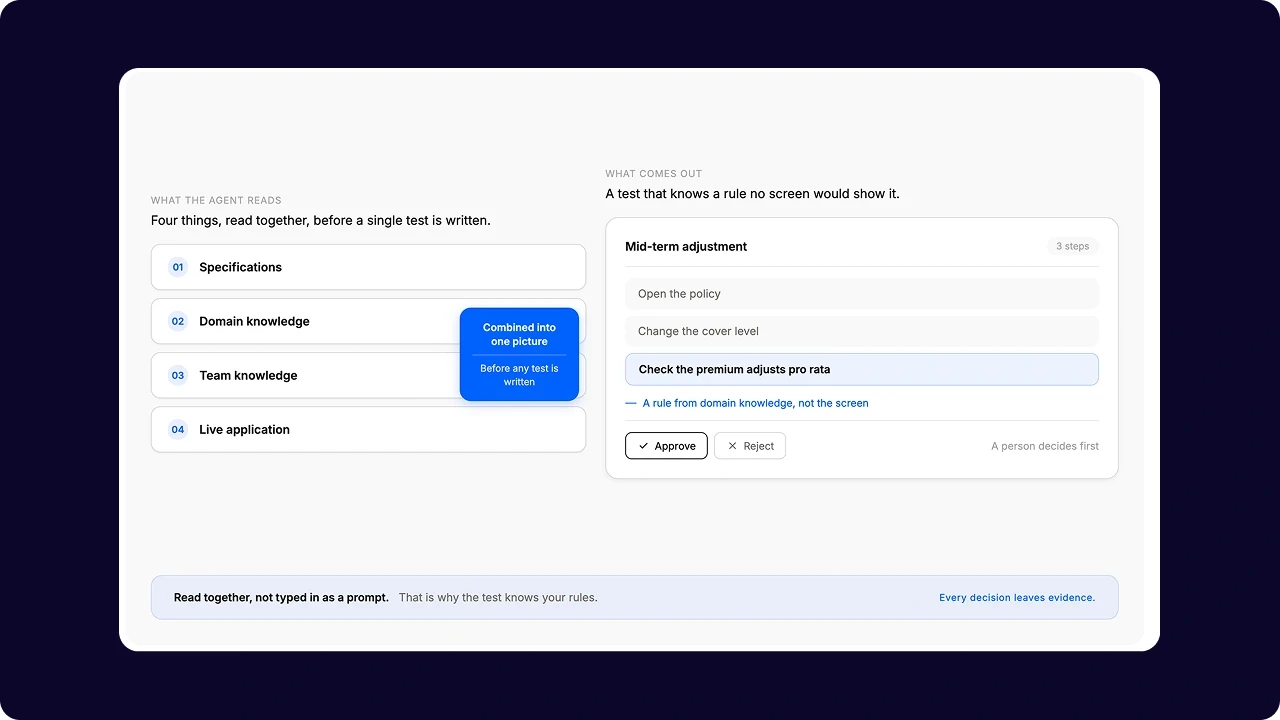
Whether your current coverage uses Playwright, Cypress or Selenium, the existing scripts and image baselines do not need to be replaced at once.Retain them while identifying the visual standards, business rules and critical scenarios they were designed to protect. Recreate priority coverage in Virtuoso QA as governed journeys linked to explicit requirements rather than importing framework code directly. Start with a representative workflow, validate equivalence and expand the transition at a controlled pace.
Already Using an Open Source Framework For Visual Testing?
Whether your current coverage uses Playwright, Cypress or Selenium, the existing scripts and image baselines do not need to be replaced at once.Retain them while identifying the visual standards, business rules and critical scenarios they were designed to protect. Recreate priority coverage in Virtuoso QA as governed journeys linked to explicit requirements rather than importing framework code directly. Start with a representative workflow, validate equivalence and expand the transition at a controlled pace.
Already Using an Open Source Framework For Visual Testing?
Whether your current coverage uses Playwright, Cypress or Selenium, the existing scripts and image baselines do not need to be replaced at once.Retain them while identifying the visual standards, business rules and critical scenarios they were designed to protect. Recreate priority coverage in Virtuoso QA as governed journeys linked to explicit requirements rather than importing framework code directly. Start with a representative workflow, validate equivalence and expand the transition at a controlled pace.
Why Enterprises Choose Virtuoso QA for Visual Testing
Virtuoso QA validates against the standards your brand and compliance teams set rather than against a library of captured images, which changes what a visual failure means and what it costs to keep the coverage current.
Reduce brand and compliance exposure
Consistent experiences across markets help protect brand integrity and reduce the risk of mandatory content being omitted from customer facing pages.

Accelerate release decisions
Teams spend less time investigating insignificant visual changes, allowing material issues to be resolved without extending release timelines.
Lower the cost of visual assurance
Coverage can grow with the digital estate without requiring a proportional increase in manual review capacity or baseline maintenance.

Focus specialist expertise where it adds value
Designers and testers can spend more time assessing usability, accessibility and customer experience instead of repeating routine visual checks.
Why Enterprises Choose Virtuoso QA for Visual Testing
Virtuoso QA validates against the standards your brand and compliance teams set rather than against a library of captured images, which changes what a visual failure means and what it costs to keep the coverage current.
Reduce brand and compliance exposure
Consistent experiences across markets help protect brand integrity and reduce the risk of mandatory content being omitted from customer facing pages.
Accelerate release decisions
Teams spend less time investigating insignificant visual changes, allowing material issues to be resolved without extending release timelines.
Lower the cost of visual assurance
Coverage can grow with the digital estate without requiring a proportional increase in manual review capacity or baseline maintenance.
Focus specialist expertise where it adds value
Designers and testers can spend more time assessing usability, accessibility and customer experience instead of repeating routine visual checks.
Why Enterprises Choose Virtuoso QA for Visual Testing
Virtuoso QA validates against the standards your brand and compliance teams set rather than against a library of captured images, which changes what a visual failure means and what it costs to keep the coverage current.
Reduce brand and compliance exposure
Consistent experiences across markets help protect brand integrity and reduce the risk of mandatory content being omitted from customer facing pages.
Accelerate release decisions
Teams spend less time investigating insignificant visual changes, allowing material issues to be resolved without extending release timelines.
Lower the cost of visual assurance
Coverage can grow with the digital estate without requiring a proportional increase in manual review capacity or baseline maintenance.
Focus specialist expertise where it adds value
Designers and testers can spend more time assessing usability, accessibility and customer experience instead of repeating routine visual checks.
Why Enterprises Choose Virtuoso QA for Visual Testing
Virtuoso QA validates against the standards your brand and compliance teams set rather than against a library of captured images, which changes what a visual failure means and what it costs to keep the coverage current.
Reduce brand and compliance exposure
Consistent experiences across markets help protect brand integrity and reduce the risk of mandatory content being omitted from customer facing pages.
Accelerate release decisions
Teams spend less time investigating insignificant visual changes, allowing material issues to be resolved without extending release timelines.
Lower the cost of visual assurance
Coverage can grow with the digital estate without requiring a proportional increase in manual review capacity or baseline maintenance.
Focus specialist expertise where it adds value
Designers and testers can spend more time assessing usability, accessibility and customer experience instead of repeating routine visual checks.
Explore Other Virtuoso QA Capabilities
Validate visual and functional behaviour together
Confirm that pages meet design standards while navigation, forms and critical user actions work as intended.
Generate governed coverage from business context
Touchstone turns specifications and process documentation into source cited requirements and reviewable test journeys.

Explore Other Virtuoso QA Capabilities
Validate visual and functional behaviour together
Confirm that pages meet design standards while navigation, forms and critical user actions work as intended.
Generate governed coverage from business context
Touchstone turns specifications and process documentation into source cited requirements and reviewable test journeys.
Explore Other Virtuoso QA Capabilities
Validate visual and functional behaviour together
Confirm that pages meet design standards while navigation, forms and critical user actions work as intended.
Generate governed coverage from business context
Touchstone turns specifications and process documentation into source cited requirements and reviewable test journeys.
Al-native, proven in production.
10x
Faster execution
9x
Faster authoring
85%
Less maintenance
50%
Lower QA cost
Al-native, proven in production.
10x
Faster execution
9x
Faster authoring
85%
Less maintenance
50%
Lower QA cost
Al-native, proven in production.
10x
Faster execution
9x
Faster authoring
85%
Less maintenance
50%
Lower QA cost
Proven where quality and accountability matter
Recognized by independent analysts, trusted by enterprise teams, and built with the security controls required for critical software.

WAVE STRONG PERFORMER
Proven where quality and accountability matter
Recognized by independent analysts, trusted by enterprise teams, and built with the security controls required for critical software.
WAVE STRONG PERFORMER
Proven where quality and accountability matter
Recognized by independent analysts, trusted by enterprise teams, and built with the security controls required for critical software.
WAVE STRONG PERFORMER
Frequently Asked Questions
How visual testing works in Virtuoso QA, from where the rules come from to what a failure actually tells you.
Can this replace Percy or Applitools?
Do we have to maintain baseline images?
What happens when an element moves slightly?
Can rules come from our brand guidelines rather than being written by hand?
Can it run on every deployment?
Frequently Asked Questions
How visual testing works in Virtuoso QA, from where the rules come from to what a failure actually tells you.
Can this replace Percy or Applitools?
Do we have to maintain baseline images?
What happens when an element moves slightly?
Can rules come from our brand guidelines rather than being written by hand?
Can it run on every deployment?
Frequently Asked Questions
How visual testing works in Virtuoso QA, from where the rules come from to what a failure actually tells you.
Can this replace Percy or Applitools?
Do we have to maintain baseline images?
What happens when an element moves slightly?
Can rules come from our brand guidelines rather than being written by hand?
Can it run on every deployment?

See what your next release looks like with Virtuoso
Book a walkthrough on your applications and your workflows. Bring a requirement, a user journey, or a brittle Selenium script, and watch the loop run on something you recognise.
See what your next release looks like with Virtuoso
Book a walkthrough on your applications and your workflows. Bring a requirement, a user journey, or a brittle Selenium script, and watch the loop run on something you recognise.
See what your next release looks like with Virtuoso
Book a walkthrough on your applications and your workflows. Bring a requirement, a user journey, or a brittle Selenium script, and watch the loop run on something you recognise.
AICPA
SOC

WAVE STRONG PERFORMER
@ Copyright 2026 SpotQA, Creators of Virtuoso QA
AICPA
SOC
WAVE STRONG PERFORMER
@ Copyright 2026 SpotQA, Creators of Virtuoso QA
AICPA
SOC
WAVE STRONG PERFORMER
@ Copyright 2026 SpotQA, Creators of Virtuoso QA