Insurance
Insurance Software Testing Guide: Policy, Claims, Billing

Adwitiya Pandey
Published On






Table of contents
Lorem ipsum
Lorem ipsum
Lorem ipsum
Lorem ipsum
Lorem ipsum
What is Insurance Software Testing?
Insurance software testing means proving that policy administration, rating, billing, claims, portals and every connected system still produce the right prices, cover, payments and documents after each change, and being able to show how you know.
It’s hard because insurance logic is the product, time drives every calculation, vendors release on their own calendars and regulators expect proof.
Virtuoso QA tests any browser-based application. For insurers, that means the whole estate: core suites such as Guidewire, Duck Creek, Sapiens, Majesco and EIS, CRM, broker and customer portals, rating platforms, document and payment services, and the in-house applications in between, with API and data checks in the same journey. Touchstone, Virtuoso QA’s agentic platform, turns each release into evidence.
What Does Insurance Software Testing Cover?
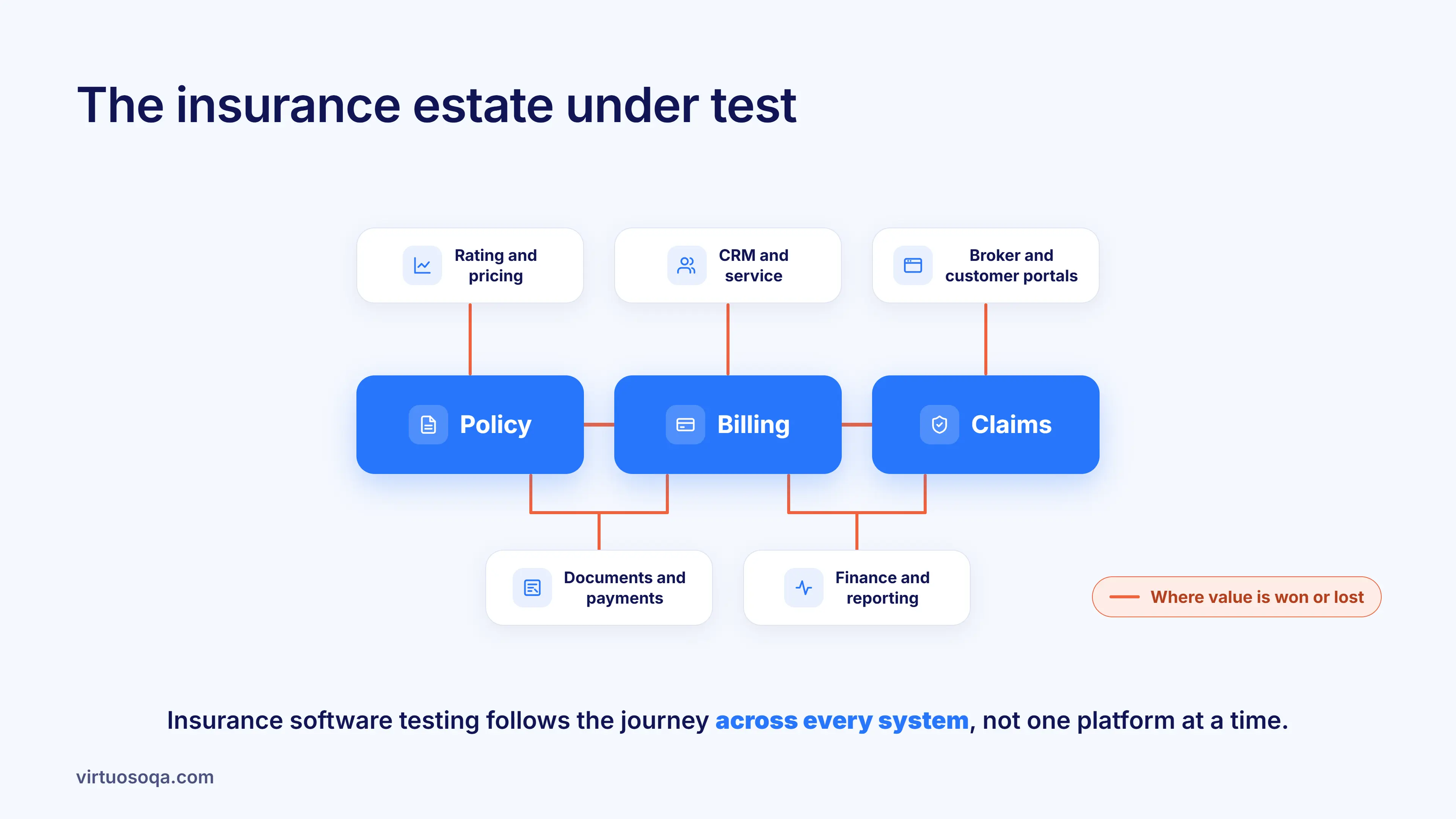
An insurance estate is a set of systems that together quote, bind, bill, service and settle policies. Each has its own owner, technology and release rhythm, and value is created or lost at the handoffs between them. Insurance software testing focuses on the products the insurer has configured on these platforms, not the platforms themselves.
Layer | Typical Systems | Who Changes It | How Often |
|---|---|---|---|
Core policy, billing and claims | Guidewire, Duck Creek, Sapiens, Majesco, EIS, OIPA and others | Vendor releases plus the insurer’s configuration | Two or three major vendor releases a year, plus frequent configuration |
Rating and pricing | Core rating, Earnix, Radar, Akur8, hx Renew | Pricing teams | Often weekly or monthly |
CRM and service | Salesforce, Dynamics 365 | Vendor releases plus admin configuration | Three Salesforce releases a year, plus frequent flow changes |
Distribution | Quote-and-buy sites, broker portals, price comparison feeds | Digital teams and partners | Often weekly |
Documents, payments and finance | Composition platforms, payment providers, SAP, Oracle, Workday | Several teams and vendors | Continuous |
Guidewire ships three cloud releases a year (Guidewire), and Duck Creek runs three feature releases a year plus monthly updates (Duck Creek). The full map is in The Insurance Application Estate, and the differences by line are in P&C vs Life vs London Market.
Why Does Insurance Software Break?
Insurance releases fail in a handful of recurring ways, most of them invisible until customers or regulators notice. Good insurance software testing is built around these failure patterns. The full set of fourteen is in Why Insurance Releases Fail.
Why Do Vendor Upgrades Break Insurance Test Suites?
Core platform releases change screens, element identifiers and sometimes default behaviour two or three times a year. Scripted suites tied to page structure fail in bulk, teams spend weeks repairing them, and real behaviour changes hide among the noise. Regression must be tied to business requirements, with each release traced to the tests it affects.
Why Do Configuration Changes Skip Testing?
Rating tables, product rules, templates and workflows are changed by business teams without an engineering release. Because the change never enters the delivery pipeline, regression never runs, and an error in one table can misprice every policy in a renewal cycle. Configuration deployments need the same automatic regression as code.
Why Are Rating and Date Logic So Fragile?
Premiums depend on many interacting factors, and nearly every insurance calculation depends on dates: inception, mid-term change, renewal, date of loss. Small errors in factor mapping or date handling produce plausible but wrong numbers that pass casual checks and repeat across thousands of policies.
Why Do Integrations Fail Quietly?
Policy, billing, claims, documents, payments and finance exchange data constantly. When one side changes a field, version or format, the other often accepts the message, applies a default and carries on. The journey completes, the screen looks fine and the outcome is wrong.
Why is Producing Evidence So Slow?
In most insurers, evidence of what was tested and approved is assembled after the fact from spreadsheets, screenshots and emails. Go-live decisions wait on the assembly, auditors find gaps, and nobody can reproduce last quarter’s results. Evidence needs to be produced as testing happens.
Types of Insurance Software Testing
Insurance software testing combines several types of testing, each catching a different kind of defect.
Type | What It Checks in Insurance Software |
|---|---|
Quotes, policy changes, claims and billing behave as the product rules say | |
Vendor releases, configuration changes and code changes haven’t broken existing journeys | |
Policy, billing, claims, documents, payments and finance exchange data correctly | |
A complete journey, such as quote to bind to first payment, works across every system | |
Data and calculation testing | Premiums, taxes, reserves and payments are correct for each date and risk |
Underwriters, claims handlers and pricing teams confirm the system supports their work | |
Performance testing | Quote and claims journeys hold up at renewal peaks, using specialist tools |
Security and access testing | Customers, brokers and staff can only see and change what they should |
What Must an Insurance Regression Suite Cover?
A regression suite should cover the business processes that move money, define cover or carry regulatory obligations, end to end, across every system involved. This is where insurance software testing pays off most. The table lists the core processes, why each matters and where each is covered in depth.
Business process | Why it matters | Release risk | Covered in |
|---|---|---|---|
Rating and underwriting rules | Price and acceptance decisions | Mispricing at scale; pricing rule breaches | Rating and Underwriting Testing |
Policy lifecycle | Cover customers rely on | Wrong terms after mid-term changes | Policy Lifecycle Testing |
Renewals | Retention and pricing regulation | Defects repeated across a whole cycle | Renewal Testing |
Claims | The promise being kept | Wrong payments; unfair outcomes | Claims Testing |
Portals | Customer and broker access | Data exposure; inconsistent values | Portal Testing |
Connected apps | Payments, documents, CRM, finance | Silent failures between systems | Connected Systems Testing |
Vendor upgrades | Fixed release calendars | Bulk script failure; missed behaviour change | Vendor Upgrade Testing |
How Does Virtuoso QA Test Insurance Software?
Virtuoso QA runs insurance journeys written in plain English on a deterministic engine across browsers, with API calls and data checks in the same journey. When a release changes the interface, Virtuoso QA proposes repairs for a reviewer to accept or reject, so routine changes don’t stall a suite and nothing changes without a record.
Touchstone adds the agentic layer, generally available since 30 September 2026. The Analyst drafts requirements from the insurer’s own documents, The Architect builds journeys, The Autopilot turns them into runnable tests, the deterministic engine runs them in CI, and a named person approves each step.
Every requirement cites its source, every result is tied to a build, and every decision is kept as evidence. AI proposes, people govern, and the AI that reasons never executes the tests.
A sample journey, as Touchstone would run it:
Create a home policy for a three-bedroom house in Leeds, incepting 90 days ago, with one claim in the current term.
Trigger the renewal process for that policy.
Check that the renewal premium matches the price the pricing team approved for this risk.
Request a new business quote for the same risk through the same channel and check the renewal premium is no higher.
Check the renewal notice shows last year's premium and this year's premium.
Check the instalment plan in billing matches the renewal premium.
Boundaries stated plainly: Touchstone tests browser-based applications, including mobile web, and APIs. Native mobile apps and thick clients are outside scope, heavily nested iframes and shadow DOM are workable but higher friction, and performance and load testing need specialist tools alongside it.
Which Connected Systems Matter Most?
Four integrations account for most cross-system defects in insurance: core to billing and payments, core to document composition, core to CRM, and operational systems to finance and reporting.
Insurance software testing should cover each one as part of the journeys that drive it, not in isolation.
What Do Auditors and Regulators Expect as Evidence?
Regulators rarely prescribe test methods, but they expect controlled change, good customer outcomes, reliable financial data and validated AI. Solvency II and Solvency UK, the Consumer Duty, ICOBS 6B, IFRS 17 and the NAIC AI bulletin each translate into specific evidence. See What Each Regime Demands of Test Evidence and Release Evidence for Insurers.
Virtuoso QA’s approach to release evidence records the requirement, result, approver and build behind every test, so the record auditors ask for exists before they ask.
How Do Insurance Software Testing Tools Compare?
Insurers usually combine more than one approach to insurance software testing. The table compares the main options on the criteria that matter most for a regulated, multi-system estate. Each is the right call somewhere.
Option | Strongest At | Weaker At | Right Call When |
|---|---|---|---|
Platform-native test tools | Developer-level tests inside one core platform | Journeys across the wider estate; business readability | Platform teams test their own configuration code |
Open-source frameworks (Selenium, Playwright) | Flexibility for engineering-owned code | Maintenance under vendor releases; evidence and approvals | Engineers own the code and its release |
Enterprise test automation suites | Broad technology coverage, including some desktop applications | Specialist skills; evidence depends on configuration | Thick-client systems dominate the estate |
Testing services | Capacity and platform expertise on demand | Knowledge retention; cost grows with releases | Peaks, migrations, specialist programmes |
Virtuoso QA with Touchstone | Cross-system browser and API journeys, governed AI, release evidence | Native mobile, thick clients, performance testing | Frequent vendor and configuration change with evidence to produce |
The full comparison is in Insurance Testing Tools and Where Virtuoso QA Fits.
What Does Good Look Like in Practice?
This is an illustrative scenario, not a customer case.
A UK motor and home insurer releases a new pricing model, a comparison-site incentive and repriced breakdown cover in one release. Requirements drafted from the pricing, marketing and product documents, approved by their owners, find three renewal pricing defects before invitations go out, and the evidence goes straight into the pricing committee pack.
Insurance Software Testing Release Readiness Checklist
Every system, configuration change and vendor release in scope is listed
Requirements are approved by named business owners
Critical journeys pass end to end, from quote to documents
Renewals pass for representative customers and histories
Claims pass from first notice to payment
Rating matches approved prices in every channel
Integrations return correct outcomes, not just responses
Results are tied to the release build and can be reproduced
Exceptions are accepted by named risk owners
Go-live is approved by people independent of the build
Interesting Reads
Duck Creek Testing: How to Automate P&C Insurance Application Testing
Test Automation for SAP Commerce Cloud
Guidewire Testing: What to Test, When, and How to Keep Up With the Release Calendar
Microsoft Dynamics 365 Test Automation: Enterprise ERP Testing with Self-Healing AI
Frequently Asked Questions
How often should an insurer run regression testing?
Can one tool test Guidewire, Salesforce and a custom portal together?
How do insurers prove a release was properly tested?
Does Virtuoso QA work with any insurance platform?