Blog
22 Best API Automation Testing Tools in 2026

Modhana Priya
Published on

Table of contents
Lorem ipsum
Lorem ipsum
Lorem ipsum
Lorem ipsum
Lorem ipsum
APIs now carry the majority of traffic on the modern web, which means the quality of your APIs sets the ceiling for the quality of everything built on top of them. This guide breaks down the 22 best API automation testing tools for 2026, grouped by the job each one does best rather than ranked one to twenty-two, so you can match a tool to your actual stack, team, and risk profile.
Each entry covers its features, its pros, and its cons, followed by a clear framework for choosing.
Why API Testing Decides Whether Your Product Holds up
You can pour months into a polished interface, but if the API behind the search box or the payment button buckles under load or mishandles a bad request, the whole experience falls over with it. The API is where your application talks to its own backend, to partners, and increasingly to AI agents, and every one of those conversations is a place something can break.
The stakes have climbed sharply. APIs now handle huge percent of web traffic, and that makes them the single largest surface attackers probe.
Akamai's State of the Internet research found that 87 percent of organisations dealt with an API security incident during 2025, with daily API attacks per organisation more than doubling year on year. An untested endpoint is no longer just a quality gap; it is an open door.
Manual checking cannot keep pace with that reality. Teams shipping on modern release cycles need API tests that run automatically on every commit, catch regressions before they reach staging, and validate behaviour, performance, and security together. The tools below are how that gets done.
What API Automation Testing Tools Actually Do
An API automation testing tool sends requests to your endpoints, inspects the responses, and checks them against the contract your API is supposed to honour, all without a person clicking through by hand. The good ones do this at scale, across environments, and inside your delivery pipeline.
The reasons teams invest in them are consistent:
Faster feedback: Because API tests work at the layer beneath the interface, you can run them before the front end even exists and catch defects early, when they are cheapest to fix.
Deeper coverage: Tests reach the integration points and business logic that interface tests skim over, confirming that services actually talk to each other correctly.
Lower maintenance: API tests are far more stable than interface tests, since they do not break every time a button moves or a layout shifts.
Language freedom: Most tools speak standard formats like JSON and XML, so the team works in whatever language suits it.
Stronger security: Good tooling surfaces the authentication gaps, data exposure, and injection openings that turn an endpoint into a liability.
The Types of API Testing Your Tool Needs to Cover
Different tools are built for different jobs, so it helps to know the categories before you compare names:
Functional testing confirms each endpoint returns the right data, handles edge cases, and behaves as specified across every request type. It is the foundation everything else sits on.
Load and performance testing measures how the API holds up when traffic spikes, tracking speed, stability, and scalability under realistic pressure.
Security testing hunts for the vulnerabilities an attacker would exploit: unauthorised access, leaked data, and injection flaws. In regulated environments it is increasingly a continuous requirement rather than an annual audit.
Contract testing verifies that the providers and consumers of an API still honour the shared agreement between them, catching integration breaks before they reach production.
Mocking and service virtualisation simulate endpoints that do not exist yet or are unstable, so testing is not blocked by a dependency that is still being built.
Most mature teams end up combining several tools across these categories rather than expecting one to do everything.
How to Read This List
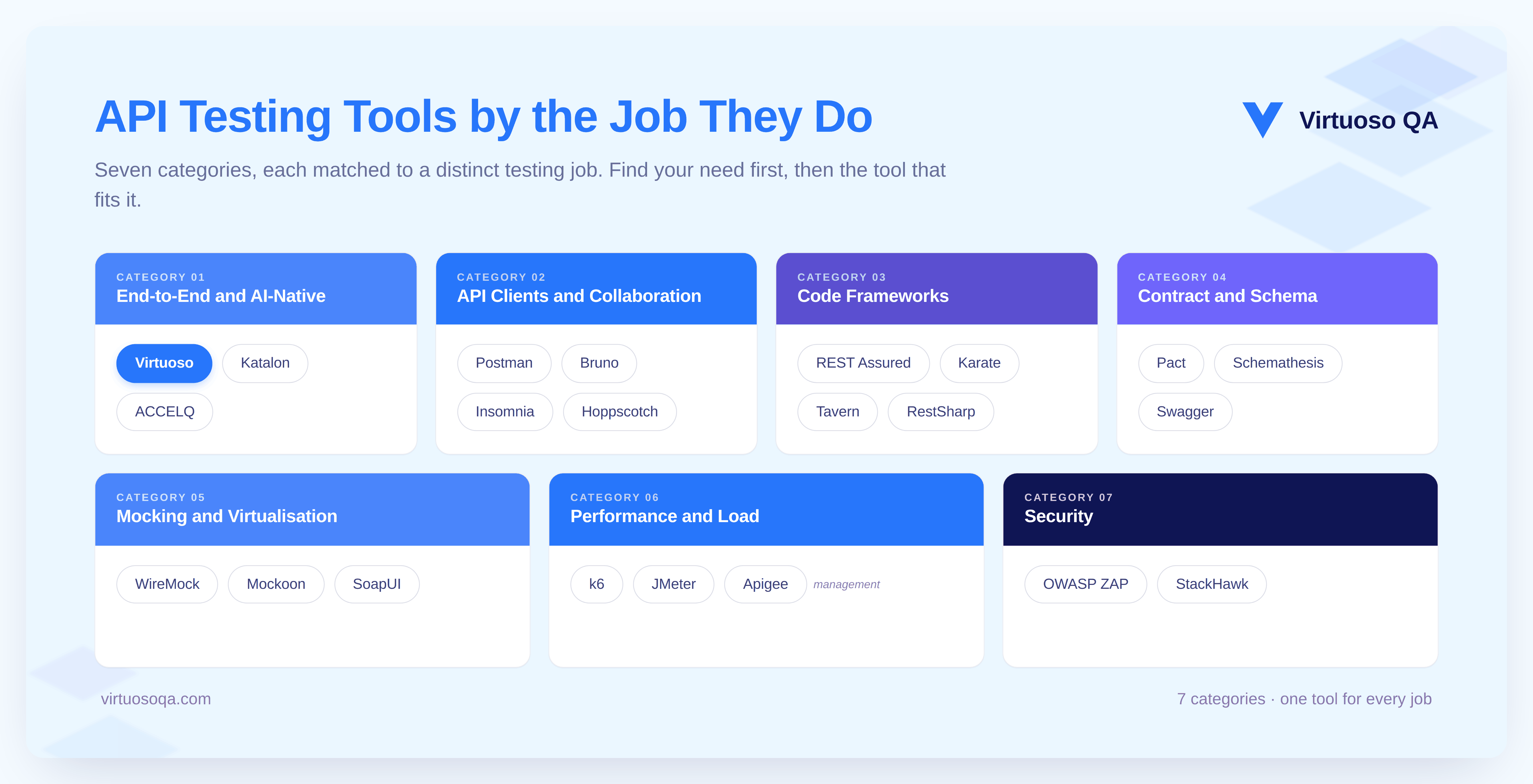
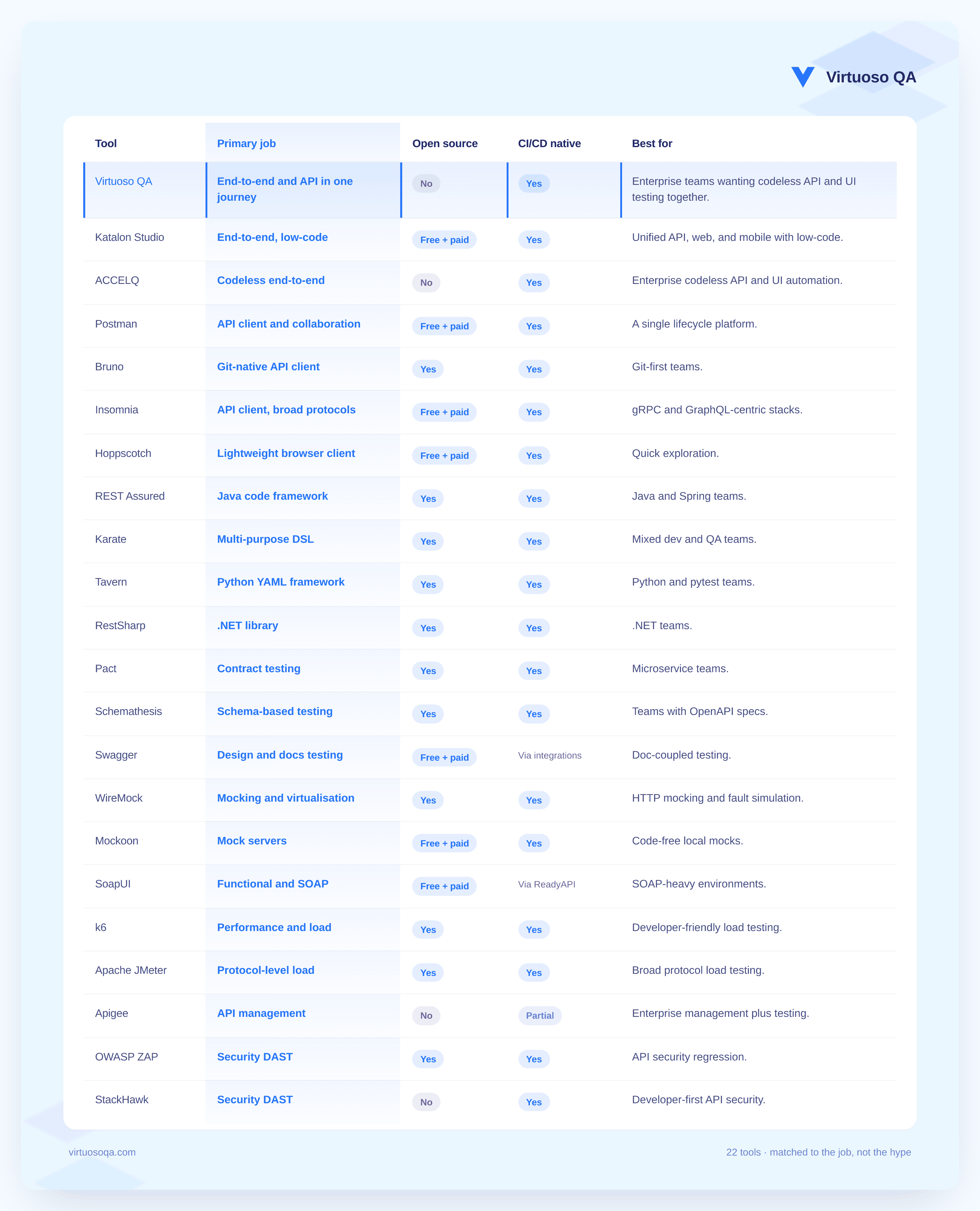
Rather than a forced ranking, the tools are grouped by what you are trying to accomplish. Find the job that matches your need, then compare the options inside it.
The groups run from end-to-end and AI-native platforms through to security, and each tool is broken down into its features, its pros, and its cons so you can weigh it quickly.
The 22 Best API Automation Testing Tools
End-to-end and AI-native platforms
These tools test APIs as part of a wider quality strategy, usually alongside the interface, and increasingly use AI to author and maintain tests.
1. Virtuoso QA
Virtuoso QA is an AI-native end-to-end test automation platform where API testing lives inside the same journey as UI actions and database checks, so a single test can drive the interface, fire the API call, and verify the data behind it in one pass.
Tests are authored in plain English through Natural Language Programming, which means QA engineers and non-developers alike can build and maintain API coverage without writing or babysitting scripts.
What sets it apart for API work is that the platform is AI-native rather than AI-bolted, so tests adapt to change rather than simply finding a different way to click.
Features
API validation embedded directly within UI journeys for true end-to-end coverage, alongside database validation through SQL checks.
Plain-English authoring through Natural Language Programming, with self-healing at roughly 95 percent accuracy.
AI Root Cause Analysis returning logs, network requests, and a proposed cause on failure, with native CI/CD integration across Jenkins, Azure DevOps, GitHub Actions, GitLab, and CircleCI.
Pros
Validates API and UI together in one journey rather than testing the API in isolation.
Codeless authoring opens API testing to QA engineers and non-developers alike, not just those who can write scripts.
Cons
Teams wanting only a standalone request client, with no interest in end-to-end coverage, may find the platform broader than they need.
2. Katalon Studio
Katalon is a low-code platform that covers API, web, mobile, and desktop testing in one place, with a visual request builder and an assertion engine for REST, SOAP, and GraphQL.
It suits teams that want a single environment across test types without committing to pure scripting.
Features
Visual request builder and assertion engine supporting REST, SOAP, and GraphQL.
AI-assisted self-healing and failure analysis to reduce maintenance.
Import of definitions from OpenAPI, Postman, and SoapUI to get started quickly.
Pros
One platform spanning API, web, and mobile with low-code accessibility.
Self-healing reduces maintenance compared with purely script-based alternatives.
Cons
As an AI-bolted platform it layers AI onto a traditional framework, so resilience differs from a ground-up AI-native design.
3. ACCELQ
ACCELQ is a codeless, AI-powered platform that unifies API, UI, and end-to-end validation in a single workflow, aimed at enterprise-scale regression.
Features
Codeless API and UI test design in a unified workflow.
Self-healing automation and CI/CD integration.
Regression tracking built for enterprise scale.
Pros
Strong fit for enterprises wanting codeless API and UI automation together.
Reduces scripting bottlenecks across mixed teams.
Cons
Breadth can be more than a small team focused only on API checks requires.
API Clients and Collaboration Tools
These are the tools you reach for to explore, inspect, and share APIs, often before a single automated test is written.
4. Postman
Postman remains the default starting point for most teams, organising and sharing requests through Collections and Workspaces and running them in CI/CD through Newman or the CLI.
Features
Collections and Workspaces for organising, sharing, and version-controlling requests.
Collection Runner to chain requests, plus newer agentic features that turn plain-language commands into API actions.
Protocol support spanning REST, SOAP, GraphQL, gRPC, WebSocket, and MQTT.
Pros
A single platform for API development, testing, and collaboration across the lifecycle.
Huge community and integration ecosystem.
Cons
The features most teams need at scale, such as Git sync, SSO, and audit logs, sit behind paid tiers, and large collections can feel slow.
5. Bruno
Bruno is the most interesting Postman alternative for teams that want everything in Git, storing collections as plain-text files in the repository with no cloud sync or account required.
Features
Plain-text collections that branch, diff, and review alongside application code.
Offline-first design with no cloud dependency or account to start.
CLI runner with JUnit-compatible output for CI/CD.
Pros
Treats API collections as code, which suits Git-first teams.
Fast, local, and open source.
Cons
Not yet a feature-for-feature Postman replacement, and lighter on enterprise governance and SSO.
6. Insomnia
Insomnia is a developer-friendly client with broad protocol coverage and both local and cloud storage modes.
Features
Support for HTTP, gRPC, GraphQL, WebSocket, and SSE.
Local and cloud storage modes.
Strong authentication support and environment management.
Pros
Broad protocol coverage suits gRPC and GraphQL-central stacks.
Clean, approachable interface.
Cons
Lighter documentation and limited SOAP support.
7. Hoppscotch
Hoppscotch is a lightweight, open-source, browser-based client that needs no install and can be self-hosted.
Features
Browser-based client with no installation required.
Collections, environments, and workspaces for collaboration.
Self-hosting option for full control.
Pros
Fast and frictionless for quick API exploration.
Open source with unlimited workspaces and collaborators.
Cons
No real load-testing capability and a smaller community.
Code-Based API Automation Frameworks
When click-and-check is not enough, these frameworks give you automated, repeatable, pipeline-friendly tests in code.
8. REST Assured
REST Assured is the Java standard for REST API testing, producing readable tests that live alongside application code.
Features
Fluent given-when-then syntax for readable test scripts.
Built-in JSON and XML parsing.
Integration with JUnit, TestNG, and the Serenity BDD framework.
Pros
Battle-tested in enterprise Java environments for years.
Tests live in the same codebase as the application, easy to version and review.
Cons
No GUI, and not a fit for teams working outside Java.
9. Karate
Karate combines API testing, mocking, performance testing, and UI automation in one framework, using a Gherkin-style DSL that needs no step definitions.
Features
Readable DSL requiring no step definitions, accessible to non-programmers.
Built-in mocking and Gatling integration so functional suites double as load tests.
Support for REST, GraphQL, gRPC, SOAP, and WebSocket.
Pros
One framework across API, mocking, and performance.
Readable by testers as well as developers.
Cons
A learning curve for complex conditional logic, and teams wanting tests in the same general-purpose language as the product may prefer REST Assured or Tavern.
10. Tavern
Tavern is a pytest-based framework that uses concise YAML to define tests, running them as pytest tests.
Features
Declarative YAML test definitions.
Runs as pytest tests for clean integration with Python infrastructure.
Support for REST and MQTT protocols.
Pros
Natural fit for Python and pytest teams.
Powerful assertion capabilities for API validation.
Cons
No built-in performance or security testing, and focused on integration rather than unit testing.
11. RestSharp
RestSharp is a .NET library for making HTTP calls to REST APIs, handling serialisation and authentication with minimal code.
Features
Synchronous and asynchronous HTTP calls over REST.
Automatic serialisation of requests and deserialisation of responses.
Built-in support for OAuth1, OAuth2, and JWT authentication.
Pros
Easy to configure within a .NET application.
Fine-grained control over every parameter of the HTTP call.
Cons
No built-in GUI, mocking, or orchestration, and limited to .NET-compatible languages.

Contract and Schema-Based Testing
This category is underrepresented in most lists and one of the most valuable for microservice teams, because it tests whether an API honours the contract consumers depend on, not just whether an endpoint returns 200.
12. Pact
Pact is the standard for consumer-driven contract testing, letting the consumer define what it expects and the provider verify it independently.
Features
Consumer-driven contracts captured and verified without a shared test environment.
Support for Java, JavaScript, Python, Ruby, Go, .NET, and more.
Independent provider verification against the captured contract.
Pros
Among the highest-leverage investments for microservice teams tired of brittle end-to-end environments.
Catches integration breaks before they reach staging.
Cons
Requires buy-in from both the producer and consumer sides of each contract.
13. Schemathesis
Schemathesis generates test cases automatically from an OpenAPI or GraphQL schema and checks for crashes, schema violations, and validation bypasses.
Features
Automatic test generation from OpenAPI or GraphQL schemas.
Checks for crashes, schema violations, and stateful workflow problems.
Available as both a CLI and a Python library.
Pros
Meaningful coverage with almost no test-writing effort if you have a spec.
One of the most underused, high-value tools in the space.
Cons
Useless without usable specifications, since it is spec-driven by design.
14. Swagger
Swagger centres on API design and documentation through the OpenAPI specification, with interactive docs you can test endpoints from.
Features
Interactive API documentation generated from the OpenAPI spec.
Built-in mocking, linting, and validation across the API lifecycle.
Code generation for client SDKs and server stubs.
Pros
Ties design, documentation, and testing around a shared spec.
Widely adopted with a large ecosystem.
Cons
No native load or security testing, and limited SOAP support.
Mocking and service virtualisation
These tools simulate endpoints so testing is not blocked by dependencies that are unstable or not yet built.
15. WireMock
WireMock is the go-to for HTTP mocking and service virtualisation, supporting request matching, dynamic responses, and fault injection.
Features
HTTP request matching, dynamic response templating, and record-and-playback from real services.
Fault injection to test error-handling logic.
Runs standalone or embedded in a test suite.
Pros
Strong for simulating HTTP services and testing error and edge-case handling.
Supports both synchronous and asynchronous behaviours.
Cons
Focused on mocking rather than functional testing, and HTTP-centric.
16. Mockoon
Mockoon creates mock REST APIs locally with no code, deployable through a CLI, Docker image, or libraries.
Features
Code-free creation of mock REST APIs on unlimited routes.
Deployment through CLI, Docker image, and libraries.
Cloud option to sync and share mocks across a team.
Pros
Quick to set up with little configuration.
Customisable mocks that mimic real API behaviour.
Cons
Lighter on advanced validation and complex authentication methods.
17. SoapUI
SoapUI is a long-standing tool for functional, regression, and load testing of SOAP and REST APIs, with strong Groovy-based assertion flexibility.
Features
Functional, regression, and load testing for SOAP and REST.
Powerful Groovy-based assertions and built-in mocking.
Recent additions including GraphQL support and Docker-based execution.
Pros
Deep assertion flexibility that few tools match.
A user-friendly graphical interface for building test flows.
Cons
The more advanced features sit in the commercial ReadyAPI tier, and large projects can hit performance limits.

Performance and Load Testing
18. k6
k6 is where most teams start for performance testing today, with a JavaScript-based scripting model that integrates naturally into CI/CD.
Features
JavaScript-based scripting familiar to most developers.
First-class CI/CD integration.
Extension into reliability and synthetic monitoring under Grafana's stewardship.
Pros
Best-in-class developer experience for performance testing.
Genuinely capable open-source core.
Cons
Built for performance, not functional assertions.
19. Apache JMeter
JMeter is the battle-tested option for protocol-level load testing, with a huge plugin ecosystem.
Features
Simulation of thousands of concurrent users across complex scenarios.
Support for HTTP, HTTPS, SOAP, REST, FTP, and more at the protocol level.
CSV-driven data sourcing and CI/CD integration through non-GUI mode.
Pros
Broad protocol coverage and a vast plugin ecosystem.
Free, open source, and cross-platform with deep documentation.
Cons
A dated interface and a steeper scripting learning curve than k6.
20. Apigee
Apigee is Google Cloud's full-lifecycle API management platform rather than a dedicated testing tool, but it earns a place for its testing-adjacent capabilities.
Features
Mock service creation and management for simulating API behaviour.
Performance testing and production traffic analytics.
Compliance support for frameworks including PCI DSS, HIPAA, and SOC2.
Pros
Combines API management, governance, and monitoring with testing.
Strong fit for regulated and multi-cloud environments.
Cons
Tied to Google Cloud, and management-led rather than test-led.
Security Testing
21. OWASP ZAP
ZAP is the open-source standard for dynamic security testing, with API-specific scanning that fits CI/CD.
Features
Active and passive scanning for API security issues.
Automation-friendly modes through Docker, CLI, and API.
Open-source with a large security community.
Pros
The open-source standard for security regression testing in the pipeline.
A strong complement to functional API testing.
Cons
Finds security issues, not business-logic bugs, so it is not a functional testing replacement.
22. StackHawk
StackHawk is a developer-first DAST platform built for API security in CI/CD, mapped to the OWASP API Security Top 10.
Features
Scanning for injection, XSS, and insecure configurations across REST, SOAP, GraphQL, and gRPC.
Business-logic and authorisation testing covering BOLA, BFLA, and privilege escalation.
Source-code-based API discovery and routing of findings to Jira, Slack, and pull requests.
Pros
Built around the developer workflow, with enough context to fix issues without a separate security team.
Brings DAST into AI coding assistants through its MCP server.
Cons
Security-focused, so it needs pairing with a functional tool.
How to Choose the Right API Testing Tool
There is no single best tool, only the best fit for your architecture, team, and risk profile.
Work through these questions in order:
What Do You Need to Test?
Map your protocols (REST, SOAP, GraphQL, gRPC, async) and the testing types that matter most (functional, load, security, contract). The tool's strengths should line up with your biggest gaps.
Who is Writing the Tests?
Code-first frameworks like REST Assured and Tavern suit engineering-heavy teams, while codeless and low-code platforms like Virtuoso QA, Katalon, and Postman let QA and non-developers contribute. Match the tool to the people, not the other way round.
How Does it Fit Your Pipeline?
A tool that runs headless on every build beats a more capable one that only runs when someone remembers. Confirm CLI, Docker, and CI/CD support before committing.
What Will Maintenance Cost You?
As your API surface grows, brittle tests become the bottleneck. Self-healing and AI-assisted maintenance, as in Virtuoso QA and Katalon, pay back over time.
What Support Do You Need?
Many strong options are open source, but enterprise governance, single sign-on, and vendor support often justify a commercial tool.
A common and effective pattern is to combine tools: an open-source framework for flexible functional testing, a dedicated platform for security or performance, and an end-to-end platform to tie API and UI coverage together.
Best Practices for Effective API Automation Testing
1. Start Early and Automate From Day One
Because API tests can run before the interface exists, they catch defects when they are cheapest, so wire functional and regression tests into every build.
2. Layer Security in, Do Not Bolt it on
Run security scans in the pipeline so vulnerabilities surface beside other failures rather than weeks later in a separate review.
3. Use Realistic Test Data
Data that mirrors real usage uncovers issues artificial sets miss, so lean on data-driven testing with external sources.
4. Keep Documentation and Contracts Current
Generate docs from specs and validate schemas in CI to catch drift before it breaks consumers.
5. Prioritise by Risk, Not Completeness
You will never cover every path, so focus on the journeys where failure costs the most, and let AI-assisted generation and self-healing absorb the maintenance load.
Common Challenges, and How the Right Tooling Helps
1. Complex Architectures
Microservices multiply the number of independently testable pieces, so combine contract testing with integration tests and use mocks to isolate unstable dependencies.
2. Security and Authentication
APIs are prime targets for injection, broken authentication, and unauthorised access, so make security scanning continuous rather than occasional.
3. Documentation Gaps and Schema Drift
Incomplete docs stall testing and schema changes break tests, so generate specs from code or docs from specs and automate schema validation in CI.
4. Maintenance Burden
As the API surface grows, brittle scripts become the bottleneck, which is exactly where AI-native self-healing earns its keep.
Related Reads
Frequently Asked Questions
What are API automation testing tools?
Which API automation testing tool is best?
Can API testing be automated end to end with the UI?
Are open-source API testing tools good enough for enterprise use?
How does AI change API testing?