Blog
12 Advantages of Agile Testing for Modern QA Teams

Adwitiya Pandey
Published on

Table of contents
Lorem ipsum
Lorem ipsum
Lorem ipsum
Lorem ipsum
Lorem ipsum
Agile testing is what made modern software delivery viable. Before it took hold, testing was an end-of-cycle phase where defects accumulated in expensive batches and feedback arrived weeks after the code that caused them. The Agile movement collapsed that loop by embedding testing into every iteration, every story, and ultimately every commit.
The advantages are not theoretical. Teams that practise Agile testing well release more frequently, recover from defects more quickly, and respond to changing requirements without restarting the testing cycle. Teams that practise it badly inherit the worst of both worlds: the documentation overhead of waterfall and the schedule pressure of Agile, with neither the rigour nor the adaptability either approach was meant to provide.
What is Agile Testing?
Agile testing is a software testing practice aligned with the principles of the Agile Manifesto. It embeds testing into every stage of an iterative development cycle, treats quality as a whole-team responsibility, and uses continuous feedback to keep the product aligned with user needs as those needs evolve.
Three commitments separate Agile testing from its predecessors:
Testing is continuous: Verification and validation happen throughout the iteration, not at the end of a release.
Testing is collaborative: Developers, testers, business analysts, product owners, and stakeholders share responsibility for quality rather than handing it off across a wall.
Testing is adaptive: Test plans evolve with the product. Static test cases written months ahead of delivery are replaced by living scenarios that reflect current user stories.
The category includes test-driven development, behaviour-driven development, acceptance test-driven development, exploratory testing, continuous integration testing, and the broader practice of pairing automation with human judgement throughout the cycle.
Why the Advantages of Agile Testing Matter More Now
The market context has changed twice in the past five years. The first shift was the move from quarterly to weekly to daily releases. The second is the rapid uptake of AI coding assistants that produce code faster than humans can review or verify it.
Both shifts widen the gap between what can be built and what can be trusted. Agile testing closes that gap when practised properly, and the advantages compound when AI-native automation amplifies the practice. Teams without Agile testing ship more code with less confidence. Teams with mature Agile testing ship more code with more confidence.
12 Core Advantages of Agile Testing
The benefits cluster into twelve substantive advantages, each observable and measurable in practice.
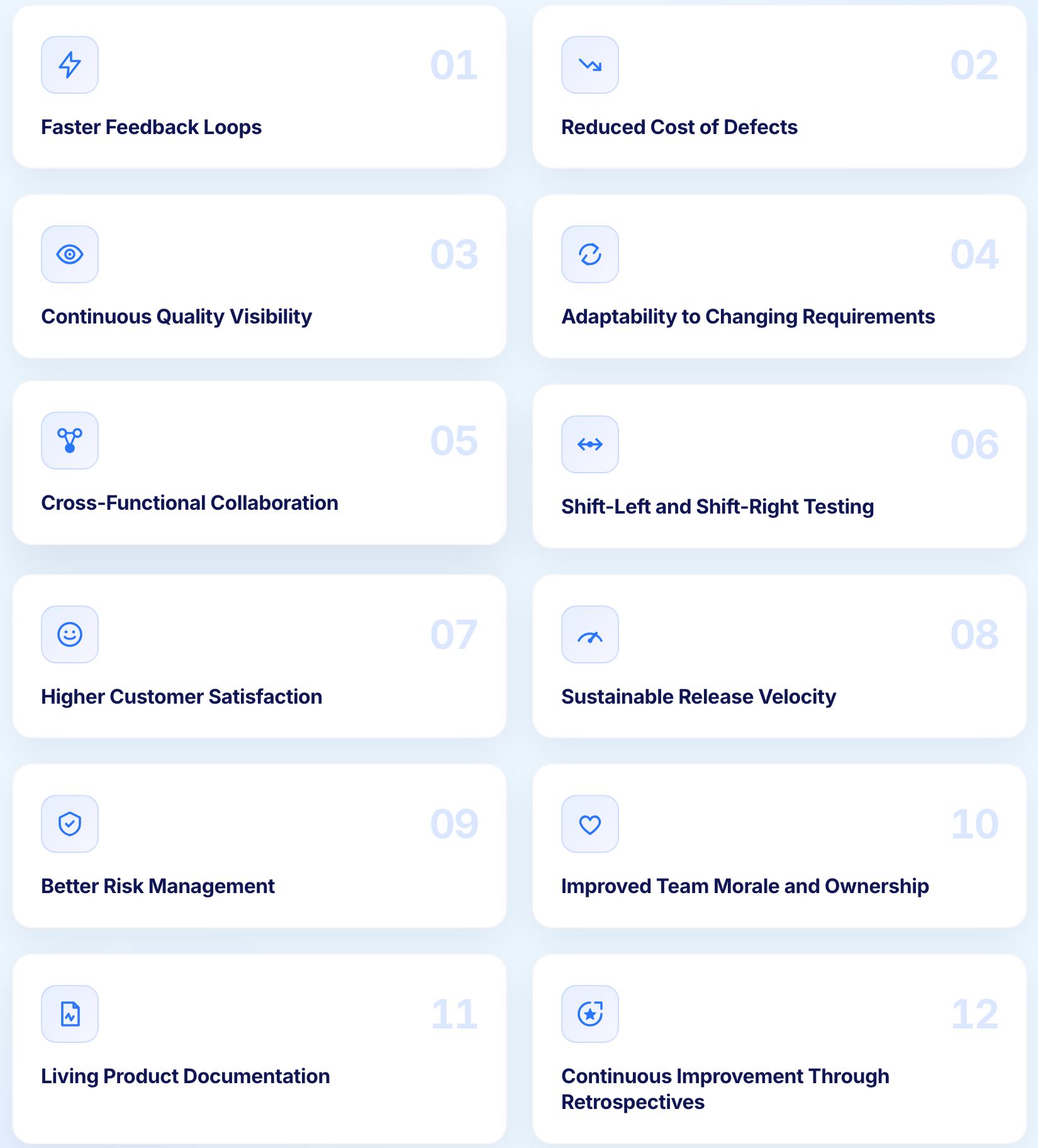
1. Faster Feedback Loops
Defects in Agile environments are detected in minutes or hours, not weeks. A unit test fails on commit. An integration test fails in the pipeline. A user story fails acceptance during the sprint review. Each layer surfaces problems while the developer still has the context to fix them.
The cost of fixing a defect found in production is many times the cost of fixing the same defect found in development. Agile testing collapses that multiplier by moving detection to the point of creation.
2. Reduced Cost of Defects
Decades of empirical research consistently show defect repair costs rising by orders of magnitude as defects move further down the lifecycle. A defect caught at the unit test layer costs minutes to fix. The same defect surfacing in production costs orders of magnitude more once incident response, customer communications, regression risk, and brand impact are factored in.
Agile testing compresses defect detection into the cheapest part of the cost curve.
3. Continuous Quality Visibility
Quality in waterfall environments is opaque until late-cycle test phases produce a verdict. Quality in Agile environments is visible on every dashboard, every commit, and every sprint demo. Stakeholders no longer wait for a quality verdict. The verdict refreshes continuously, and trust in the release decision rises as a consequence.
4. Adaptability to Changing Requirements
User needs, market conditions, and competitive pressure all change during a release cycle. Agile testing accommodates change rather than punishing it. Test artefacts evolve with the user stories that drive them, and the team can pivot mid-cycle without invalidating the work done to date.
Waterfall testing penalises change. Agile testing absorbs it.
5. Cross-Functional Collaboration
Agile testing dissolves the wall between developers and testers. The Three Amigos model, developer, tester, and business analyst, refines stories together, agrees on acceptance criteria, and owns quality jointly. The defects that previously surfaced from misunderstood requirements rarely make it past the conversation stage in mature teams.
6. Shift-Left and Shift-Right Testing
Agile testing extends in both directions simultaneously:
Shift-left moves quality activity earlier: into requirements refinement, design reviews, and developer-authored tests
Shift-right extends it later: into production validation, observability, and feature-flag-driven canary testing
The product is verified at more points across its lifecycle, not fewer.
Refer Shift Left vs Shift Right Testing: Which Strategy Wins for a detailed comparison between shift-left and shift-right testing strategies.
7. Higher Customer Satisfaction Through Frequent Delivery
Frequent, working releases beat infrequent, theoretical perfection. Customers see progress every iteration, provide feedback on real software rather than imagined features, and shape the product as it is built. Agile testing makes frequent release safe. Without it, frequent release becomes frequent regression.
8. Sustainable Release Velocity
Velocity that depends on heroic late-cycle test phases is not sustainable. Velocity that depends on continuous testing, automation coverage, and small batch sizes is sustainable indefinitely. Agile testing is the practice that makes weekly or daily release cadences a normal operational state rather than an exceptional event requiring extraordinary effort.
9. Better Risk Management
Risk in waterfall is concentrated at the end of the cycle, when discovery is most expensive. Risk in Agile is distributed across iterations, surfaced early, and managed continuously. The largest risk in any release is the risk that has not yet been seen. Agile testing changes the visibility curve so risks surface where the team can still respond to them.
10. Improved Team Morale and Ownership
Teams that own quality together perform better than teams that pass work over a wall. Developers understand the tests their code must satisfy. Testers understand the design constraints developers face. Product owners understand the trade-offs both teams navigate. Shared ownership produces shared accountability and a more resilient delivery culture.
11. Documentation That Lives With the Product
Written test plans go stale within weeks of being written. Executable specifications, BDD scenarios, and natural-language test journeys remain valid for as long as the application they verify is running. Agile testing produces living documentation as a natural output rather than a separate maintenance burden.
12. Continuous Improvement Through Retrospectives
Sprint retrospectives create a structural feedback loop that sustained quality programmes need. The team examines what worked, what did not, and what to change. Test practice improves iteratively rather than waiting for an annual quality audit to identify gaps that have already cost releases.
Agile Testing vs Traditional Testing
The comparison is sometimes presented as a binary but the practical distinction is more nuanced. Traditional testing concentrates verification at the end of a long cycle. Agile testing distributes verification across short cycles. Traditional testing treats quality as a phase. Agile testing treats quality as a constant.
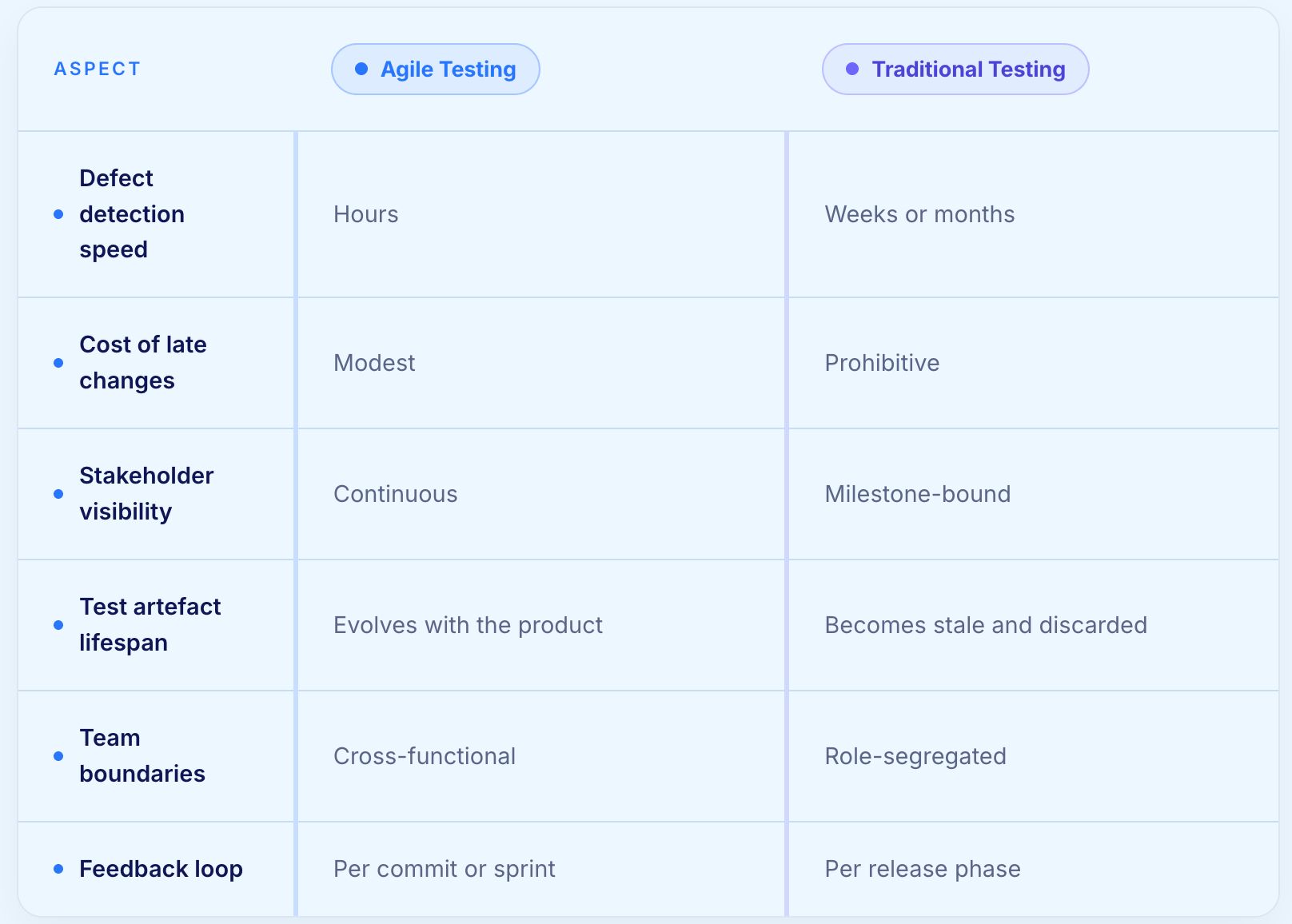
Neither approach is universally superior. Highly regulated environments with formal verification gates retain elements of traditional testing for sound reasons. Most modern software, however, is better served by Agile testing in some form.
Agile Testing in the Age of AI-Generated Code
AI coding assistants have accelerated development by a meaningful multiple in many enterprises. The change has specific implications for every Agile testing advantage.
Faster feedback loops are more valuable than ever because AI assistants generate more code, more variability, and more potential drift between releases. The feedback that used to surface a single defect now surfaces several.
Continuous quality visibility becomes existential rather than reassuring. Stakeholders need confidence that an AI-accelerated release contains AI-accelerated quality, not AI-accelerated incidents.
Adaptability extends from accommodating changing requirements to accommodating changing implementations. AI assistants rewrite functions, refactor across files, and reshape behaviour in ways that brittle test suites cannot survive.
Cross-functional collaboration extends to include the AI itself as a participant in the cycle. Test scenarios increasingly serve as the specification that AI assistants write code against, raising the importance of test artefacts being readable, executable, and maintained.
Continuous validation of customer outcomes, executed at the velocity of AI-accelerated development, is the firewall between AI productivity and AI incidents. Mature Agile testing is the practice that allows that firewall to scale.
How Virtuoso QA Amplifies Every Advantage of Agile Testing
Agile testing produces its full benefit only when the supporting platform sustains the practice across release cycles, refactors, and team turnover. Virtuoso QA is built specifically for that role.
Natural Language Programming for Whole-Team Authoring
Test scenarios written in plain English are accessible to developers, testers, business analysts, and product owners alike. The Three Amigos model becomes practical to operate at the artefact level, not just the conversation level.
GENerator for Sprint-Friendly Test Authoring
GENerator ingests user stories, BDD scenarios, Figma designs, Jira tickets, and legacy test suites from Selenium, Tosca, and TestComplete, and produces full Virtuoso journeys in minutes. Sprint planning that used to defer test creation to later can now author the test suite as the story is refined.
StepIQ for Context-Aware Step Generation
StepIQ surfaces the screens, fields, and behaviours of the live application, producing test steps anchored to current product reality. The drift between specification and implementation that erodes Agile testing in long-running products is closed structurally.
Composable Testing for Sustainable Coverage
Composable testing libraries turn proven scenario fragments into reusable assets. Each new sprint adds to a maintained library rather than rewriting from scratch. The coverage compound effect that mature Agile teams seek is delivered at the platform level.
Self-Healing and AI-Augmented Object Identification
Object identification combines visual analysis, DOM structure, and contextual data. Self-healing operating at approximately 95% accuracy adapts as the application evolves. The maintenance tax that brittle automation imposes on Agile teams collapses, freeing engineering time for new coverage rather than locator updates.
API and Database Validation Within UI Journeys
Combined UI, API, and database validation within a single journey closes the gap between component-level verification and customer-outcome validation. The outcome of every Agile sprint can be tested as the customer will experience it, not as the components will report it.
AI Root Cause Analysis
When a sprint test fails, AI Root Cause Analysis surfaces the precise failure point with logs, network traces, screenshots, and DOM snapshots. The triage cycle that traditionally consumes hours of an Agile sprint compresses to minutes, cutting investigation time by up to 75 percent.
CI/CD Integration
Native integrations with Jenkins, Azure DevOps, GitHub Actions, GitLab, and CircleCI run the test suite on every pipeline event. Failures route to Jira, Xray, or TestRail, and feedback arrives at the speed of the pipeline.
The combined effect is that every advantage of Agile testing, from faster feedback to sustainable velocity to continuous quality visibility, is amplified rather than constrained by the testing platform.

The Future of Agile Testing
Three directions are already reshaping the discipline in the most advanced QA organisations.
Agentic Testing
AI agents will read product analytics, support tickets, and user research, and propose tests that human teams had not enumerated. The practice extends from human-authored test design to human-curated test design. The tester's role shifts from writing scenarios to reviewing and validating the ones AI surfaces.
Risk-Weighted Execution
As regression suites grow, running everything on every commit becomes uneconomical. Change-impact analysis combined with historical failure probability prioritises the tests that matter for a given pull request. Agile testing becomes a cost-optimisation discipline alongside a quality discipline.
The Trust Layer as a Strategic Asset
As AI-accelerated development becomes the norm, Agile testing extends beyond verification of human-written code to continuous validation of AI-coded systems. The advantages compound, and the platform layer that delivers them becomes a strategic investment rather than a tooling line item.
Related Reads
Frequently Asked Questions
How does Agile testing reduce the cost of defects?
Can Agile testing work without automation?
How does Agile testing improve customer satisfaction?
How does Agile testing fit with continuous integration and continuous delivery?
How does Virtuoso QA support Agile testing teams?
Is Agile testing suitable for every type of software?