Blog
Automated Shadow DOM Testing: The AI-Native Approach

Rishabh Kumar
Published on

Table of contents
Lorem ipsum
Lorem ipsum
Lorem ipsum
Lorem ipsum
Lorem ipsum
Modern web applications are built on encapsulation. The Shadow DOM, a core feature of the Web Components standard, allows developers to isolate a component's internal markup, styles, and behavior from the rest of the page. This encapsulation is a tremendous advantage for development. It is a significant problem for test automation.
When traditional testing tools attempt to locate elements inside a Shadow DOM boundary, they fail. Standard CSS selectors return nothing. XPath queries cannot traverse the shadow root. The element exists visually on the page, but programmatically, it is invisible to conventional automation approaches.
This is not a niche concern. Salesforce Lightning Web Components, Angular components, Shopify storefronts, Adobe Experience Manager, and thousands of enterprise web applications now rely on Shadow DOM encapsulation. Any organization running automated tests against these platforms must solve the Shadow DOM testing problem or accept persistent test failures, escalating maintenance costs, and unreliable quality gates.
This guide explains what the Shadow DOM is, why it breaks traditional test automation, how leading frameworks attempt to handle it, and why AI native testing fundamentally changes the equation for enterprise teams.
What is the Shadow DOM and Why Does it Exist
The Shadow DOM is part of the Web Components specification, a set of browser standards that enable developers to create reusable, self contained UI components. It provides a mechanism called encapsulation, where a component's internal Document Object Model (DOM) is hidden from the main page document.
How Shadow DOM Encapsulation Works
When a developer attaches a shadow root to an element, the browser creates a separate DOM subtree for that component. This subtree, known as the shadow tree, is represented as a DocumentFragment. The internal elements, styles, and scripts inside this shadow tree are private. They cannot be accessed through standard DOM querying methods like document.querySelector() or document.getElementById().
This means that CSS styles defined in a parent component do not leak into the shadow tree, and styles inside the shadow tree do not affect the rest of the page. JavaScript running outside the component cannot directly manipulate elements inside the shadow boundary.
Open vs. Closed Shadow DOM
Shadow roots can operate in two modes. An open shadow root allows external JavaScript to access the shadow tree through the element's shadowRoot property. A closed shadow root blocks even this access, returning null when external code attempts to read the shadowRoot property.
Most modern frameworks, including Salesforce Lightning Web Components, use open shadow roots in some form. However, Salesforce's Lightning Web Security (LWS) enforces a closed mode behavior on the ShadowRoot's mode property, adding an additional layer of complexity for testing tools.
Why Developers Use Shadow DOM
The benefits of Shadow DOM for development teams are clear. Component isolation prevents style conflicts in large applications. Teams can develop, test, and ship individual components independently without worrying about naming collisions or unintended side effects. This modularity is essential for enterprise applications where dozens of teams contribute to a single interface.
The challenge emerges when QA teams need to verify the behavior of these encapsulated components through automated tests.
Why Shadow DOM Breaks Traditional Test Automation
Traditional test automation relies on a simple contract: the testing tool traverses the DOM, locates elements using selectors (CSS, XPath, or IDs), and performs actions on those elements. Shadow DOM fundamentally violates this contract.
1. Standard DOM Queries Cannot Reach Shadow Elements
When a test script calls document.querySelector('button.submit') and that button exists inside a shadow tree, the query returns null. The element is rendered on screen and fully functional for the user, but it does not exist in the document's main DOM tree from the perspective of standard querying methods.
This forces test engineers to write multi step traversal logic: first locate the host element, access its shadowRoot property, then query within that shadow tree. For nested shadow roots, where one web component contains another web component, each layer requires separate traversal. In complex enterprise applications, it is common to encounter three, four, or even five levels of nested shadow boundaries.
2. Dynamic Element IDs Compound the Problem
Many frameworks that use Shadow DOM also generate dynamic element identifiers. Salesforce Lightning, for example, produces unique IDs for each session. An element that carries the ID "input-42-label" in one session might become "input-187-label" in the next. Combined with Shadow DOM encapsulation, this creates a situation where neither the locator strategy nor the element identifier remains stable between test runs.
3. Framework Updates Invalidate Locators
Enterprise platforms that rely on web components release frequent updates. Salesforce ships three major platform releases every year (Spring, Summer, and Winter), plus monthly updates for products like Agentforce and Data Cloud. Each release can modify component internals, restructure the DOM tree, change CSS class names, or alter how elements render.
Salesforce is actively migrating its base Lightning components from a synthetic shadow polyfill to native shadow DOM. This transition changes internal DOM structures, breaks CSS combinators that previously worked, and invalidates any test that relies on component internals. The SLDS 2 (Cosmos) design system update compounds these changes by modifying how base components are structured from the inside out.
For teams maintaining traditional Selenium or Cypress test suites against Salesforce, this means dedicated maintenance cycles after every platform release. Organizations report dedicating full time engineering resources solely to post release test repair.
4. iFrames Add Another Encapsulation Layer
Shadow DOM is not the only encapsulation challenge. Many enterprise applications also use iFrames to embed third party functionality or isolate specific modules. Salesforce Lightning, for instance, uses iFrames alongside Shadow DOM in certain contexts. Testing tools must switch contexts to interact across iframe boundaries, and combining iframe traversal with shadow DOM traversal creates deeply nested access patterns that are extremely fragile.

How Enterprise Applications Use Shadow DOM
Shadow DOM is not an academic concern limited to custom web component libraries. It is embedded in the architecture of the most widely deployed enterprise platforms in the world.
Salesforce Lightning Web Components
Salesforce's Lightning Web Components (LWC) framework is built directly on the Web Components standard, including Shadow DOM. Every Lightning component on a Salesforce page encapsulates its internal HTML, CSS, and JavaScript behind a shadow boundary. Elements inside this boundary are not available through traditional DOM queries.
Salesforce's official developer documentation explicitly states that elements in a shadow tree are not accessible via traditional DOM querying methods and that code cannot use document or document.body to access the shadow tree of a Lightning web component.
For end to end UI testing, Salesforce recommends adapting tests for Shadow DOM use and acknowledges that strategies are rapidly evolving. The platform has introduced the UI Test Automation Model (UTAM) as a supported approach, but adoption requires significant investment in page object creation and maintenance.
With over 150,000 Salesforce customers globally and Lightning being the default UI framework, Shadow DOM testing for Salesforce is one of the highest volume automation challenges in enterprise software.
You can check our Guide on Salesforce Lightning Web Components Testing to discover how to tackle shadow DOM, dynamic rendering, and Salesforce updates with AI-native self-healing strategies.
Angular and Other Component Frameworks
Angular uses a concept called View Encapsulation that provides similar isolation benefits. While Angular's default mode (Emulated) does not use native Shadow DOM, applications can enable ShadowDom encapsulation mode, which attaches a native shadow root to component host elements. React does not use Shadow DOM natively, but React applications that incorporate web components (through libraries or design systems) encounter the same testing challenges at those integration boundaries.
Enterprise Web Applications at Scale
Beyond specific frameworks, Shadow DOM appears across enterprise platforms including Adobe Experience Manager (with its component based content architecture), Shopify storefronts (using web components for customizable elements), ServiceNow (with dynamic platform components), and countless custom applications built on modern web component libraries like Lit, Stencil, or the base Web Components APIs.
Any organization testing web applications in 2025 and beyond must treat Shadow DOM testing as a core automation capability, not an edge case.
Traditional Approaches to Shadow DOM Testing
Testing teams have developed several strategies to work with Shadow DOM. Each carries significant tradeoffs in maintainability, scalability, and reliability.
Selenium WebDriver and Shadow DOM
Selenium's relationship with Shadow DOM has been challenging. Prior to Selenium 4, there was no built in support for accessing shadow roots. Teams had to execute custom JavaScript through Selenium's JavaScriptExecutor to pierce shadow boundaries.
A typical Selenium shadow DOM traversal requires code to first find the shadow host element, execute JavaScript to access its shadowRoot property, and then query within that returned shadow root. For nested components, this pattern must be repeated at each level, creating deeply nested, fragile code that breaks whenever the component hierarchy changes.
Selenium 4 introduced the SearchContext interface improvements and the getShadowRoot() method, which simplified single level shadow DOM access. However, nested traversal, dynamic content waiting, and cross browser consistency remain ongoing challenges.
Playwright's Native Shadow DOM Support
Playwright offers the most developer friendly Shadow DOM support among open source frameworks. Its locator engine automatically pierces open shadow roots by default, allowing selectors to reach into shadow trees without explicit traversal code. The css:light selector engine is available for cases where teams need to restrict queries to the light DOM only.
This automatic piercing significantly reduces the code complexity of Shadow DOM testing. However, Playwright still requires teams to write and maintain coded tests, manage selectors, handle dynamic elements, and update tests when platform releases change component structures. Playwright reduces the Shadow DOM boilerplate but does not eliminate the fundamental maintenance burden.
Cypress and Shadow DOM
Cypress added Shadow DOM support through the includeShadowDom configuration option and the shadow() command. When enabled globally, Cypress commands can traverse shadow boundaries. The implementation works for many scenarios but encounters limitations with deeply nested shadows, dynamic rendering patterns, and interactions that require waiting for asynchronous component initialization.
The Common Thread: Maintenance
Regardless of the framework chosen, coded approaches to Shadow DOM testing share a fundamental limitation. They translate the visual intent of a test ("click the Submit button") into a structural implementation ("traverse three shadow boundaries, locate element by dynamically generated class name, wait for async rendering, execute click"). When the structure changes, the implementation breaks, even though the visual intent remains identical.
This structural dependency is why Selenium users spend an estimated 80% of their time on maintenance and only 10% on authoring new tests. Shadow DOM applications amplify this ratio further because every component boundary adds another point of failure in the locator chain.

Why AI Native Testing Changes the Shadow DOM Equation
The core problem with Shadow DOM testing is not the shadow boundary itself. It is the reliance on structural locators to identify and interact with elements. AI native test automation eliminates this dependency entirely.
1. Semantic Element Identification vs. Structural Locators
AI native test platforms identify elements based on what they are and what they do, not where they sit in the DOM hierarchy. Instead of constructing a locator path that traverses shadow boundaries ("find host element > access shadowRoot > query by CSS class > find nested host > access shadowRoot > find button by attribute"), an AI native approach identifies the element through a combination of visual analysis, contextual understanding, DOM structure analysis, and available attributes.
This means the testing platform understands that a "Submit" button is a "Submit" button regardless of whether it exists in the light DOM, behind one shadow root, or nested three levels deep inside encapsulated web components. The shadow boundary becomes transparent to the testing layer.
2. Self Healing Across Platform Releases
When Salesforce ships a platform release that restructures component internals, moves elements between shadow boundaries, or changes CSS class names, traditional tests break immediately. AI native self healing adapts to these changes automatically by re identifying elements through their semantic characteristics rather than their structural position.
Virtuoso QA delivers approximately 95% self healing accuracy across UI changes. For Salesforce environments where three major releases per year plus monthly updates create constant structural churn, this capability transforms testing economics. Teams that previously dedicated weeks to post release test repair can redirect that effort toward expanding coverage and validating new business functionality.
3. Natural Language Programming Eliminates Selector Complexity
With Natural Language Programming, test authors describe Shadow DOM interactions in plain English without any awareness of the underlying encapsulation structure.
A test step like "Navigate to the Accounts tab" works identically whether the Accounts tab exists in the light DOM, inside a Lightning Web Component shadow tree, or nested within multiple encapsulated components. The AI platform interprets the intent and resolves element identification transparently.
This has a profound impact on who can create and maintain Shadow DOM tests. Instead of requiring SDETs with deep knowledge of shadow root traversal, any QA practitioner can author robust tests against complex web component architectures.
4. Live Authoring for Complex Web Components
Virtuoso QA's Live Authoring capability enables test authors to build tests interactively against the live application, receiving real time feedback as each step is created. When working with Shadow DOM heavy applications like Salesforce Lightning, this means the platform handles shadow boundary traversal in real time during authoring, eliminating the painful write, run, debug, repeat cycle that characterizes coded Shadow DOM testing.
Building a Shadow DOM Testing Strategy for Enterprise Applications
Effective Shadow DOM testing requires a strategic approach that accounts for both current complexity and future architectural evolution.
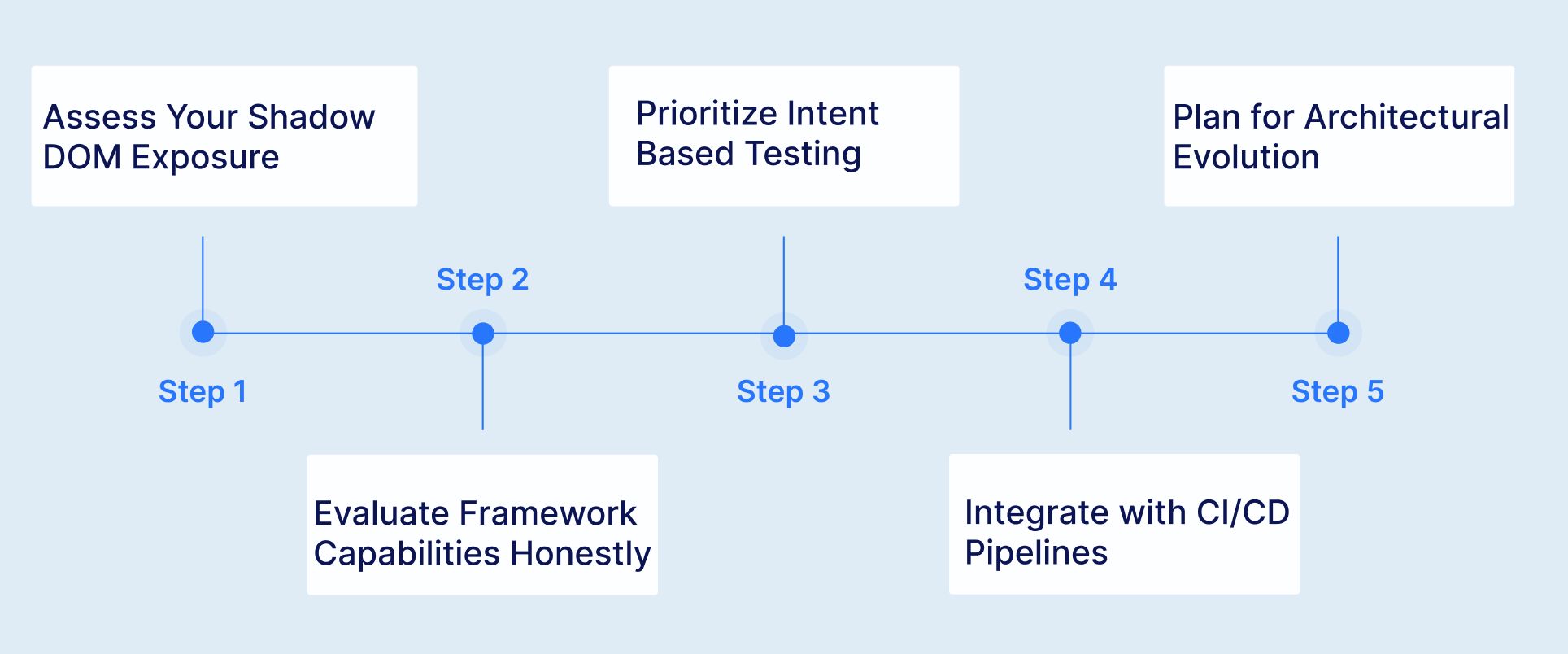
1. Assess Your Shadow DOM Exposure
Begin by auditing your application portfolio for Shadow DOM usage. Any application built on Salesforce Lightning, Angular with ShadowDom encapsulation, modern web component libraries, or enterprise platforms like ServiceNow, Adobe AEM, or Dynamics 365 likely contains Shadow DOM boundaries that affect test automation.
The depth and frequency of shadow nesting directly impacts automation complexity. Applications with shallow, stable shadow structures may tolerate coded approaches. Applications with deep nesting, dynamic rendering, and frequent platform updates require a fundamentally different approach.
2. Evaluate Framework Capabilities Honestly
If your current framework requires custom JavaScript to traverse shadow boundaries, generates fragile multi step locator chains, or demands significant maintenance after every platform release, the total cost of ownership is likely much higher than it appears. Research consistently shows that 73% of test automation projects fail, and Shadow DOM complexity is an increasingly common contributor to that failure rate.
3. Prioritize Intent Based Testing
The most resilient approach to Shadow DOM testing is to remove structural dependencies entirely. Tests that express intent ("click the Login button") rather than structure ("traverse shadowRoot of element with tag x-login-form, find button element with class btn-primary") survive component restructuring, shadow boundary changes, and platform updates.
This intent based approach aligns naturally with AI native testing platforms that use semantic understanding to identify and interact with elements regardless of their encapsulation context.
4. Integrate with CI/CD Pipelines
Shadow DOM tests must run reliably in automated pipelines, not just in manual execution. Ensure your testing approach integrates with your CI/CD toolchain. Virtuoso QA connects directly with Jenkins, Azure DevOps, GitHub Actions, GitLab, CircleCI, and Bamboo, enabling Shadow DOM tests to execute as automated quality gates within continuous delivery workflows.
5. Plan for Architectural Evolution
Web component standards continue to evolve. Salesforce is actively transitioning from synthetic shadow to native shadow DOM. Browser vendors are enhancing shadow DOM APIs. New frameworks adopt web components at increasing rates. Your testing strategy should be resilient to these changes rather than dependent on the current state of any single standard or framework.
The Future of Shadow DOM and Web Component Testing
The trajectory of web development points toward more encapsulation, not less. Web components are becoming the standard building block for enterprise UI development across platforms and frameworks.
Increasing Adoption of Web Components
As browser support for web components reaches full maturity across Chrome, Firefox, Safari, and Edge, adoption is accelerating. Enterprise platform vendors are consolidating on web component standards for portability and interoperability. This means Shadow DOM testing will grow from a specialized concern to a universal requirement for QA teams.
AI Native Testing as the Standard
The complexity of modern web architectures, including Shadow DOM, dynamic rendering, single page applications, and micro frontends, increasingly exceeds what manual locator management can sustain. AI native testing platforms that understand element semantics rather than element structure represent the inevitable evolution of test automation.
Organizations that adopt this approach today gain immediate advantages in maintenance reduction, test stability, and team productivity. Organizations that wait will face compounding technical debt as web applications grow more complex with each passing release.
The Convergence of LLMs and Testing Intelligence
Large language models are enhancing every layer of the testing lifecycle, from test generation and maintenance to root cause analysis and intelligent reporting. In the context of Shadow DOM testing, LLMs enable natural language test authoring that abstracts away encapsulation complexity entirely, making advanced web component testing accessible to the entire QA organization rather than a handful of specialized automation engineers.
Virtuoso QA integrates generative AI with LLMs to create low code natural language extensions, enabling teams to express complex Shadow DOM interactions in plain English while the AI platform handles the technical traversal, element identification, and self healing transparently.
Conclusion
Shadow DOM testing is no longer an edge case. It is a central challenge for any organization automating tests against modern enterprise web applications. The encapsulation that makes web components powerful for developers creates significant obstacles for traditional test automation approaches.
Coded frameworks offer workarounds, but they impose escalating maintenance costs that grow with every platform release, every new component, and every layer of nesting. The fundamental architecture of locator based testing is incompatible with the architectural direction of modern web development.
AI native testing resolves this incompatibility by eliminating the dependency on structural locators entirely. Semantic element identification, self healing adaptation, and natural language test authoring make Shadow DOM boundaries transparent to the testing layer. The result is test suites that survive platform releases, scale across complex applications, and remain maintainable by QA teams without specialized web component expertise.
For enterprise organizations running critical business processes on Salesforce, Angular, or any modern web component architecture, the choice is clear: invest continuously in fighting encapsulation boundaries, or adopt an approach that renders those boundaries irrelevant.

Related Reads
Frequently Asked Questions
Why can't Selenium find elements inside the Shadow DOM?
How does Playwright handle Shadow DOM differently from Selenium?
What makes Salesforce Lightning Web Components especially difficult to test?
What is the difference between open and closed Shadow DOM?
How does AI native testing solve Shadow DOM challenges?
What is the self healing accuracy rate for Shadow DOM tests?