

Blog
Decision Table Testing: Guide with Examples, Types, and Best Practices
.png)
Published on
March 3, 2026

Learn decision table testing to ensure complete coverage of input combinations. Covers types, step-by-step creation, industry examples, and AI automation.
Every software system makes decisions. A login form decides whether to grant access or deny it. A pricing engine decides which discount to apply. An insurance underwriting system decides whether to approve a policy, refer it for manual review, or reject it outright. The more complex the system, the more decisions it makes, and the more critical it becomes to test every possible combination of inputs that drives those decisions.
Decision table testing is the black box test design technique built precisely for this challenge. It organizes conditions, actions, and rules into a structured tabular format that ensures complete coverage of input combinations without redundancy, guesswork, or missed scenarios.
This guide covers what decision table testing is, how it works, its key components and types, detailed examples across multiple industries, its advantages and limitations, best practices for enterprise QA teams, and how AI is transforming decision table testing from a manual exercise into an automated, scalable capability.
Decision table testing is a black box testing technique that represents the relationship between input conditions and expected system actions in a structured table. Each column in the table defines a rule: a unique combination of input conditions and the corresponding action the system should take.
The purpose is simple but powerful. Complex business logic often involves multiple conditions that interact with each other. A single condition might have two or three possible values. When three conditions each have two possible values, there are eight possible combinations. When five conditions each have three values, there are 243 combinations. Manually tracking these combinations leads to missed scenarios, redundant tests, and gaps in coverage.
A decision table eliminates this problem by systematically enumerating every valid combination, assigning the expected action for each, and converting each column into a test case. The result is complete, structured, and traceable test coverage for any system driven by conditional business logic.
Every decision table consists of four core components that work together to map inputs to outcomes.
Conditions are the input variables that influence the system's behavior. Each condition represents a factor that the system evaluates when making a decision. In a loan approval system, conditions might include credit score, annual income, and employment status. In an e-commerce checkout, conditions might include payment method, shipping address validity, and coupon code applicability.
Each condition has a defined set of possible values. For binary conditions, these are typically True or False (sometimes represented as Y or N). For multi-valued conditions, these might be categories like High, Medium, or Low, or specific ranges like "income above $50,000" versus "income below $50,000."
Actions are the system's expected responses when a particular combination of conditions is met. Actions represent what the system does, not what it evaluates. In the loan approval example, actions might include "approve loan," "reject loan," or "refer to manual underwriting." In the e-commerce example, actions might include "process payment," "display error message," or "apply discount."
Rules are the columns of the decision table. Each rule defines one specific combination of condition values and the corresponding action or actions the system should execute. If a decision table has three binary conditions, the table will have up to eight rules (2^3), with each rule representing a unique test case.
Condition alternatives are the specific values assigned to each condition within a rule. Action entries indicate which actions are triggered (or not triggered) for each rule. Together, they populate the body of the table and define the complete decision logic under test.
Decision tables come in several forms, each suited to different levels of complexity. Choosing the right type depends on the nature of the system's decision logic and the number of conditions involved.
A limited decision table restricts condition values to binary states: True/False or Yes/No. This is the simplest form and works well for systems with straightforward, independent conditions.
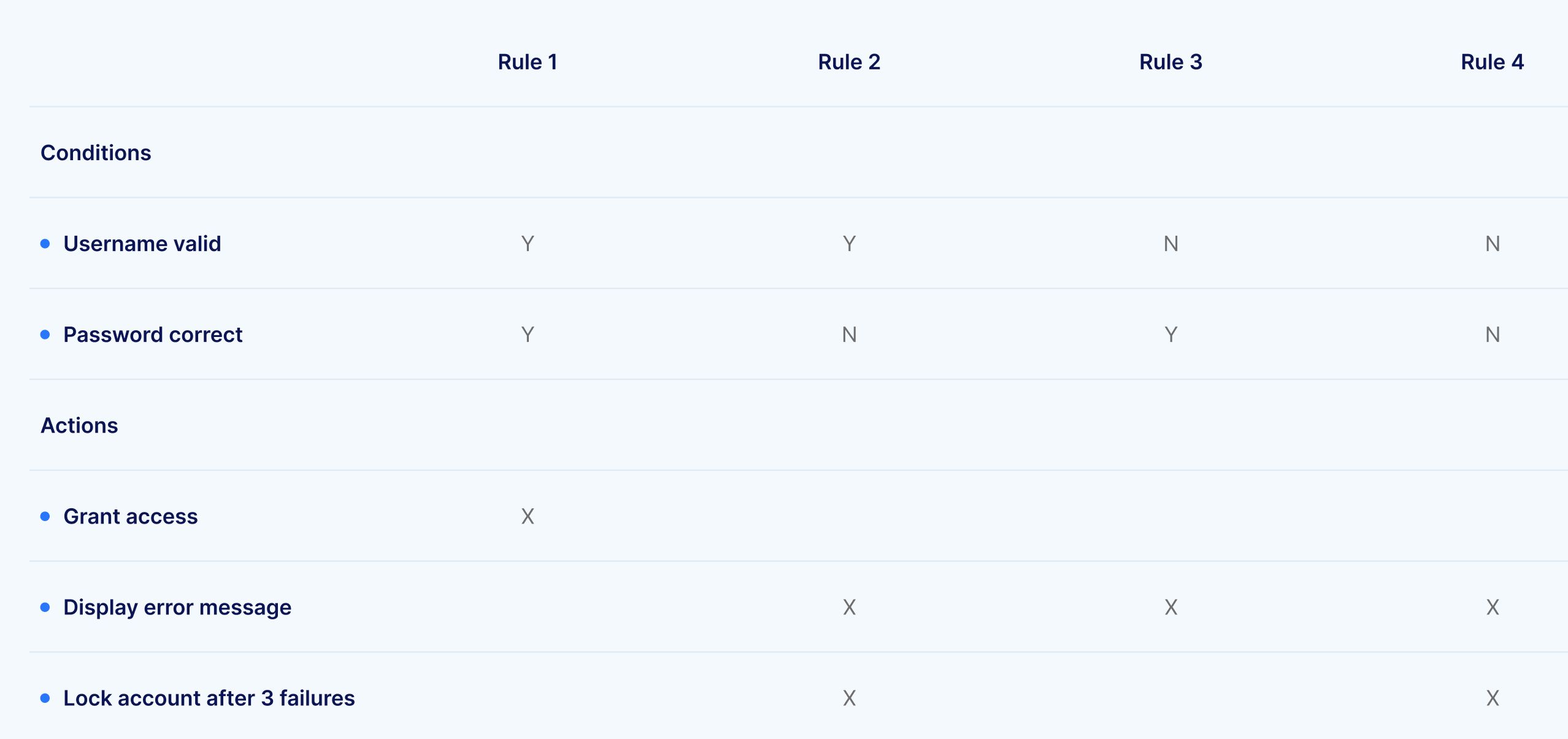
This table produces four test cases covering every combination of username and password validity. Each column is a distinct test scenario with a clearly defined expected outcome.
An extended decision table allows conditions to have multiple values beyond binary. This is essential for systems where inputs are categorical or range-based.
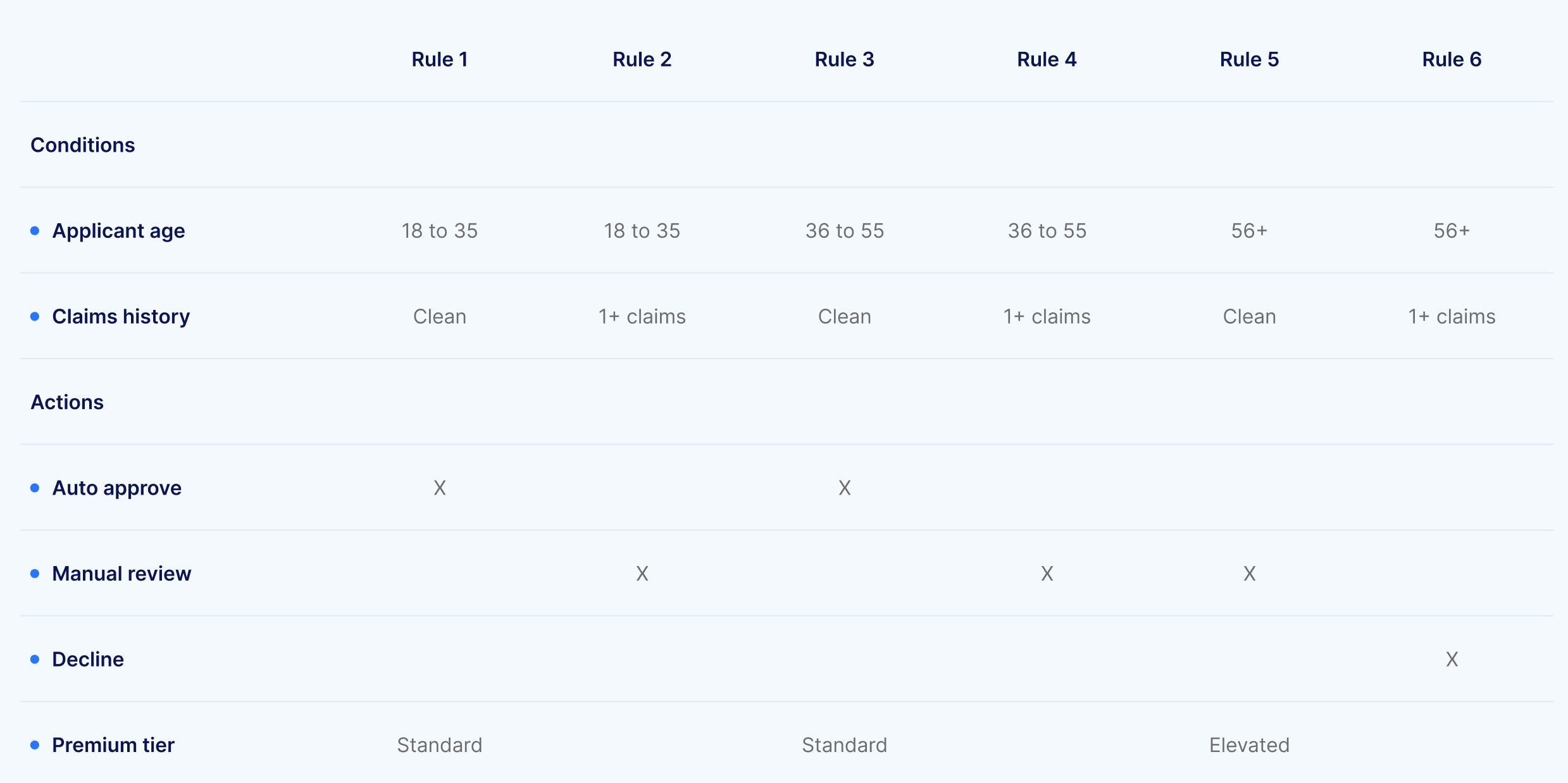
This table captures the nuanced underwriting logic that insurance companies use daily. An applicant aged 56 or older with a clean claims history gets approved but at an elevated premium tier, while the same age group with prior claims is declined outright.
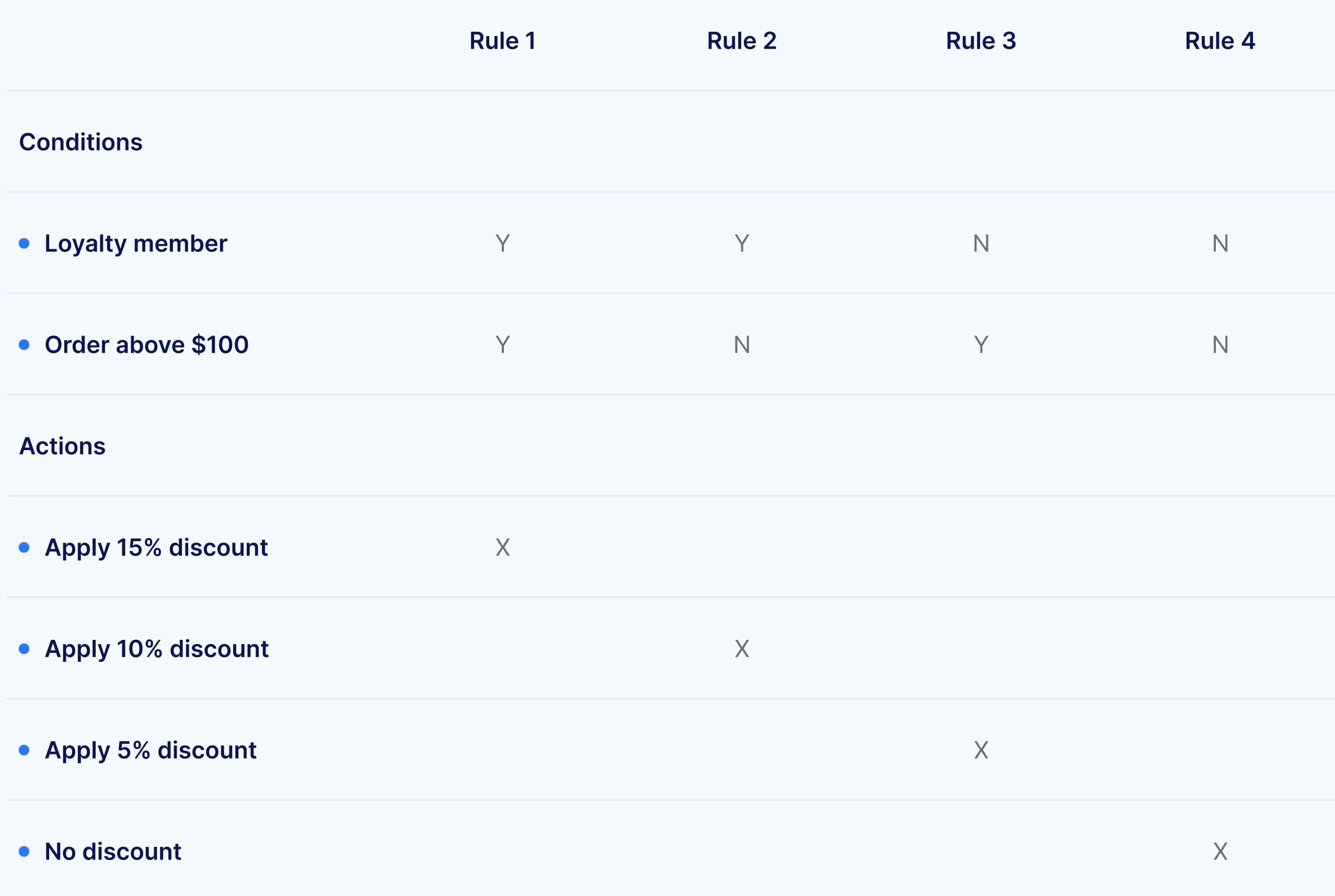
A condition action table maps each condition directly to a specific outcome, making it particularly useful when the relationship between inputs and outputs is clear and one to one.
Example: E-commerce Discount Engine
A switch table applies when a single controlling condition determines the outcome through multiple branches. It simplifies decision logic into a lookup structure.
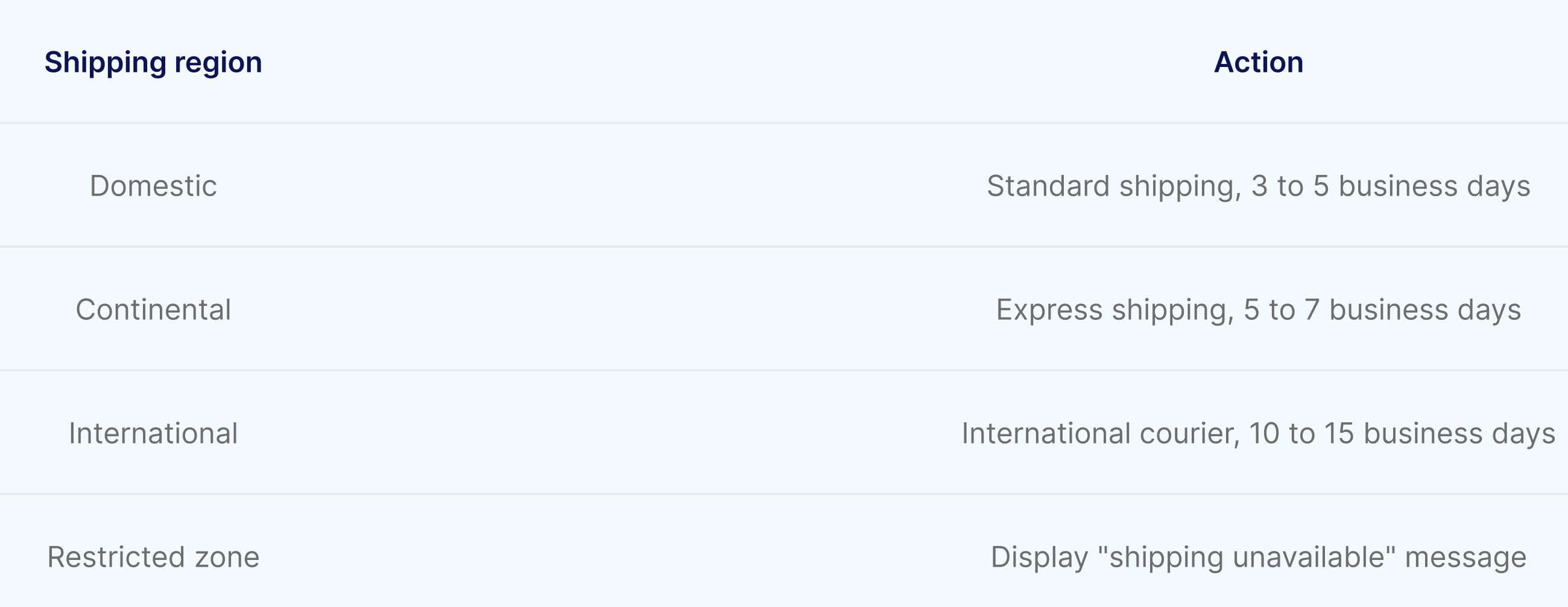
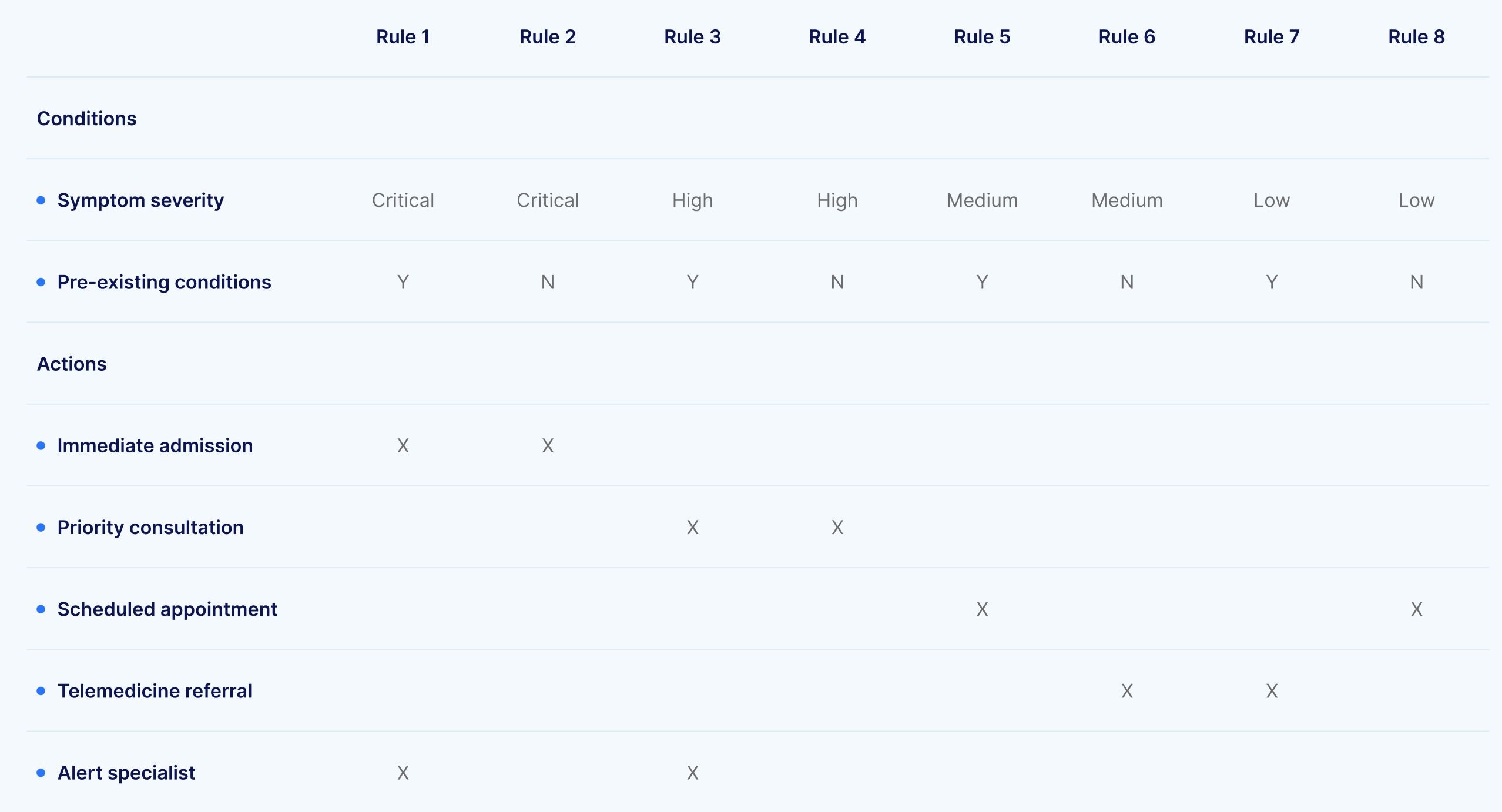
Rule based decision tables combine multiple interacting conditions to handle complex, layered business logic. They are the most comprehensive form and are commonly used in financial services, healthcare, and insurance systems where regulatory compliance demands complete traceability.
This table ensures that a patient presenting with critical symptoms and pre-existing conditions receives both immediate admission and a specialist alert, while a patient with low severity and no pre-existing conditions is routed to a telemedicine consultation. Every pathway is explicitly defined and testable.
Building a decision table follows a systematic process that converts business logic into testable rules.
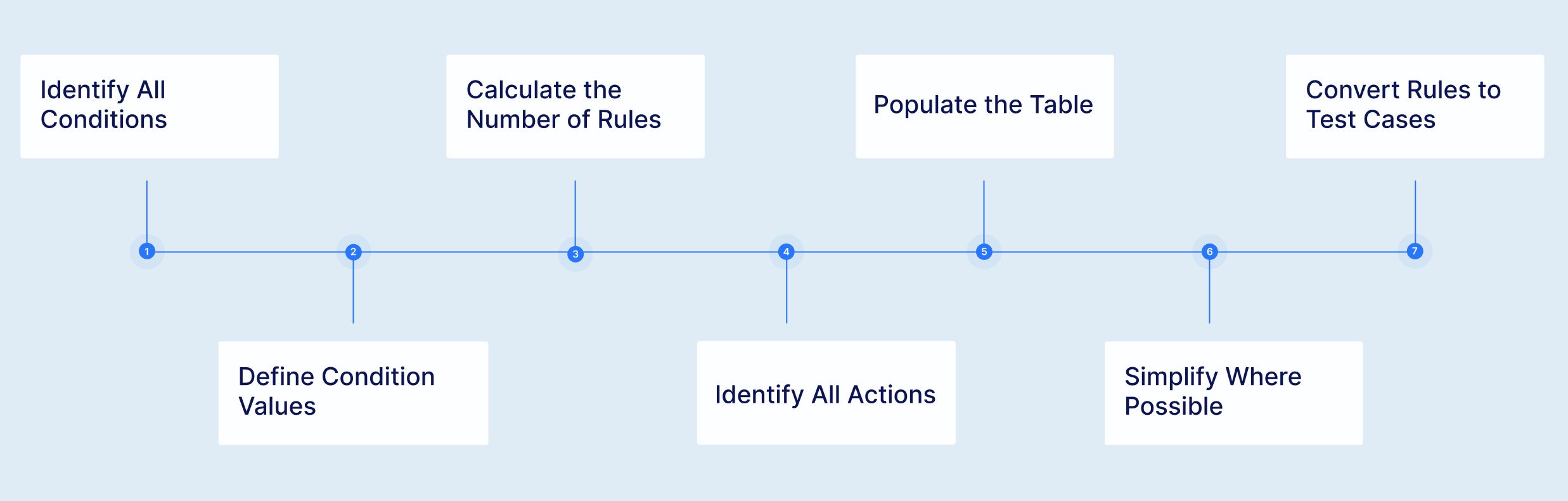
Start by listing every input condition that influences the system's decision. Review requirements documents, user stories, and business rules to ensure completeness. For an enterprise loan origination system, conditions might include credit score range, debt to income ratio, employment verification status, and loan amount requested.
For each condition, define the complete set of possible values. Binary conditions have two values. Multi-valued conditions might have three, four, or more. Be precise: "credit score above 700" is testable; "good credit score" is not.
For a limited decision table with binary conditions, the number of rules equals 2^n, where n is the number of conditions. For extended tables, multiply the number of values for each condition. Three conditions with 2, 3, and 2 values respectively produce 2 × 3 × 2 = 12 rules.
List every possible action the system can take. Include both positive outcomes (approve, process, route) and negative outcomes (reject, display error, escalate). Include compound actions where the system performs multiple responses for a single rule.
Fill in the condition alternatives for each rule, ensuring every unique combination is represented. Then assign the correct action or actions for each rule based on the business logic.
Some conditions may be irrelevant for certain rules. If the outcome is the same regardless of a condition's value, that condition can be marked as "don't care" (often represented with a dash) for those rules.
This reduces redundancy without sacrificing coverage. The same collapsing logic is what makes the difference between a decision table and a decision tree worth understanding, since the two represent the same rules in different shapes
Each column (rule) becomes one test case. Define the specific test data, expected results, and preconditions for each. This traceability from business rule to test case is one of decision table testing's greatest strengths.
Traditional decision table testing is manual and time consuming. QA teams build tables by hand, populate them from requirements documents, and convert each rule into test cases individually. As the number of conditions grows, the table size grows exponentially, and maintenance becomes a significant burden.
AI is transforming this process in three fundamental ways.
Large language models (LLMs) and natural language processing (NLP) can analyze requirements documents, user stories, and business rules to automatically identify conditions, actions, and rules. Instead of a QA analyst spending hours manually extracting decision logic, AI can parse a requirements document and produce a complete decision table in minutes.
Virtuoso QA's GENerator takes this further by converting requirements inputs, including BDD/Gherkin specifications and business process documentation, into fully executable test journeys. The decision logic embedded in requirements is not just tabulated but operationalized into tests that run autonomously.
Decision tables are inherently data driven. Each rule represents a unique data combination that must be tested. AI native test platforms excel at this because they support parameterization with external data sources including CSV files, APIs, and databases.
Virtuoso QA's data driven testing capabilities allow teams to load decision table data directly into test journeys. Each row of the table drives a test execution with its specific combination of inputs, and results are captured, analyzed, and reported automatically. Combined with AI test data generation, teams can produce realistic, compliant synthetic data for every rule without manual effort.
Business rules change. Regulations evolve. Product logic updates. When the underlying decision logic changes, every affected test case must be updated. In traditional automation, this is manual, error prone, and slow.
AI native platforms with self healing capabilities adapt automatically. When the application's behavior changes to reflect updated business rules, the AI detects the change, updates the affected test steps, and flags any discrepancies for review. Virtuoso QA achieves approximately 95% accuracy in self healing, ensuring that decision table tests remain current without manual maintenance.
The most advanced application of AI in decision table testing is autonomous test case generation. Rather than building tables manually, AI analyzes the application under test, identifies the decision points, maps the conditions and actions, and generates test cases that cover the complete decision space.
Virtuoso's StepIQ feature analyzes the application and auto generates test steps based on UI elements, application context, and user behavior patterns. When combined with data driven parameterization, this creates a system where decision table tests are generated, parameterized, executed, and maintained with minimal human involvement.

Decision table testing delivers several measurable advantages for QA teams working with complex business logic.
Every valid combination of conditions is explicitly represented in the table, eliminating the risk of missed scenarios. This is particularly important for regulated industries where untested decision paths represent compliance risk.
Each rule in the table maps directly to a business requirement and a test case. This traceability simplifies audit processes and provides clear evidence of test coverage.
Systems with five or more interacting conditions produce hundreds of possible combinations. Decision tables organize this complexity into a visual, manageable format that both technical and business stakeholders can review and validate.
Decision tables serve as a shared reference between business analysts, developers, and testers. When the table is agreed upon, everyone understands exactly what behavior the system should exhibit for every input combination.
The tabular, rule based structure of decision tables translates directly into data driven automated tests. Each rule becomes a parameterized test case, making decision tables one of the most automation friendly test design techniques available.
Decision tables are powerful but not universally applicable. Understanding their limitations ensures appropriate use.
A system with 10 binary conditions produces 1,024 rules. With multi-valued conditions, the number grows even faster. Large tables become difficult to create, review, and maintain without tool support or optimization techniques.
Decision tables work best with discrete, categorical inputs. Conditions involving continuous ranges (temperature, price, time) require equivalence partitioning or boundary value analysis to reduce values to testable categories before a decision table can be applied.
Standard decision tables assume conditions are independent. When the value of one condition constrains the possible values of another (for example, if "account type = savings" limits "overdraft eligibility" to "no"), the table may include invalid combinations that must be identified and removed.
When business rules change frequently, decision tables require constant updates. Without AI powered maintenance, this overhead can become a bottleneck, particularly for large enterprise systems with hundreds of decision points.
These practices maximize the effectiveness of decision table testing in enterprise QA environments.
Decision tables should be derived from documented business rules and requirements, not from observing the application's interface. This ensures the table tests intended behavior, not incidental behavior.
For conditions with continuous ranges, use equivalence partitioning to reduce the range to representative categories. Then build the table using those categories. This prevents the table from growing unmanageably large while maintaining meaningful coverage.
After building the decision table, supplement it with boundary value analysis for any condition that involves a range. If a condition threshold is "income above $50,000," test at $49,999, $50,000, and $50,001. Boundaries are where defects cluster.
Review the completed table for rules that represent logically impossible combinations of conditions. Remove or mark them to avoid wasting test execution time on invalid scenarios.
Convert the decision table into a data source (CSV, database, or API) and feed it into an automation platform that supports parameterized execution. This transforms the table from a planning document into an executable test suite.
For enterprise systems with complex, evolving business logic, manual decision table management does not scale. AI native platforms that generate test cases from requirements, parameterize execution from data sources, and self heal when logic changes are the only sustainable path for organizations managing hundreds or thousands of decision rules.
Decision table testing in its traditional form is a design technique. It produces a table on paper or in a spreadsheet. The challenge for enterprise teams is converting that table into automated tests that run reliably, maintain themselves, and scale across complex business systems.
Virtuoso QA bridges this gap through an AI native architecture that operationalizes decision logic from design to execution.
The result is decision table testing that is not just designed but operational: generated from requirements, parameterized from data, executed across 2000+ browser and device combinations, maintained by AI, and analyzed for root cause automatically.


Try Virtuoso QA in Action
See how Virtuoso QA transforms plain English into fully executable tests within seconds.
