Blog
Loop Testing: The Four Types and How to Test Them

Abhilash
Published on

Table of contents
Lorem ipsum
Lorem ipsum
Lorem ipsum
Lorem ipsum
Lorem ipsum
Loops are where programs do their hardest work, and they are also where the most expensive defects hide, namely off-by-one errors, infinite iteration paths, boundary conditions that fail on the millionth pass, and termination logic that breaks silently under load.
Loop testing is the white-box technique purpose-built for this risk surface, and the discipline has not aged with the rise of AI-assisted coding. If anything it has become more important, because code-generation tools now produce loop code faster than it can be carefully reviewed.
This guide covers the four loop types, the seven-condition test set for simple loops, worked code examples, the combinatorial problem in nested loops, how loop testing complements statement and branch coverage, the AI-era failure modes, and the discipline that separates deliberate loop testing from coverage chasing.
The Quiet Power of Loops
Open any production codebase and watch where the work happens. Database iterations, transformation pipelines, retry mechanisms, batch processors, infinite-scroll implementations, payment reconciliation runs. Loops carry the load, and they are also the constructs most likely to fail in ways that are difficult to detect, expensive to fix, and impossible to reproduce from production logs.
Loop testing is the white-box discipline that addresses this risk directly. Where statement coverage tells you a line ran, and branch coverage tells you a decision was taken, loop testing evaluates the loop across selected boundary, representative, and risk-significant iteration conditions, which coverage tools do not target.
Related Read: Statement Coverage vs Branch Coverage - Why 100% Can Still Ship a Bug
What Loop Testing Means in Practice
Loop testing is a structural white-box technique discussed in the classic path-testing literature, including Boris Beizer's "Software Testing Techniques," and subsequently adopted into mainstream software-engineering guidance. It has been refined across decades of practitioner work since.
The intent has not changed, which is to subject every loop to a deliberate set of conditions designed to surface its failure modes before production does.
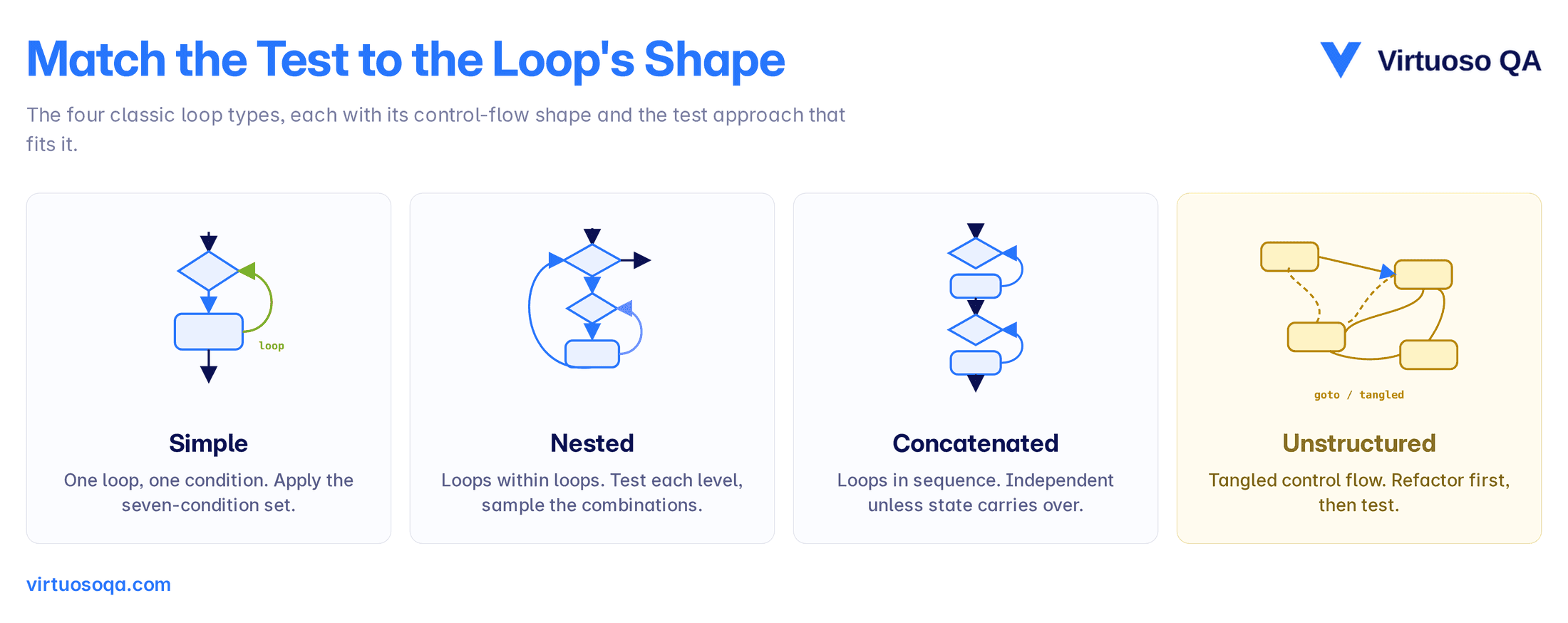
Four loop categories define the discipline.
Simple loops.
Nested loops.
Concatenated loops.
Unstructured loops
Each category carries a defined test design strategy. The strategies overlap, but each surfaces different classes of defect, and treating them as interchangeable, which most beginner content does, is exactly how loop defects survive into production.
Why Loops Are Still Where Production Bugs Hide
A pattern many teams recognise from experience is that loops account for a notable share of high-severity bugs relative to the code they occupy. Several reasons compound.
Loops carry state across iterations, so a defect on the seventeenth pass does not look like a defect on the first.
Termination conditions are usually written once and tested once, even when the loop will run a very large number of times in production.
Boundary behaviour at the loop edges, namely zero iterations, one iteration, and the maximum iteration, is rarely covered by happy-path tests.
Nested loops multiply paths combinatorially, and the test budget rarely keeps pace.
Performance pathologies hide inside otherwise correct loops, surfacing only at scale.
The pattern repeats across organisations. A loop ships, the loop appears correct, and the loop fails later, often at an awkward hour, in a way that takes a senior engineer real effort to diagnose.
The discipline of loop testing exists because the alternative is exactly that. Loop bugs tend to cluster at the boundaries, which is precisely where the deliberate test design of loop testing concentrates.
The Four Loop Types and How to Test Them
The technique rests on understanding which loop is in front of you and matching the test design to its shape. The next four sections take each loop type in turn.
1. Simple Loops
A simple loop is a single iteration construct that contains no other loop within its body. For, while, do-while, and foreach constructs can all be simple loops when they are not nested.
The classic boundary set for a simple loop that can run from zero to n iterations covers seven conditions.
Skip the loop entirely, meaning zero iterations.
Run the loop once.
Run the loop twice.
Run the loop m times, where m is a typical value less than the maximum.
Run the loop n minus one times.
Run the loop n times, meaning the maximum iterations.
Provide an input that would require n plus one iterations, and verify the specified over-limit behaviour, such as rejection before processing.
For post-test loops such as do-while, zero iterations may be infeasible, because the body executes before the condition is evaluated, so one iteration is the structural minimum and the set adjusts accordingly. More generally, for a loop with a minimum of min and a maximum of max, the boundary set becomes min minus one where that is a valid invalid-input test, then min, min plus one, a typical value, max minus one, max, and max plus one.
The reasoning is direct. Zero iterations test the skip path, one iteration tests entry and exit, two iterations test the transition behaviour between successive passes, a middle value tests typical operation, and the maximum and the values surrounding it test the boundary where most loop bugs concentrate.
Most production loop bugs cluster at the boundaries, namely the loop that runs once too many times, the loop that exits one short of expectation, and the loop that fails when the input collection is empty, and the classic simple-loop boundary set was built to catch exactly these.
One extension is worth knowing. Where the loop has a minimum iteration count greater than zero, or has excluded values it should never take, the set expands to probe those too, namely one below the minimum, the minimum itself, and any value the loop is specified to exclude.
The principle is unchanged, which is to test every boundary the loop's specification implies, not only the obvious zero-to-maximum range.
A Worked Example of a Simple Loop
Consider a loop that iterates over a list of pending insurance claims and applies a fraud-scoring function to each, where the maximum supported batch is one hundred claims.
The classic simple-loop boundary set produces seven concrete test conditions for this loop.
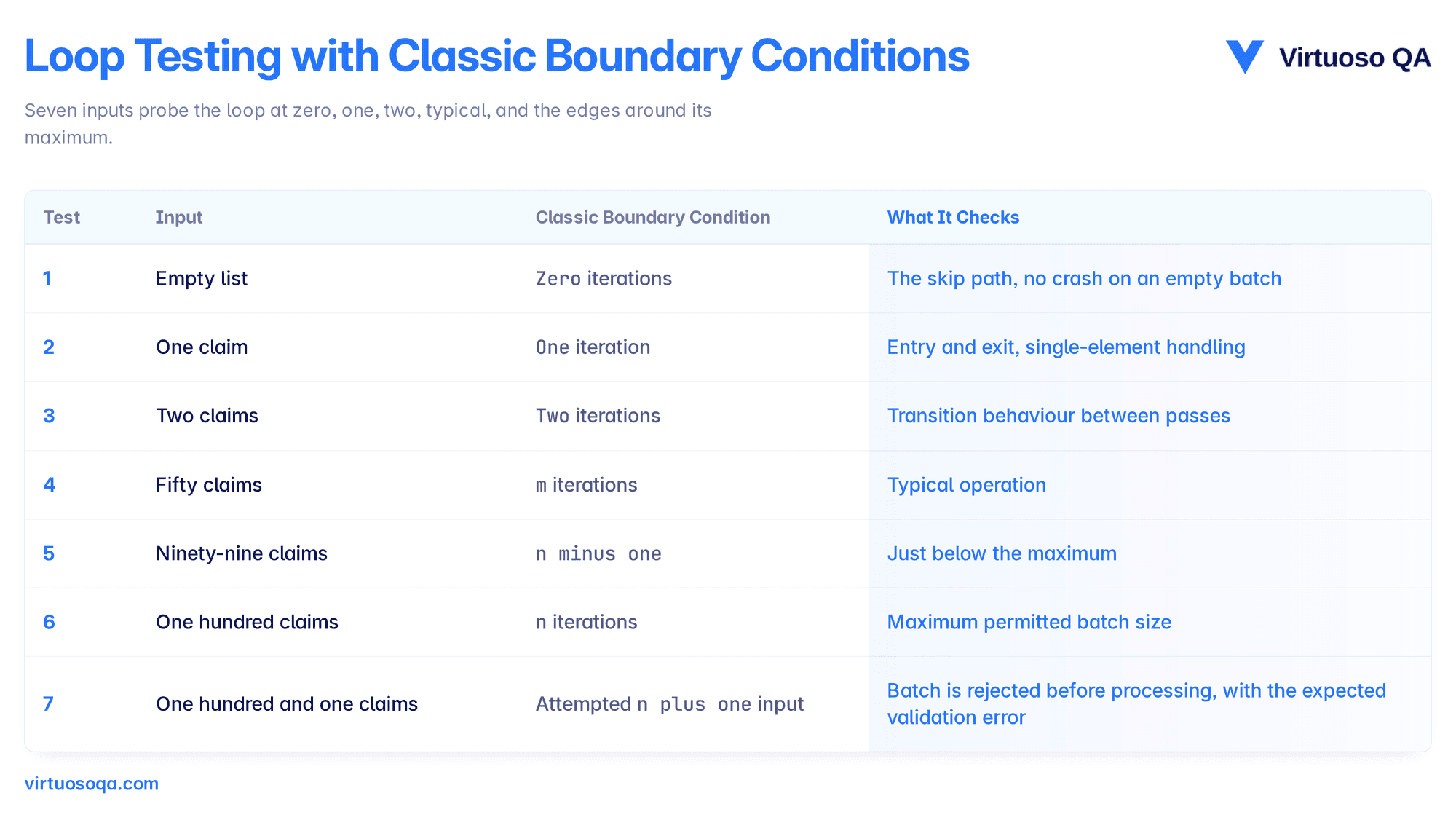
Each test verifies that the loop entered, exited, and produced the correct state for the claims it processed. The discipline is not in the volume of tests but in the deliberateness of each one, since test 1 catches the empty-input crash, test 6 catches the off-by-one at the maximum, and test 7 verifies the explicitly defined behaviour for an oversized batch, namely rejection without partial processing.
2. Nested Loops
A nested loop contains one or more loops inside another loop, and combinatorial explosion is the central problem. A loop running n times inside a loop running m times produces n times m iterations, and combining the full simple-loop boundary set across every level produces a test count that quickly becomes unworkable.
The scale of the problem is concrete. The classic checklist has five categories but seven concrete iteration conditions, and combining every concrete condition across nesting levels grows exponentially, reaching forty-nine combinations for two levels and three hundred and forty-three for three. Testing every combination quickly becomes impractical, which is why the classic approach tests each level in turn rather than exhaustively.
The pragmatic strategy reduces the combinatorial cost without surrendering coverage.
Start with the innermost loop, holding all outer loops at their minimum iteration counts.
Test the innermost loop at its minimum plus one, a representative value, maximum minus one, and maximum while holding all outer loops at their minimum iteration counts.
Move outward one level at a time, holding the remaining loops at representative values.
Continue until every level has been exercised.
As a modern risk-based extension, add a small number of fully loaded tests where all loops run at typical or maximum values together, to sample the interaction effects the level-by-level approach does not exhaust. This is a supplemental risk-based step rather than part of the classic procedure.
The discipline trades exhaustive coverage for risk-weighted coverage. Boundary bugs at each nesting level are caught, and the interaction effects that occur only under heavy combined load are sampled rather than exhausted.
When exhaustive testing is impractical, use requirements, domain constraints, data models, and production usage patterns to identify genuinely infeasible combinations and document why they are excluded.
3. Concatenated Loops
Concatenated loops are two or more loops placed sequentially within the same function or block, and they are tested as independent simple loops when the loops are truly independent of one another. Independence is the qualifier that matters most, since two loops are independent when the iteration count or behaviour of the second does not depend on state left by the first.
If the loops are dependent, with the second reading variables modified by the first, the construct must be tested as if it were nested, with explicit awareness of how state propagates between them.
Mistreating dependent concatenated loops as independent is one of the more common loop-testing errors in industry, and the bug pattern is distinctive. The first loop completes within bounds, the second loop completes within bounds, but the state handoff between them silently corrupts the result, which no test of either loop in isolation would ever catch.
4. Unstructured Loops
Unstructured loops contain irregular control flow, such as jumps into or out of the loop, multiple entry points, tangled goto-based paths, or termination logic shared across unrelated control-flow regions, and code reviewers and architects work to eliminate them before merge. A conventional break or continue does not by itself make a loop unstructured, though each resulting path still needs testing, and a single loop can be unstructured on its own without combining several constructs.
The standard recommendation in modern practice is to refactor unstructured loops out of existence, and when refactoring is not possible, the loop is decomposed into the closest equivalent simple, nested, or concatenated structure and tested accordingly, with additional path testing applied to cover the unstructured transitions.
Unstructured loops are a smell, and their presence usually correlates with deeper architectural issues that loop testing alone will not fix. Beizer's own advice was blunt, that such loops found in legacy code should be redesigned rather than merely tested around.
How Loop Testing Complements Statement and Branch Coverage
Loop testing is often confused with the structural coverage metrics, and placing it correctly clarifies what it adds. Statement coverage confirms that a line ran, and branch coverage confirms that a decision took both its true and false outcomes, but neither says anything about how many times a loop iterated or whether it behaved correctly at its boundaries.
A loop can have one hundred percent statement and branch coverage from a single test that runs it three times, while the zero-iteration, one-iteration, and maximum-iteration behaviours remain completely untested.
Loop testing is a focused part of path testing, and it complements the coverage metrics rather than being another percentage measure alongside them. Where general path testing aims to cover paths across the whole control-flow graph, loop testing concentrates on the paths that pass through loops, with deliberate attention to the iteration boundaries that ordinary coverage misses.
The practical consequence is that coverage numbers and loop testing are complementary, not substitutes, and a team that treats a green coverage report as evidence its loops are tested has confused the two.
Designing a Loop Test Case
A loop test case is not a unit test that happens to call a function containing a loop, and the discipline requires deliberate design.
Five inputs shape every loop test case.
The loop type, meaning simple, nested, concatenated, or unstructured.
The iteration variable and its full range.
The termination condition and the conditions that trigger it.
The state carried across iterations.
The expected output at each iteration boundary.
The test case is then constructed using the strategy appropriate to the loop type, with explicit assertions at the relevant iteration, state, entry, and exit boundaries.
The worked example earlier shows the shape, where the seven conditions for the claims loop each became a concrete test with an explicit expected result, and the value came from the deliberateness of each case rather than from the number of them.
How AI-Assisted Coding Changes the Loop Testing Conversation
Loop testing has been a stable discipline for decades, and the constructs have not changed. What has changed is that code-generation tools can now produce loop code at high velocity, and that generated code can carry the same boundary, termination, and state-management defects as human-written code. Because a generation tool can produce both an implementation and its tests from the same flawed assumption, a subtle off-by-one or a termination condition that fails only on rare input can pass its own generated tests and still reach production.
Three failure modes are worth watching for in generated loop code.
A termination condition that fails on rare input: The condition holds for almost all inputs but fails on a rare one, so the loop runs cleanly in development and hangs in production when that input finally arrives.
Silently changed iteration semantics: A refactor quietly shifts the loop from inclusive to exclusive at the upper bound, or from zero-indexed to one-indexed, in a way that regenerated unit tests do not catch.
Subtle off-by-one errors: Generated code may use the wrong inclusive or exclusive boundary, causing the loop to process one item too many or one item too few.
The practical response is to keep independent, boundary-focused tests, and to avoid generating both the implementation and its tests from the same assumptions.
Where Unit-Level Loop Testing Meets Journey-Level Verification
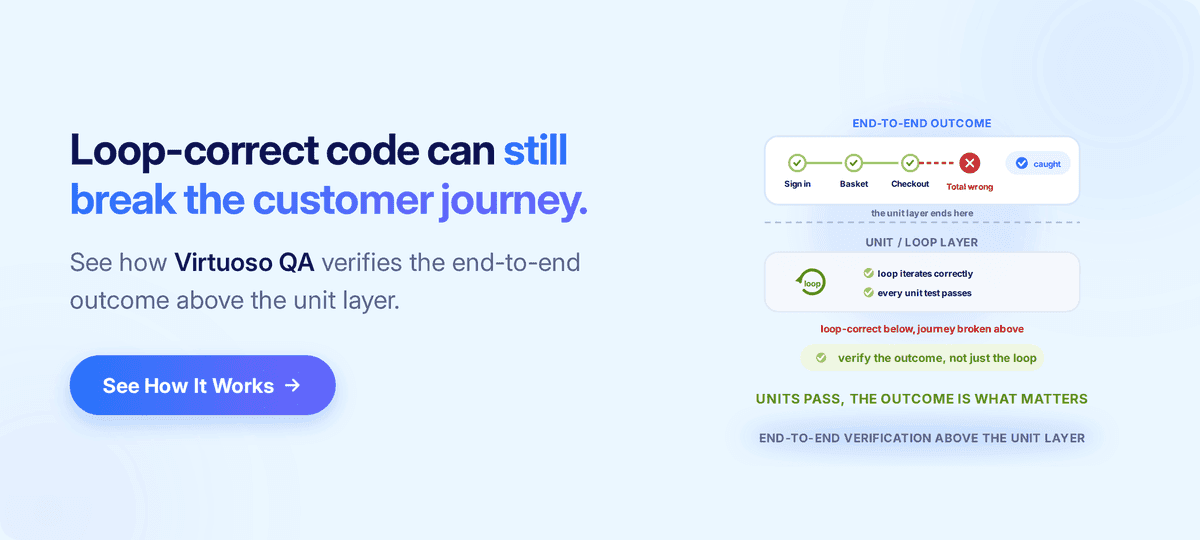
A loop can be structurally correct and still wrong for the business. A claims fraud-scoring loop that iterates correctly, terminates correctly, and applies the scoring function correctly can still produce the wrong customer outcome if the scoring function itself encodes a flawed business rule.
White-box loop testing addresses correctness inside the function, journey-level verification addresses correctness across the customer outcome, and both are required, since neither substitutes for the other.
The mature engineering organisation pairs them deliberately, running loop testing and adjacent white-box techniques at the unit and integration boundaries, continuous verification of the customer journeys those units assemble into across the UI, API, and database layers, and risk-based prioritisation that maps code change to journey impact, so that when a loop changes the dependent journeys are revalidated immediately.
Code correctness has never been a sufficient definition of software quality on its own, and the AI-coded era has made the gap between code-correctness and customer-outcome more visible than it has ever been.
Common Loop Bugs and How Loop Testing Catches Them
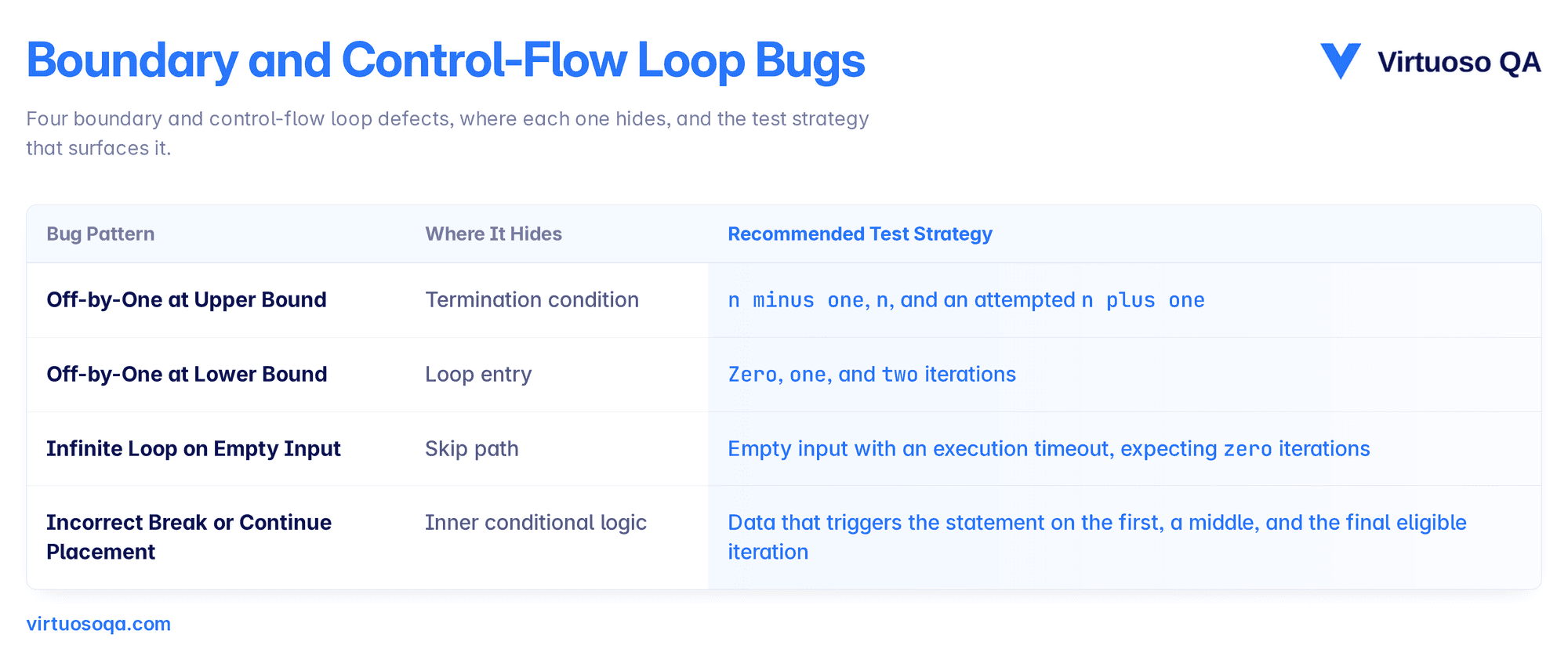
Loop bugs fall into recurring patterns, and recognising the pattern accelerates diagnosis when production fails.
The recurring patterns split into two groups, namely the classical loop-boundary defects the iteration set targets directly, and the operational defects that repetition amplifies but that need their own test strategies.
Classical Loop-Boundary Defects
Operational Defects Amplified by Repetition
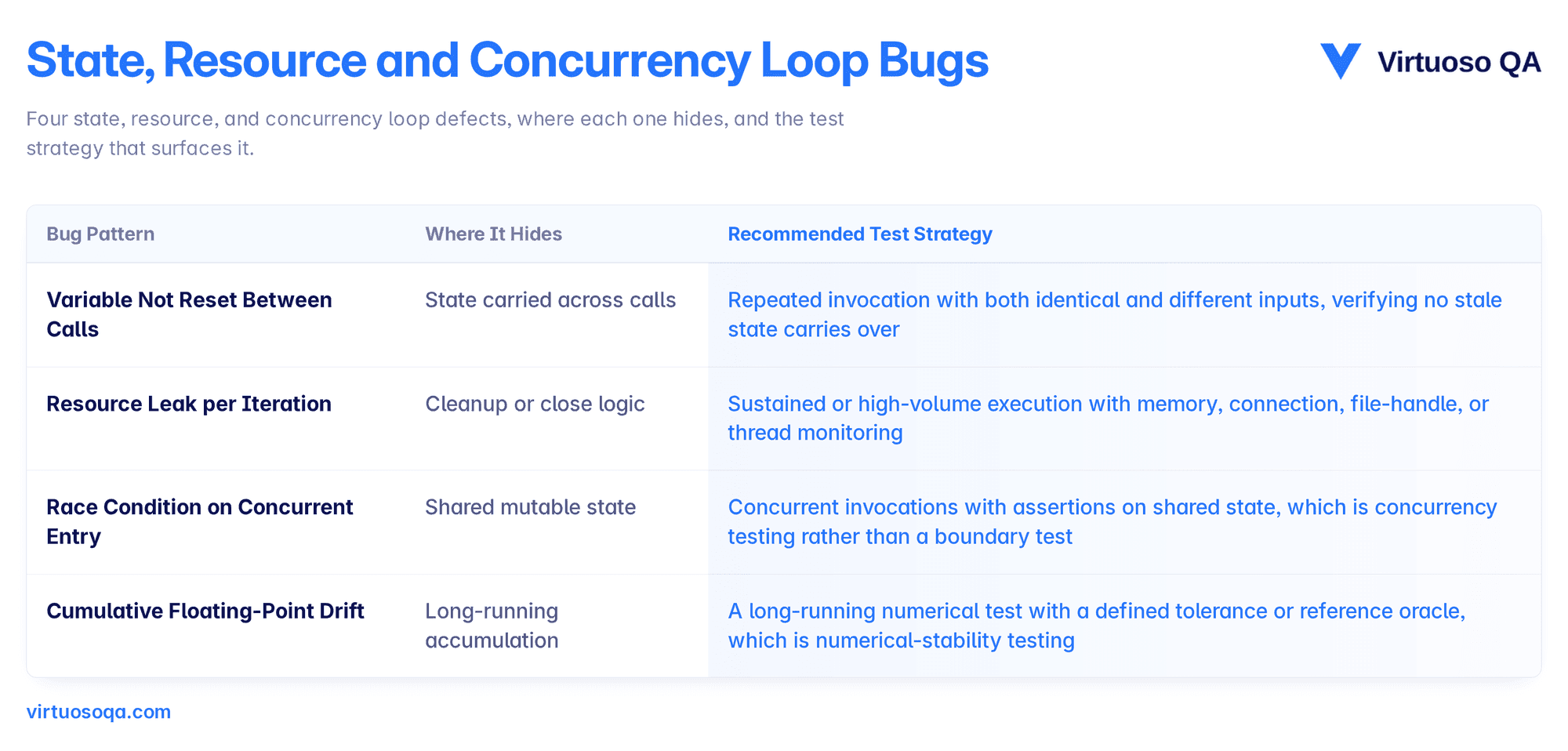
The table is not exhaustive, since bug patterns evolve with language features and runtime behaviour, but the principle holds, which is that deliberate test design catches what ad-hoc testing misses.
Where Virtuoso QA Fits
Virtuoso QA does not replace unit-level loop testing. It complements it by validating the integrated, end-to-end behaviour that loop-level components contribute to across UI, API, and, where configured, database checks, namely a claim submitted end to end, a payment reconciliation running clean, or an order moving through the workflow without behavioural regression.
The pairing is deliberate. Loop testing protects code correctness at the function level, and Virtuoso QA protects customer-outcome correctness at the journey level, so the two cover different risks and complement one another.
Self-healing helps reduce the maintenance caused by interface changes, while AI Root Cause Analysis provides diagnostic evidence, such as failure reasons, screenshots, and logs, that helps teams distinguish application failures from test, environment, and integration issues.
Code velocity rises through AI assistance, verification velocity rises through agentic test generation and self-healing at the journey layer, and loop testing remains essential at the unit layer, so both stay current and neither falls behind.
A Practitioner's Checklist for Loop Testing
A short checklist captures the discipline. Apply it to loops whose failure could materially affect correctness, reliability, security, data integrity, or performance.
The loop type has been identified, meaning simple, nested, concatenated, or unstructured.
The appropriate test strategy for the identified loop type has been documented.
The boundary conditions implied by the loop's specification have been covered, including zero, one, and two iterations where applicable, a typical value, and the values around the maximum.
Nested loops have been tested one level at a time, initially holding outer loops at minimum values and then holding the remaining loops at representative values.
Concatenated loops have been examined for state dependency between them.
Unstructured loops have been flagged for refactor or decomposed into testable parts.
State carried across iterations has been validated, not assumed.
The loop has been considered under concurrent invocation if reachable in production.
For business-critical loop behaviour, relevant integration or customer-journey coverage exists where appropriate.
The checklist is short by design. Loop testing fails not because the discipline is complex, but because the discipline is skipped.
Frequently Asked Questions
How Many Test Cases Does the Beizer Set Require for a Simple Loop?
What Is the Difference Between Loop Testing and Path Testing?
Is Loop Testing Still Relevant With AI-Assisted Coding?
Does Coverage Data Replace Loop Testing?
How Does Virtuoso QA Relate to Loop Testing?
What Is the Most Common Loop Bug Missed in Practice?