Blog
Gray Box Testing: Combining Black Box and White Box Approaches

Abhilash
Published on

Table of contents
Lorem ipsum
Lorem ipsum
Lorem ipsum
Lorem ipsum
Lorem ipsum
Gray box testing is a testing approach in which the tester has partial knowledge of the internal structure of the software being tested. The tester combines an external view, meaning what the user experiences and what the system returns, with selective knowledge of the internal architecture, meaning data schemas, API contracts, integration topology, and business rules.
The combination produces tests that are more targeted than pure black box testing and more grounded in real-world use than pure white box testing.
This guide covers the definition and the knowledge-spectrum reframe that explains why the technique matters, the classic techniques, the security and API use cases, a worked enterprise example, the tools, the advantages and honest limits, and why AI-generated code has made structural awareness more valuable rather than less.
The Textbook Framing, and Why it Misleads
The textbooks treat software testing as a three-way choice. Black box, where the tester knows nothing about the inside. White box, where the tester knows everything. Gray box, where the tester knows something. The framing makes for clean diagrams, and it also obscures a practitioner truth that anyone who has tested enterprise software for more than a year recognises, which is that most testing of complex systems is gray box, whether the team calls it that or not.
The tester verifying a Salesforce customisation knows the data model. The tester verifying a Dynamics 365 release knows the entity relationships. The tester verifying a banking integration knows the API contracts. None of them has the developer's full visibility into the implementation, and none of them is testing in true ignorance of the structure, so all of them are working in the middle.
The three-box diagram implies gray box is a niche compromise between two purer approaches, when in reality it is the space where most real testing already lives, and the term simply gave teams a vocabulary for what they were already doing.
What is Gray Box Testing?
Gray box testing is a software testing approach in which the tester combines external behavioural verification with partial internal knowledge of the system under test. The tester knows some of how the system is built, meaning data structures, API contracts, integration points, business rules, and configuration, without having the full implementation-level visibility a developer has.
The partial-knowledge characteristic is the defining property. A pure black box test treats the system as an opaque box, where inputs go in, outputs come out, and the relationship between them is what gets verified.
A pure white box test treats the system as a transparent box, where every code path, every branch, and every variable is visible and can be probed.
A gray box test treats the system as a translucent box, where some of the internal structure shows through, enough to guide the testing but not so much that the tester is verifying implementation details.
A working definition is that gray box testing is testing performed with the level of structural knowledge a senior QA engineer typically has, but a developer working on the same module does not need. The definition captures something the textbook definitions miss, which is that gray box testing is not a hybrid technique invented to fill a gap, it is a description of what experienced testers were already doing, named after the fact.
The naming was useful because it gave teams a vocabulary for the work and a way to discuss the trade-offs deliberately.
A Quick Comparison - Black Box vs Gray Box vs White Box Testing
The three approaches resolve cleanly along several dimensions, and setting them out point by point shows why they are not rivals but different tools for different layers of the system.
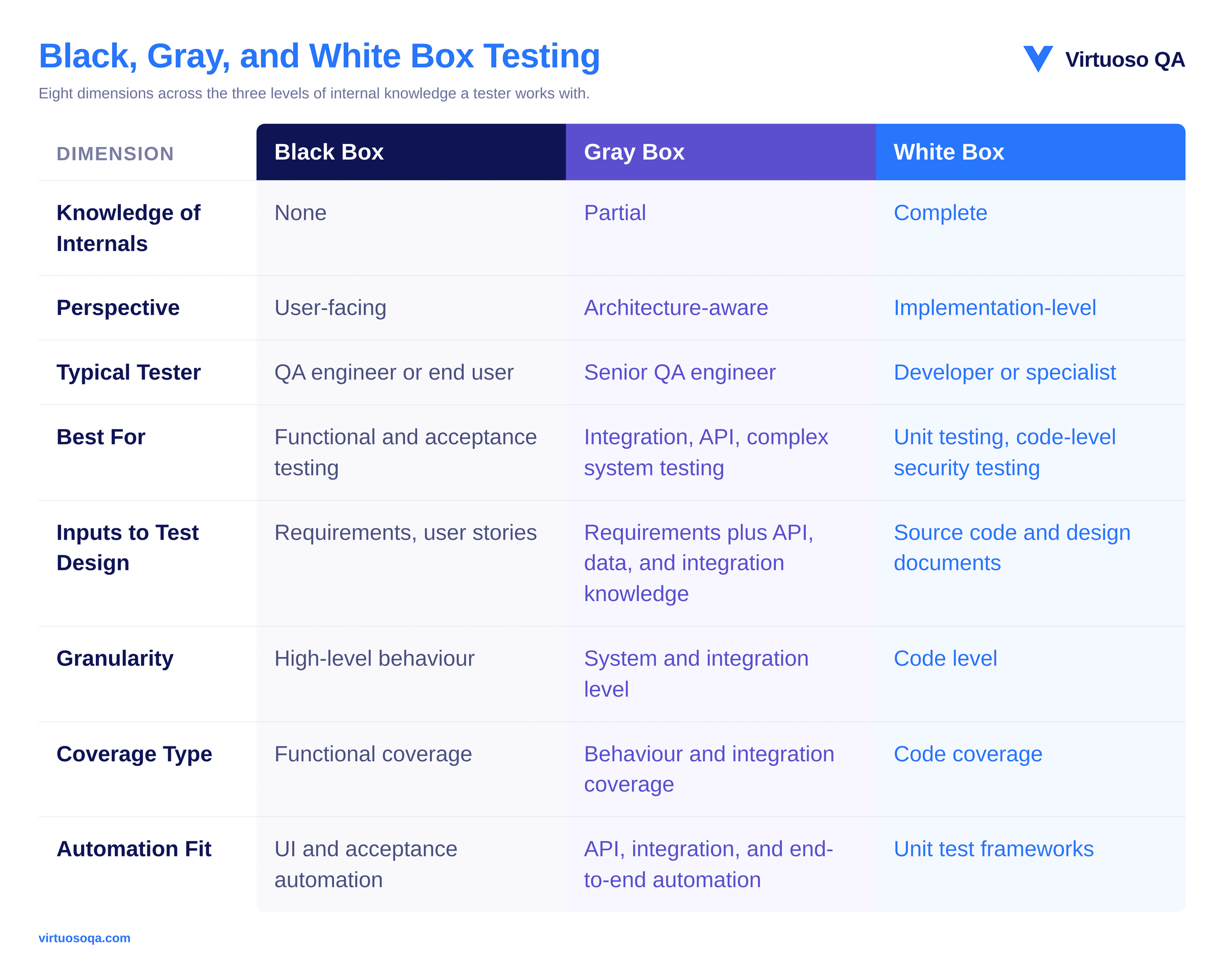
Knowledge of Internals
Black box has none, treating the system as a sealed unit where only inputs and outputs are visible.
Gray box has partial knowledge, such as schemas, API contracts, and integration points, without the full source.
White box has complete visibility of the code, every branch, path, and variable.
Perspective
Black box is user-facing, seeing the system as a customer would.
Gray box is architecture-aware, understanding how the pieces connect without reading every line.
White box is implementation-level, seeing the system as the developer does.
Typical Tester
Black box suits a QA engineer, or an end user in acceptance testing.
Gray box suits a senior QA engineer with the structural knowledge to test the seams.
White box needs a developer or a specialist who can read the code.
Best For
Black box is strongest for functional and acceptance testing, where the user outcome is what matters.
Gray box is strongest for integration, API, and complex system testing, where defects live in how components interact.
White box is strongest for unit testing and code-level security analysis, where the internal logic is the target.
Inputs to Test Design
Black box works from requirements and user stories alone.
Gray box works from the requirements enriched with API, data, and integration knowledge.
White box works from source code and design documents.
Granularity
Black box operates at the level of high-level behaviour.
Gray box operates at the system and integration level, where most enterprise defects surface.
White box operates at the code level of branches and statements.
Coverage Type
Black box aims at functional coverage of requirements.
Gray box aims at behaviour and integration coverage of the contracts and data flows between components.
White box aims at code coverage of paths and branches.
Automation Fit
Black box maps to UI and acceptance automation.
Gray box maps to API, integration, and end-to-end automation, where much modern enterprise automation sits.
White box maps to unit test frameworks.
The three approaches are not interchangeable, since they probe different layers of the system and surface different categories of defect. A complete enterprise test programme uses all three, and a team that uses only one is missing something the other two were designed to catch.

The Knowledge Spectrum
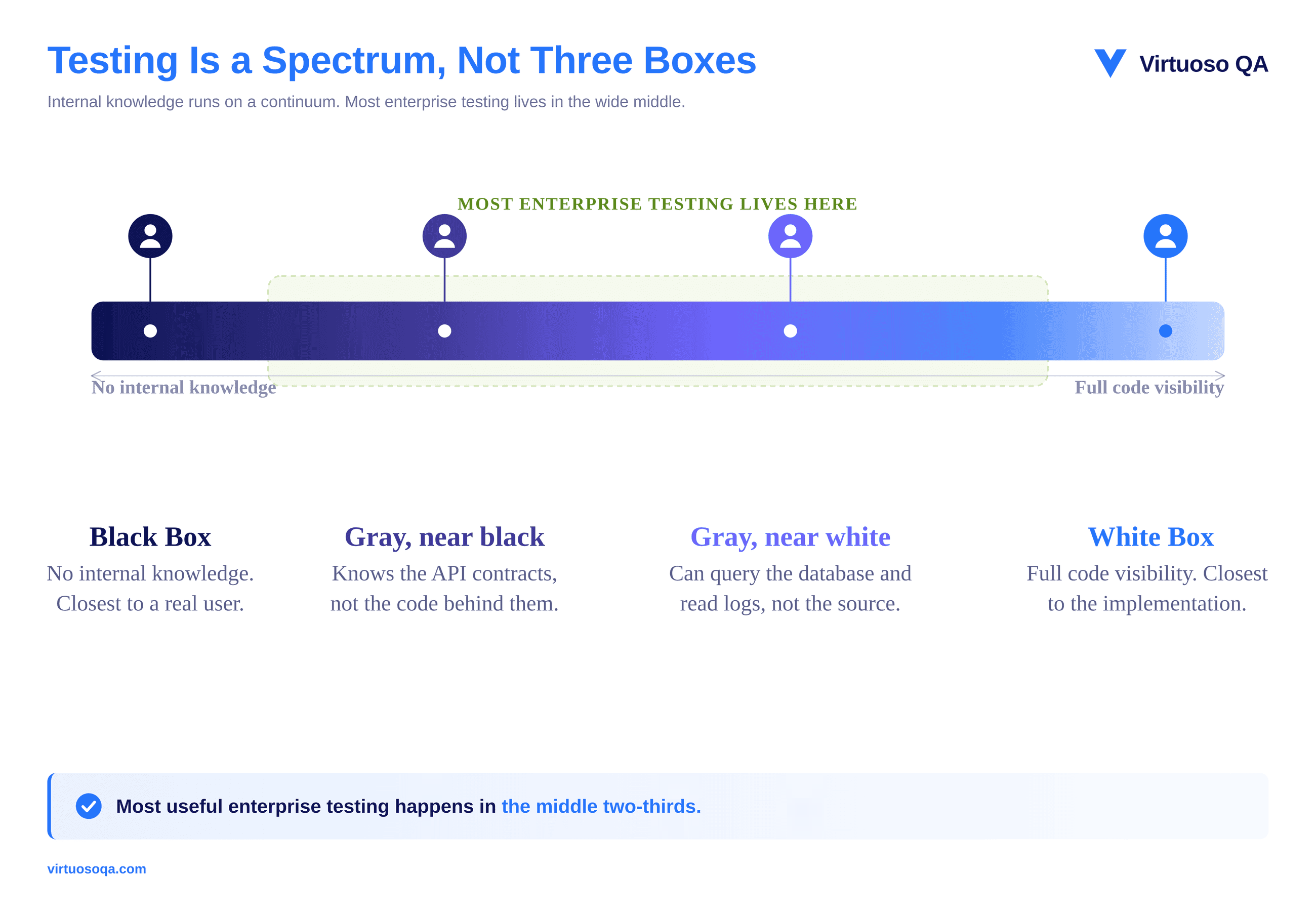
A more useful frame than three discrete boxes is a knowledge spectrum, where testing approaches sit on a continuous line from zero internal knowledge at one end to complete implementation visibility at the other.
At the left end sits the pure black box approach, a tester verifying acceptance criteria with no knowledge of how the system is built, in the mode closest to a real user's experience. At the right end sits the pure white box approach, a developer running unit tests with full access to every line of code, branch, and variable, in the mode closest to the implementation itself.
The space in between, which is most of the spectrum, is gray box territory. A tester who knows the API contracts but not the implementation behind them sits closer to the black end of the gray region, and a tester who can query the database directly and inspect log files but cannot read the source code sits closer to the white end. Both are gray box testers doing different work, and the work is shaped by the knowledge they bring.
The spectrum framing matters for two reasons.
It discourages the false choice, since teams sometimes argue about whether testing should be black box for objectivity or white box for thoroughness, as if the choice were binary, when it is almost always a question of how much knowledge to use deliberately.
The spectrum makes the trade-offs explicit, since more knowledge means more targeted tests but also more risk of testing the implementation rather than the behaviour, while less knowledge means more user-realistic tests but more risk of missing what the structure would have revealed.
Choosing where on the spectrum to operate is a design decision, not a default, and the team that consciously decides where each kind of testing belongs makes better trade-offs than the team that picks one end and pretends the rest of the spectrum does not exist.
How Gray Box Testing Works
The mechanics of gray box testing are not exotic. The tester begins from the same place a black box tester begins, meaning the requirements, user stories, acceptance criteria, or use cases that describe what the system should do, and then enriches that view with structural knowledge that informs how to probe the system effectively.
Three categories of internal knowledge are commonly available.
Interface knowledge: API contracts, request and response schemas, supported HTTP methods, parameter types, and error codes. Interface knowledge lets the tester design tests that exercise specific protocol-level scenarios a UI-only test would miss.
Data knowledge: Database schemas, entity relationships, key columns, and transaction boundaries. Data knowledge lets the tester verify that the database is in the expected state after the test, even when the user interface does not reveal the data directly.
Integration knowledge: How the system connects to other systems, what payloads are exchanged, what dependencies exist, and what failure modes can propagate. Integration knowledge is essential in modern enterprise environments where most journeys cross several systems.
The tester does not need all three categories for every test, and the discipline is to use the knowledge most relevant to the question being investigated and to leave the rest aside.
A tester who tries to verify everything visible from a gray box position ends up writing implementation-level tests that are brittle, slow, and hard to maintain, whereas a tester who uses the gray box knowledge selectively writes tests that hit the right level of abstraction and survive code changes.
The Classic Gray Box Process
Alongside the planning method later on this page, the field has a classic process sequence worth knowing, since it is the one most reference material describes and the one many practitioners expect.
The sequence identifies the inputs drawn from both black box and white box perspectives, identifies the expected outputs for those inputs, identifies the key paths through the system to exercise, identifies the sub-functions worth deeper testing, determines the inputs and expected outputs for each sub-function, executes the sub-function test cases, and verifies the results against expectations, repeating for the remaining functions.
The sequence is useful as a checklist, though it describes the mechanics rather than the judgement. The harder and more valuable part is not running the steps but deciding which structural knowledge to bring to bear and at what altitude to test, which is where the planning method later on this page does the real work.

Common Gray Box Testing Techniques
Several techniques recur in gray box programmes, often without being named, and recognising them helps a team apply them deliberately.
The first four are the classic canon of gray box techniques, and the last two are the modern mainstays that most enterprise work now depends on.
1. Matrix Testing
Matrix testing identifies the variables that affect the system's behaviour and tests systematically across combinations of values. It is gray box because the variables are often visible only with some internal knowledge, meaning configuration parameters, feature flags, role permissions, and environmental settings.
A tester running a matrix on a CRM customisation may test across role types, currency settings, and date formats, and while they do not need to read the code, they do need to know the variables exist.
2. Regression Testing With Change Awareness
Regression suites are most effective when the tester knows what changed in a release and can focus effort accordingly, and that knowledge of what changed is gray box knowledge, meaning enough architectural awareness to prioritise sensibly.
A gray box regression session targets the journeys whose components have changed, the integrations whose contracts have moved, and the data structures whose schemas have updated, which makes it more efficient than a blanket regression run.
3. Pattern Testing
Pattern testing uses historical defect data to inform where to look for problems, and knowledge of those patterns is gray box knowledge. A tester who knows the team has had three production incidents involving date-handling across time zones tests date-related functionality with particular care, regardless of whether the current feature is obviously date-related.
Pattern awareness is one of the most valuable forms of gray box knowledge and one of the hardest to systematise.
4. Orthogonal Array Testing
Orthogonal array testing is a statistical technique for combinatorial testing, where instead of testing every possible combination of input variables, which is often impractical, the tester selects a subset that covers all pairwise combinations of variable values.
It is gray box because choosing which variables to include depends on understanding the system's logic well enough to know which combinations are likely to interact, and it is particularly useful for configuration testing, feature-flag testing, and integration testing where the input space is large but the underlying logic depends on pairwise interactions.
5. API Testing
API testing is inherently gray box, since the tester knows the request and response structures, the supported methods, the error codes, and the contract semantics, without necessarily knowing how the API is implemented or what database calls it makes.
API testing operates at the contract layer, which is exactly the gray box position, and as modern enterprise systems have become API-first, this has made gray box testing the dominant mode for backend verification even when the team does not name it that.
6. Database and Integration Testing
Verifying that the system reaches the right database state, or that the right messages flow between systems, requires gray box knowledge of the schemas, the integration points, and the expected payloads, without access to the application code itself.
Database verification is particularly valuable for catching bugs the user interface hides, since a transaction may appear to succeed in the UI while leaving the database in an inconsistent state, which a black box test would miss and a gray box test that knows where to look would catch.
Some treatments also list boundary value analysis, equivalence partitioning, and decision table testing under gray box, since a tester with knowledge of the internal ranges and rules can apply them with more precision. Those are fundamentally black box design techniques that gray box knowledge sharpens rather than gray box techniques in their own right.
Gray Box Testing for Security and Penetration Testing
One of the most important applications of gray box testing is security, and a large share of the discipline's use in practice is gray box penetration testing. The reason is a matter of realism about who actually attacks a system.
A pure black box penetration test simulates an external attacker with no inside knowledge, which is a valid but incomplete threat model, and a pure white box security review examines the full source, which is thorough but does not reflect how most breaches actually unfold.
Gray box penetration testing sits where the real threats live, since it simulates the credentialed attacker, meaning the logged-in user who abuses their access, the insider with partial system knowledge, or the external attacker who has already learned the API paths and session structure. The tester works with some inside knowledge, such as valid credentials, the endpoint structure, or the authentication flow, but without the full source, which mirrors the position a real attacker reaches after initial reconnaissance.
From that position, a gray box security tester can probe for authorisation flaws, where a user reaches data or actions they should not, for injection vulnerabilities in inputs they know are user-controlled, for weak session handling and token reuse, and for information leakage in error responses.
Knowing where the authentication boundaries sit and which inputs are user-controlled lets the tester probe far more effectively than a blind external scan would, which is why gray box is the natural fit for application-level security assessment.
When to Use Gray Box Testing
Gray box testing earns its place in five specific contexts, and the common thread is a system complex enough that pure black box misses important defects and not under the team's full code control, which rules out pure white box.
1. Complex Enterprise Software
Platforms such as Microsoft Dynamics 365, Salesforce, SAP, Workday, and Guidewire have rich internal data models and many integration points, so testing them effectively requires structural awareness.
Pure black box testing tends to miss data-state issues, and pure white box testing is impractical because the customisable platform code is largely a vendor's, which makes gray box the natural fit.
Related Read: Microsoft Dynamics 365 Test Automation - Enterprise ERP Testing with Self-Healing AI
2. API-First and Microservices Architectures
Most modern enterprise applications expose APIs that internal teams and external partners consume, so testing the APIs requires contract-level knowledge and testing the journeys that depend on them requires integration-level knowledge, both of which are gray box positions.
Related Read: Microservices vs Monolithic Architecture Testing Strategies
3. Integration-Heavy Systems
Any system that connects to several external systems, such as payment processors, identity providers, fraud screens, and regulatory reporting, benefits from gray box testing of the integration layer, where the tester needs to know the payloads and failure modes but not how each external system is built internally.
4. Data-Driven Applications
Systems where the user interface is a thin layer over a rich underlying data model, such as analytics platforms, CRMs, and ERP modules, require gray box testing to verify that the data behaves correctly, not just that the UI renders sensibly.
5. Security Testing at the Application Level
Security testing benefits from partial knowledge of the attack surface, since knowing where the authentication boundaries sit, which inputs are user-controlled, and what kinds of data the system processes lets the tester probe effectively.
The five contexts cover most modern enterprise software, and the pattern is clear, that as systems have grown more complex and more integrated, the gray box position has become the dominant mode of testing regardless of whether teams label it that way.

A Worked Example of Gray Box Testing for a Building Society's New Mortgage Platform
A UK building society is implementing a new mortgage origination platform that integrates with three external systems
A credit bureau for borrower checks
An underwriting engine for risk assessment
A document management system for application paperwork.
The platform also writes to the building society's existing customer master record, and the release is the largest of the year.
The testing approach is, by necessity, gray box. The team does not have full implementation access, since the underwriting engine is third-party, the credit bureau is external, and the document management system is a vendor product.
The team does have substantial structural knowledge, namely the API contracts for each integration, the data schemas, the message flows, the role permissions, and the configuration options.
What the Testers Know
The API contracts for the credit bureau, meaning the request fields, response fields, and error codes.
The API contract for the underwriting engine, meaning the case payload structure, the decision response, and the audit fields.
The data schema for the customer master record, meaning which fields are written, which are read, and the key relationships.
The role permissions matrix, meaning which user types can perform which actions.
The configuration options, meaning interest rate models, eligibility rules, and document templates.
What the Testers Do Not Know
The internal implementation of the credit bureau or underwriting engine.
The specific code paths inside the document management vendor product.
The internal database structure of the customer master record system.
The gray box knowledge shapes the test design at three levels.
Integration-level tests verify the contracts between the platform and each external system, where the tester crafts API calls with valid and invalid payloads, checks the response handling, and verifies that errors propagate correctly, testing not the credit bureau's internal logic but how the platform handles its documented behaviour.
Data-level tests verify that customer records are written, read, and updated correctly, where the tester runs an application through the platform, checks the UI for success, and then queries the customer master record directly to verify the expected fields have been populated, which catches bugs where the UI reports success but the data is wrong.
Journey-level tests verify that the end-to-end mortgage application process produces the correct outcome, where the tester follows a representative application through all the integrations, using the journey-level abstraction but exploiting the gray box knowledge of which integration is exercised at each step.
The test suite uses all three layers. Pure black box testing at the journey level would catch the most obvious bugs but miss the data-state and integration-payload issues, and pure white box testing of the platform code would catch implementation bugs but miss the integration-contract issues with the third-party systems, whereas gray box testing covers both classes of bug at the right altitude.
Advantages of Gray Box Testing
Five advantages make gray box the dominant mode for complex enterprise software.
1. Better Coverage Than Pure Black Box
Gray box tests can verify state, payloads, and integration behaviour that black box tests would not see, so the same defect that slips past a UI-only test gets caught when the tester checks the database or inspects the API response.
2. More User-Realistic Than Pure White Box
Gray box tests stay close enough to the user's experience to verify behaviour the user actually cares about, rather than implementation details that may pass while the user-facing outcome fails.
3. A Better Trade-Off Between Effort and Result
Pure white box testing requires full code access and developer-level knowledge that most QA functions do not have at scale, and pure black box testing for complex systems requires extensive scenario coverage to compensate for the lack of structural insight, whereas gray box hits a useful middle, more efficient than pure black box and more accessible than pure white box.
4. Closer to Real Defect Patterns
Most production defects in complex systems involve interactions between components, such as a UI that submits the wrong payload, a database that gets into an unexpected state, or an integration that times out and is not handled, and gray box testing is positioned to find exactly these patterns.
5. A Natural Fit for Modern Architectures
API-first systems, microservices, integration-heavy platforms, and customisable enterprise software all benefit from structural awareness, so the gray box approach maps onto modern architectures more naturally than either pure end of the spectrum.
Limitations of Gray Box Testing
Three honest limits keep the approach in perspective.
It requires technical knowledge in testers: Gray box testing needs testers who can read API documentation, query databases, and understand integration patterns, and teams without that capability default to pure black box, which is more accessible but less effective for complex systems. Building gray box capability is a multi-year discipline.
It is less repeatable than pure black box: A gray box test depends partly on what the tester knew, so two testers with different knowledge will design different tests for the same feature, which is sometimes a strength, since different perspectives find different bugs, and sometimes a problem, since the programme depends on individual knowledge that may leave with the tester.
It cannot replace pure white box for code-level concerns: Unit testing, code coverage, mutation testing, and code-level security analysis all require white box access, so gray box testing complements these disciplines rather than replacing them, and a team that does gray box but no white box still carries implementation-level risk.
The limits are real, and gray box is not a universal solvent. The strongest test programmes use all three approaches together, choosing where on the knowledge spectrum each kind of work should sit.
How to Plan a Gray Box Testing Effort
Five steps capture the working method, and they are where the real judgement lives, beyond the mechanical process sequence earlier.
1. Inventory the Available Knowledge
Before designing tests, list the internal knowledge the team has access to, meaning API contracts, data schemas, integration topologies, role definitions, configuration parameters, and historical defect data. The inventory is the raw material for gray box test design.
2. Map Knowledge to Test Areas
For each scope area, identify which categories of internal knowledge are most relevant, so a user-facing feature may need interface knowledge, a reporting feature may need data knowledge, and an integration may need contract knowledge.
3. Choose Techniques That Leverage the Knowledge
Match techniques to what is available, meaning matrix testing for known variables, API testing for documented contracts, database verification for known schemas, and pattern testing for accumulated defect history, using the knowledge most relevant to each area rather than the knowledge easiest to apply.
4. Design Tests at the Right Altitude
Use gray box knowledge to inform the test design without making the test depend on implementation details. A test that verifies the API returns a 201 with a body containing the new record is a useful gray box test, whereas a test that verifies a specific internal handler function is called twice is a white box test in disguise that will break on the first refactor.
5. Document the Assumptions
Gray box tests depend on assumptions about internal structure that may change, since schemas evolve, APIs version, and integrations move, so documenting which assumptions each test depends on makes it maintainable.
A test labelled as depending on the credit-bureau API v2 response format can be updated thoughtfully when v3 ships, whereas a test that simply expects a specific shape with no note becomes a mystery to fix when the shape changes.
Gray Box Testing in Modern Enterprise QA
The dominant pattern in modern enterprise QA is unacknowledged gray box. Teams test complex platforms such as Dynamics 365, Salesforce, SAP, ServiceNow, Workday, Guidewire, and Oracle by combining UI-level scenario verification with structural awareness of the platforms' data models, configuration options, and integration patterns, so the work is gray box even when the vocabulary is not used.
Naming the approach explicitly produces several benefits. Test programmes become more deliberate about what knowledge they are leveraging and where, so the choice between pure black box for user realism and gray box for efficiency becomes a design decision rather than an unconscious default.
Teams plan for the gray box capability they need, so developing testers who can read API contracts, query databases, and understand integration topology becomes part of the QA career path rather than an emergent property of individual curiosity.
And the programme's documentation becomes more useful, since a test that knows it depends on a specific schema is a test whose maintenance has a path, whereas a test that depends on schema knowledge informally held in one tester's head is a test whose maintenance depends on memory.
Gray Box Testing in an AI-Coded World
AI-assisted development changes the role of gray box testing in two specific ways, and both raise its value rather than lowering it.
The first is that AI produces structure the team did not consciously design. When assistants write meaningful portions of code, the resulting system contains implementation choices the team did not explicitly make, some with downstream effects on data flow, API behaviour, or integration handling.
Pure black box testing will eventually surface those effects, but slowly, through customer-visible symptoms, whereas gray box testing with structural awareness catches them earlier, at the data and contract layer where they originate.
The second is that the trust contract lives at the journey-and-integration level. Customers care whether their workflows complete, and the implementation underneath can be rewritten overnight by AI while the contract should not change, so gray box testing at the API and integration layer verifies the contracts customers depend on in a way that survives implementation churn.
A practical pattern emerges in mature teams, where behaviour-led automation handles the journey-level verification, composable, self-healing, and authored in plain English, while gray box automation handles the contract-level verification, meaning API tests, data-state checks, and integration verifications, and together the two layers cover most of what modern enterprise software needs verified.
The discipline shifts but does not retire, and gray box testing has become more valuable in AI-coded software, not less.
Where Virtuoso QA Fits
Gray box testing depends on verifying behaviour at the journey level and contracts at the API and data level in the same programme, which is exactly the combination Virtuoso QA is built for. Tests are authored in plain English against the behaviour a workflow should exhibit, and the same platform verifies the API responses and database state underneath that journey, so the UI outcome and the structural correctness are checked together rather than in separate tools.
That unified position matches how gray box work actually happens, since the tester who wants to confirm both that the mortgage application succeeded on screen and that the customer master record was written correctly can express both in one test rather than stitching together a UI tool and a separate API and database harness.
Self-healing keeps the journey-level tests aligned as the interface changes, and the contract-level checks hold the integration and data assertions steady, which is the durability gray box automation needs to survive the pace of change in a modern enterprise estate.
The platform handles the structural verification that repeats, so the tester's gray box knowledge goes into deciding what to check rather than into maintaining how it runs.

Common Mistakes in Gray Box Testing
Five recurring mistakes account for most of the failed gray box programmes seen in practice.
1. Treating Gray Box as Either Black Box or White Box
Teams sometimes default to one of the textbook extremes, where the black box default produces tests that miss the structural issues complex systems are full of, and the white box default produces tests that are brittle and unmaintainable.
Operating deliberately in the gray box middle is a design choice, and defaulting to either end is an avoidance of the choice.
2. Not Documenting the Knowledge Being Used
Tests that depend on undocumented structural knowledge become orphans when the tester who wrote them moves on, so documenting which schemas, contracts, and integrations each test depends on keeps the dependencies visible.
3. Over-Reliance on Individual Tester Knowledge
A programme that depends on a few testers' detailed knowledge of the platform has a single-point-of-failure problem, so the structural knowledge should live in shared documentation and in the test artefacts themselves, not just in testers' heads.
4. Skipping the Structural Awareness
Some teams adopt the vocabulary of gray box without doing the structural work, so the tests look like black box tests with a label, and the label does not produce the benefit, the structural awareness does.
5. Confusing Gray Box With Manual Testing
Gray box testing is an approach, not a mode of execution, and gray box tests can be automated extensively, since much modern automation, meaning API test suites, data verification scripts, and integration checks, is gray box automation.
The approach is about knowledge, not about who or what executes the test.
Related Reads
Frequently Asked Questions
When Should Gray Box Testing Be Used?
Is Gray Box Testing Manual or Automated?
How Does Gray Box Testing Apply to API Testing?