Blog
Pairwise Testing Explained: Cut Test Cases Without Cutting Coverage

Abhilash
Published on






Table of contents
Lorem ipsum
Lorem ipsum
Lorem ipsum
Lorem ipsum
Lorem ipsum
Testing every combination of inputs is the safest idea on paper and an impossible one in practice. A feature with seven parameters of three values each has more than two thousand full combinations, and a configurable enterprise system with a dozen parameters runs into the millions. No team executes that, so the real question is not whether to reduce the test count but how to reduce it without giving up the coverage that actually catches defects.
Pairwise testing answers that question. It selects a small subset of test cases that still covers every pair of input parameter values at least once, compressing an exponential combination space into a set the team can run. The reason it works is empirical rather than convenient, namely that most software defects are triggered by the interaction of only one or two parameters, so covering every pair catches a disproportionate share of bugs at a fraction of the cost.
This page sets out what the technique is, the mathematics underneath it, the economics, a worked enterprise example, the constraints problem, when not to use it, how it scales to higher orders, a manual how-to, the tools, and why the technique matters more, not less, in systems where AI is writing the code.
What is Pairwise Testing?
Pairwise testing, which you will also see called all-pairs testing or 2-way combinatorial testing, is a test design technique that builds a set of test cases covering every possible pair of input parameter values at least once. It comes out when the full set of combinations is bigger than anyone could reasonably run.
The quickest way to see it is a small case. Three parameters with three values each gives twenty-seven full combinations. The pairwise set for the same thing is nine cases, and those nine still hit every value pair across every pair of parameters. Going from twenty-seven to nine is handy here, and it stops being handy and starts being the difference between possible and impossible once the parameter count climbs.
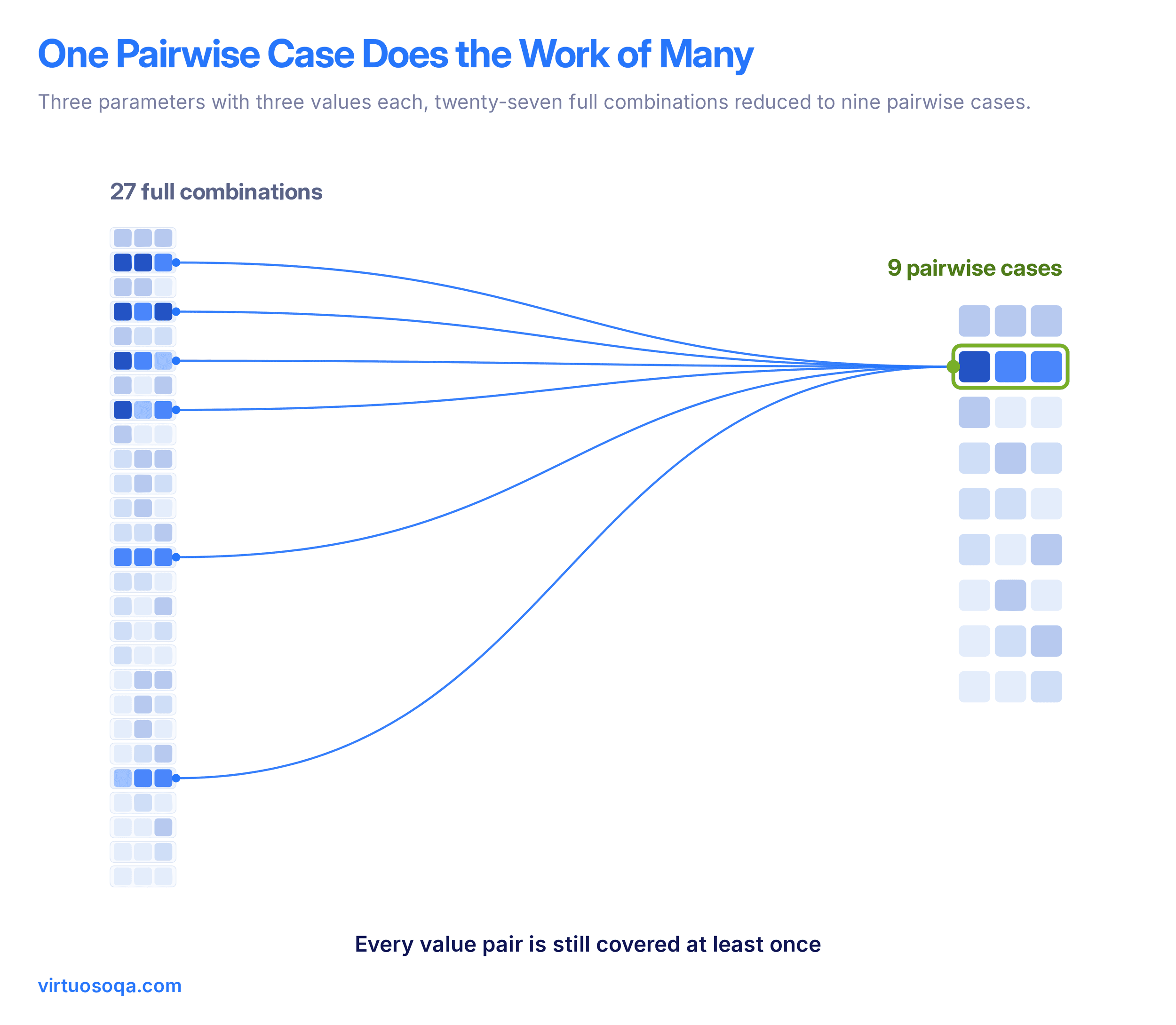
The reason it belongs in serious enterprise testing is blunt. You cannot test everything on a high-parameter system at any budget that exists, and randomly sampling combinations guarantees you nothing. Pairwise gives you a real guarantee against the failure modes behind most defects, in a number of tests you can actually run and re-run.
Why Pairwise Testing Works
The whole technique rests on a finding that surprised people when it landed. In a series of studies from 1999 to 2004, D. Richard Kuhn and colleagues at the US National Institute of Standards and Technology went through defect data across a range of software systems and kept seeing the same shape, namely that the great majority of defects came from just one or two parameters interacting, with the payoff falling away fast at three-way, four-way, and beyond.
Laid out as a rough profile, the pattern is what the rest of the argument leans on.
One and two-parameter interactions account for the bulk of defects across the systems studied.
Three-parameter interactions add a smaller slice on top.
Four, five, and six-parameter interactions mop up most of what is left.
Seven-way and higher interactions barely register in the data.
Follow that through and the conclusion is hard to argue with. If you guarantee coverage of every 2-way interaction, you catch most of the defects without ever running the full combination set, so the saving is huge and the price in missed bugs is small.
There is a second bit of maths that makes it even better, namely that a pairwise set grows roughly logarithmically as you add parameters, not exponentially. Bolting a tenth or twentieth parameter onto a system that already has five does not blow the test count up, it nudges it, so pairwise stays affordable exactly where exhaustive testing falls off a cliff.
The Economic Case From Exponential to Polynomial
The fastest way to feel why this matters is to put real numbers next to each other. Two cases, one moderate and one large, show how quickly the reduction goes from nice-to-have to no-brainer.
A moderate case: Seven parameters with three values each is 2,187 full combinations. The pairwise set is somewhere around fifteen to twenty cases, so you are cutting the work by more than a hundred times.
A large case: Twelve parameters with four values each is over sixteen million full combinations, which is simply not happening. The pairwise set is roughly thirty to forty cases. That is the jump from impossible to easy.
The number that really matters sits underneath those, namely how many of the defect-causing interactions you are still covering. Going by the Kuhn data, those thirty to forty cases catch nearly the same share of defects that several hundred or several thousand extra cases would, because once you have pairwise coverage each additional case buys you very little. For most systems, the sweet spot sits right around the pairwise line, and pushing much past it is mostly spending money to find bugs that are not there.

A Worked Enterprise Example
Toy three-parameter examples have run the pairwise conversation for twenty years, and they undersell the technique because the reduction only gets interesting at scale. So take something closer to real, namely a wealth management application with seven parameters that all feed one critical user journey.
Account type, namely Individual, Joint, Trust, or Corporate.
Currency base, namely GBP, USD, EUR, or JPY.
Compliance regime, namely UK retail, US retail, EU professional, or Asia institutional.
Device class, namely Desktop, Tablet, or Phone.
Browser engine, namely Blink, WebKit, or Gecko.
User role, namely Investor, Adviser, or Operations.
Session state, namely New session, Re-authenticated, or SSO-redirected.
Multiply it out and you get 5,184 combinations. The pairwise set lands around twenty to twenty-five cases, give or take depending on your generator and any constraints you add. That is the whole pitch in one line, namely thousands down to a couple of dozen.
Add one real-world rule and it tightens further, namely that Asia institutional compliance is not open to Individual accounts. That single constraint throws out a batch of combinations that could never happen, and a decent generator applies it without complaint, which is exactly why writing good constraints is the skill that separates someone who has run pairwise in anger from someone who has only read about it.
The set you get back covers every value pair at least once. Individual gets paired with every currency, every compliance regime it is allowed, every device, every browser engine, every role, and every session state, and the same is true for everything else.
What it does not cover is every three-way and higher combination, so a bug that only shows up when a Corporate account on a Trust compliance regime is on a Tablet running WebKit in a re-authenticated session, and only then, might slip through. The bet you are making is that oddly specific three-and-four-way interactions are rare in production, and the data backs that bet.
Orthogonal Arrays and Covering Arrays
The maths objects that generate these sets are worth a quick look, mostly because their names turn up in tool docs and papers, and the difference between them actually changes which tool you should pick.
Orthogonal arrays are tidy matrices where every pair of columns holds every value pair the same number of times. You get balanced coverage, which matters if you specifically want each pair represented equally often.
Covering arrays are looser, holding every value pair at least once without caring whether some pairs show up more than others. They usually give you a smaller set, and you pay for it with uneven representation.
For most software testing, covering arrays win, because a smaller set is worth more than perfect balance. People use the two terms loosely, but the distinction bites when you are choosing a generator, since some tools spit out orthogonal arrays and others covering arrays, and the output looks the same at a glance while the size and properties are not.
The Constraints Problem
If pairwise goes wrong in production, constraints are usually why. On paper the generated set covers every pair, but in the real world plenty of pairs cannot happen together, namely a guest checkout that cannot use invoice billing, an iOS device that cannot run an Android build, or a Trust account that cannot sit on an individual investor compliance regime.
Hand the generator a model with no constraints and it will happily hand you back rows that cannot exist, and those rows fail in the least useful way possible, namely the setup cannot be built or the system throws a validation error instead of exercising the thing you wanted to test. So your morning goes on triaging failures that were never bugs, and then you either strip the bad rows by hand or regenerate with the rules in place. Far better to put the rules in up front, and three kinds cover almost everything.
Exclusion constraints say a given pair cannot appear together.
Inclusion constraints say a given pair must appear in the set.
Conditional constraints say one value forces another, for example a JPY currency forcing an Asia locale.
Every modern generator handles all three. The work that stays with you is writing them completely, because miss one and you get invalid cases, and get too cautious and you get an undersized set that quietly skips real interactions. The generator does the combinatorial maths, you do the domain modelling, and that split is really what pairwise looks like once it leaves the textbook.

When Pairwise is Not the Right Technique
Knowing when not to reach for pairwise is as much a sign of a good tester as knowing when to. It is very good on the problems it was built for and quite poor on problems with a different shape, and there are five spots where you want something else.
1. When the Parameters Do Not Really Interact
If two parameters just do their own thing independently, pairing them buys you nothing, and boundary value analysis or equivalence partitioning on each one alone finds the same bugs for less.
2. When the Risk is Truly High-Order
Complex rules engines and safety-critical decision logic can hide bugs that only appear at three, four, or more parameters at once, and pairwise misses those by design, so you want higher n-way testing or a decision table.
3. When the Parameters Are a Sequence, Not a Set
A twelve-step workflow is not twelve simultaneous knobs, so the interactions are about order, and state-transition or path testing is the right tool.
4. When the Values Are Continuous, Not Discrete
Pairwise needs discrete values, so a field that runs from zero to a thousand has to be carved into representative values first, and boundary value analysis usually does a better job on continuous inputs anyway.
5. When Your Defect History Already Points Somewhere
If bugs keep clustering in specific triplets or quadruplets, test those directly, because a fresh pairwise set will not reproduce a pattern it was never told about.
Scaling to N-Way, From 2-Way to Higher Orders
Pairwise covers pairs, and the same machinery scales straight up from there. It helps to see the ladder written out, because the vocabulary is everywhere in combinatorial testing and each rung trades more coverage for more cost.
2-way, namely pairwise, covers every combination of any two parameters, and it is where most software should start.
3-way covers every triple, picking up interactions pairwise cannot see, at a higher case count.
K-way is the same idea dialled to whatever interaction strength you choose.
N-way covers all N parameters at once, which is just exhaustive testing wearing a different hat once N hits the parameter count.
The Kuhn data tells you when climbing the ladder is worth it. For ordinary application software, 2-way already catches so much that 3-way adds only a little, so paying for it everywhere is waste.
For safety-critical and decision-heavy systems, 2-way leaves more on the table and 3-way or higher earns its keep. The sensible move is to start at 2-way, run it, and if bugs slip through, check whether they are higher-order and only then push the specific parameters that need it up a rung, so you never buy 4-way coverage across a system that never needed it.
ACTS from NIST and PICT from Microsoft both do n-way out of the box, and the same constraint handling carries over at every level.
How to Perform Pairwise Testing Step by Step
Theory is fine, but at some point someone has to actually do this, and the steps are the same whether the output feeds a manual run or an automated suite. Here is the path from a blank page to a set you can run.
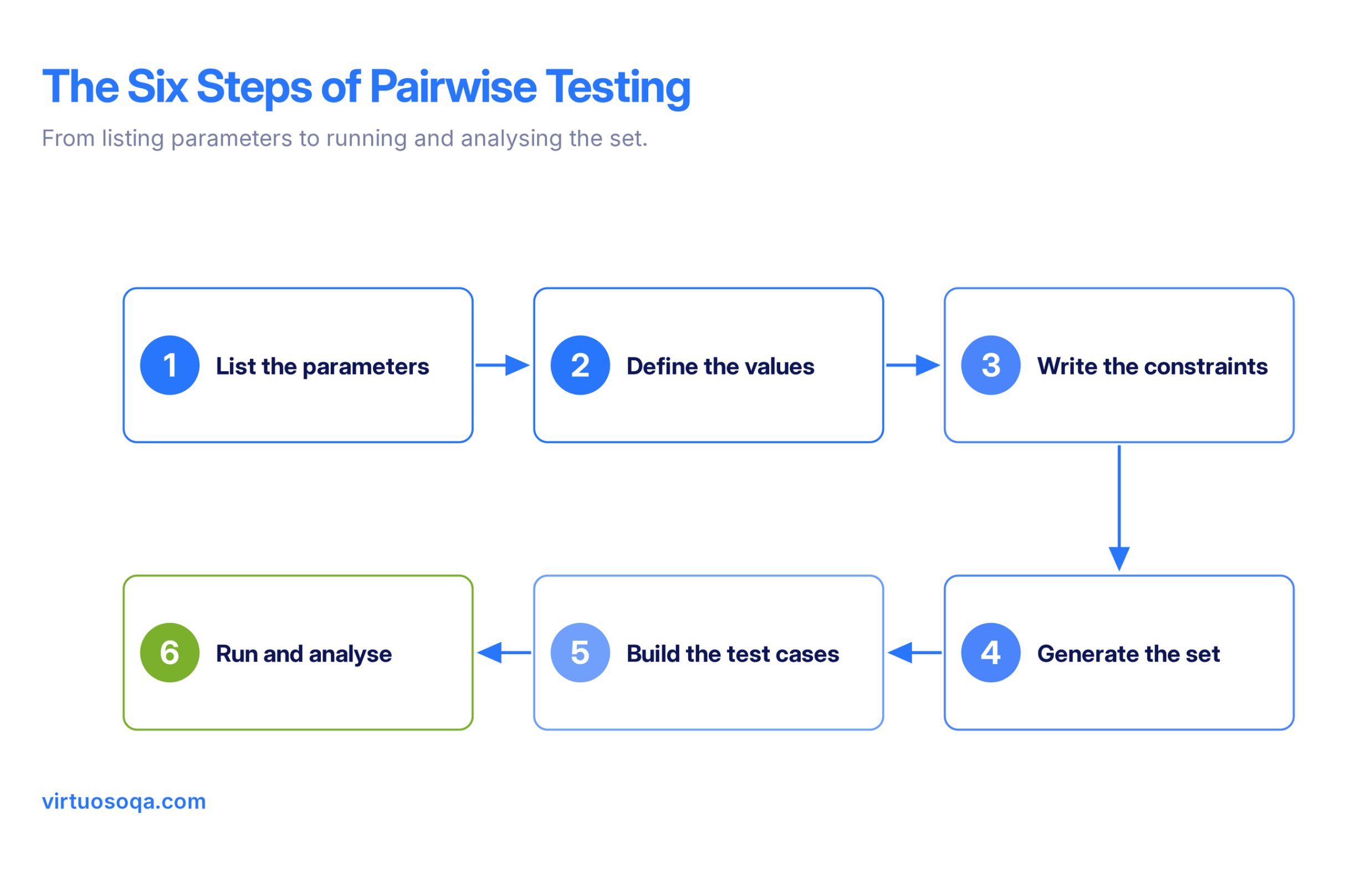
1. List the Input Parameters
Write down everything the feature takes, pulling from requirements, a chat with the developers, and a bit of hands-on poking to catch the parameters nobody documented, then rank them by which ones are most likely to interact.
2. Pin Down the Values for Each
List the discrete values that represent the states worth caring about, leaning on equivalence classes and boundary values to keep it tight, and chop any continuous parameter into representative values first.
3. Write the Constraints
Get the exclusion, inclusion, and conditional rules down before you generate, not after, so the set that comes out is actually runnable.
4. Generate the Set
Feed the parameters, values, and constraints into a generator and let it produce the minimal set that covers every pair, because doing this by hand past three or four parameters is a good way to make mistakes.
5. Turn the Output into Test Cases
Make each row a test case with clear expected results, or point a single data-driven test at the rows and run it once per combination.
6. Run it and Read the Results
Execute, keep the parameter values attached to each result, and when something fails work out whether it is a real interaction bug or a broken test, then watch which values keep showing up in failures because that points at the root cause faster than staring at logs.

Pairwise in the AI-Coded Era
AI coding assistants have changed the picture in enterprise development, and the change makes pairwise more valuable, not less. The core reason is simple, namely that AI-built systems tend to sprout more configuration parameters than human-designed ones.
An assistant will add an option, a flag, a feature toggle, a regional variant, or a permission level without the design pushback that used to keep parameter counts in check, so AI-coded apps show up with bigger parameter spaces than their predecessors. Bigger spaces sharpen the exact asymmetry pairwise trades on, because the full combination count explodes while the pairwise set only inches up, so every parameter the assistant adds makes the case stronger.
There is a second reason on top of that. AI-generated code seems more likely than hand-written code to fumble specific parameter combinations, because the model has seen each parameter on its own plenty of times and the particular pairings far less, so the bugs cluster in the combinations it saw least. Put the two together and the sensible response is to lean into combinatorial coverage, not back off it, because it is one of the highest-leverage things a QA team can do when a machine is writing the code underneath.
Pairwise and Other Test Design Techniques
Pairwise is one tool on the bench, not a replacement for the rest, and a good test design combines them on purpose. Spelling out how they fit together shows why a suite built on pairwise alone still has holes.
With Boundary Value Analysis
Boundary analysis picks the values at the edges of each parameter and pairwise combines them, so they slot together neatly, one choosing values and the other choosing combinations.
With Equivalence Partitioning
Equivalence partitioning finds the value classes pairwise then draws its representative values from, which keeps those values meaningful rather than arbitrary.
With Decision-Table Testing
The decision table makes the business rules explicit, and pairwise covers the parameter interactions those rules run across.
With State-Transition Testing
Pairwise handles the configuration combinations while state-transition testing handles the behavioural sequences, so together they cover both the setup and the behaviour.
With Exploratory Testing
Pairwise sets a coverage floor, and exploratory testing goes after the long tail of edge cases and higher-order oddities that no systematic generation surfaces.
Lean only on pairwise and you miss boundary, edge-case, and high-order bugs. Drop pairwise and you miss the combination bugs it was built to catch. A complete design keeps both, which is the unglamorous truth most tool-comparison posts skip.
How Virtuoso QA Supports Combinatorial Testing
Most pairwise efforts die in the same spot. Someone generates a lovely covering set, the product then grows and the parameter space shifts, and the set quietly rots because regenerating and re-linking it by hand is a chore that always loses to whatever else is on the backlog. Generating the set was never the hard part. Keeping it honest as the system moves underneath you is.
Virtuoso QA is an AI-native platform that lives right where that rot sets in. Parameter definitions and their values are written in plain English through Natural Language Programming, sitting next to the tests and use cases they belong to, so the modelling that pairwise depends on stays close to the tests instead of drifting off into a separate tool nobody updates.
GENerator, the platform's agentic engine, can draft parameter definitions and cases from what you already have, namely existing assets and specifications, which takes the sting out of the up-front modelling, and the cases it produces are linked to the requirements they check and run across a broad cross-browser grid.
Self-healing keeps those cases working as the interface shifts, which cuts the maintenance rather than making it vanish, and its proposed repairs land at roughly 95% user acceptance with a human still in the loop.
AI Root Cause Analysis puts the evidence behind a failure in front of you, namely screenshots, logs, and the affected functional area, which is exactly what you need to tell a real interaction bug from a broken setup.
Every AI action is proposed for review, run by a deterministic engine, and recorded, so the autonomy stays governed, and enterprises including London Market Group and AerCap use the platform to keep their coverage current as the code keeps changing.
A Practitioner Checklist for Pairwise Testing
A short checklist captures the discipline, and if you only take one thing from it, take the last item, namely that the parameter space keeps moving and your set has to move with it. That is the difference between teams that get years of value out of pairwise and teams that generate one set and forget about it.
Identify parameters and values deliberately, not by default, and discretise any continuous parameters first.
Specify constraints explicitly, covering the exclusion, inclusion, and conditional rules.
Choose the generator for the constraint depth and integration the task needs.
Review the output for invalid combinations the constraints did not catch.
Complement pairwise with boundary value tests on each parameter, decision-table tests for explicit rules, and exploratory testing for the long tail.
Add higher-order coverage selectively, where defect history justifies it.
Link generated cases to requirements and use cases for traceability.
Execute in CI/CD rather than as a one-time exercise, and regenerate when the parameter space changes rather than patching the old set.
Related Reads
Frequently Asked Questions
How Many Test Cases Does Pairwise Testing Produce
What Is an Orthogonal Array in Pairwise Testing
How Do You Perform Pairwise Testing Manually
What Is N-Way Combinatorial Testing
How Does AI-Assisted Coding Affect Pairwise Testing
How Does Virtuoso QA Support Pairwise Testing
" height="10.182000000000016px" id="C361dJxCp" width="11.692999999999984px"/></svg>)