Blog
What is Use Case Testing: QA Expert's Guide

Adwitiya Pandey
Published on

Table of contents
Lorem ipsum
Lorem ipsum
Lorem ipsum
Lorem ipsum
Lorem ipsum
Use case testing is a way of verifying software by checking whether real users can complete the journeys they came to complete. Rather than testing individual functions in isolation, it tests the full path from start to finish: the steps the user takes, the responses the system gives, and the state the system is in when the journey ends. If the user cannot reach their goal, the test fails. If the system behaves unexpectedly along the way, the test surfaces it.
Most testing techniques ask whether the system works. Use case testing asks whether the system works for the user. The distinction is what makes it one of the most valuable techniques in enterprise software testing.
What is a Use Case?
A use case describes how a user interacts with a system to reach a specific goal.
It captures three things:
What the user is trying to do
The steps they take to do it
How the system responds at each step
For example, a "Submit a Claim" use case describes a policyholder selecting a policy, entering claim details, uploading documents, and receiving a confirmation reference. It does not describe which button they clicked or which API call fired. Those details belong in the test case.
A use case is not a test. It is the specification the test is derived from. The use case describes the journey. The test proves the journey works.
Components of a Use Case
Every use case contains seven components. Each one generates a distinct set of test cases, which is why none of them should be left out.
Actor: The person, organisation, or external system pursuing the goal.
For example: Registered policyholder, admitting clerk, department head approving a purchase order
Goal: What the actor is trying to achieve, written in the actor's language rather than the system's.
For example: "submit a claim" rather than "POST to /api/claims"
Preconditions: What must be true before the use case can begin.
For example: The actor is authenticated, the policy is active, the claim incident date falls within the coverage window
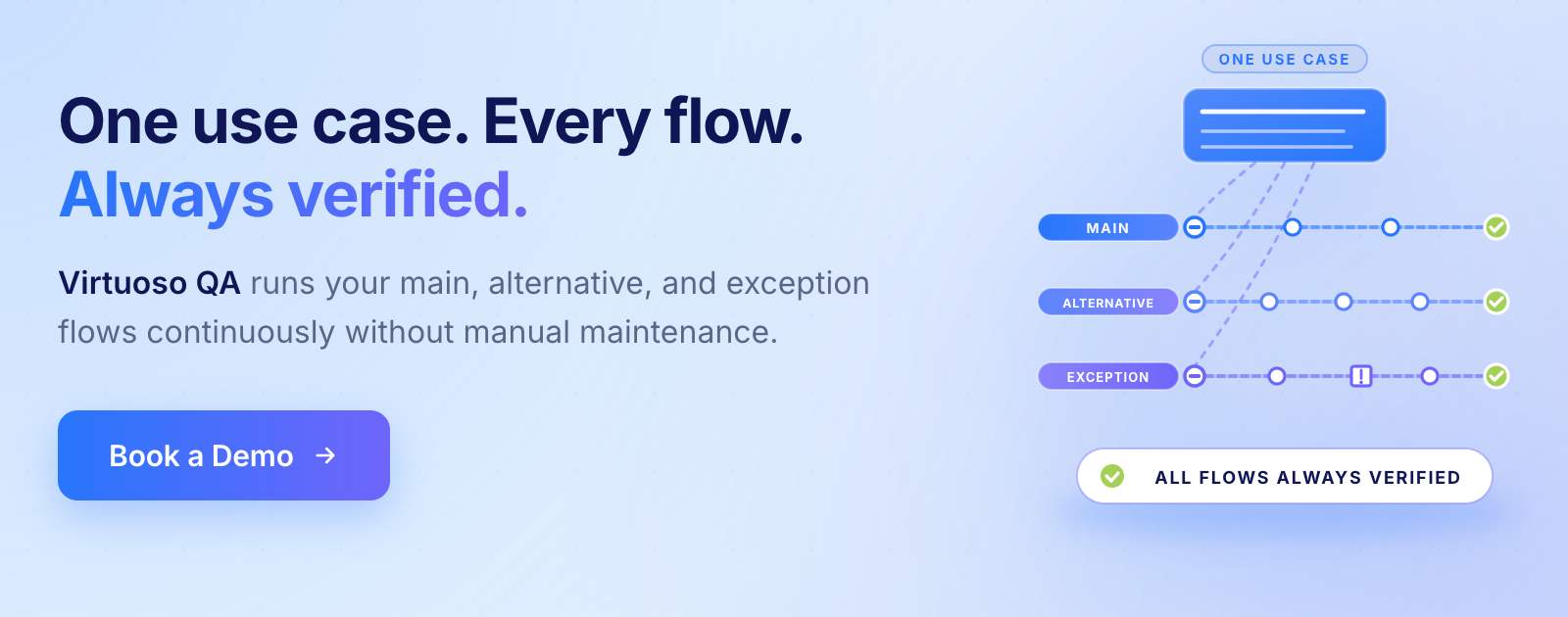
Main success scenario: The numbered sequence of steps through which the actor achieves the goal under normal conditions. This is what most people call the happy path
Alternative flows: Other paths through which the actor can still reach the same goal.
For example: Submitting a claim via mobile versus submitting via desktop, or paying with a saved card versus a new card
Exception flows: The conditions under which the goal cannot be reached, and how the system should respond when that happens.
For example: The incident date falls outside the coverage window, a required document is missing, or the downstream routing service is unavailable
Postconditions: What must be true after the use case completes, whether the journey succeeded or ended in an exception.
For example: A claim record exists, the actor has received a reference number, an audit entry has been written
The alternative and exception flows are where most of the testing value sits. Most journeys succeed. The failures that reach production are almost always the result of exception flows that were not properly specified or tested.
Use Case Example of Submitting a Claim
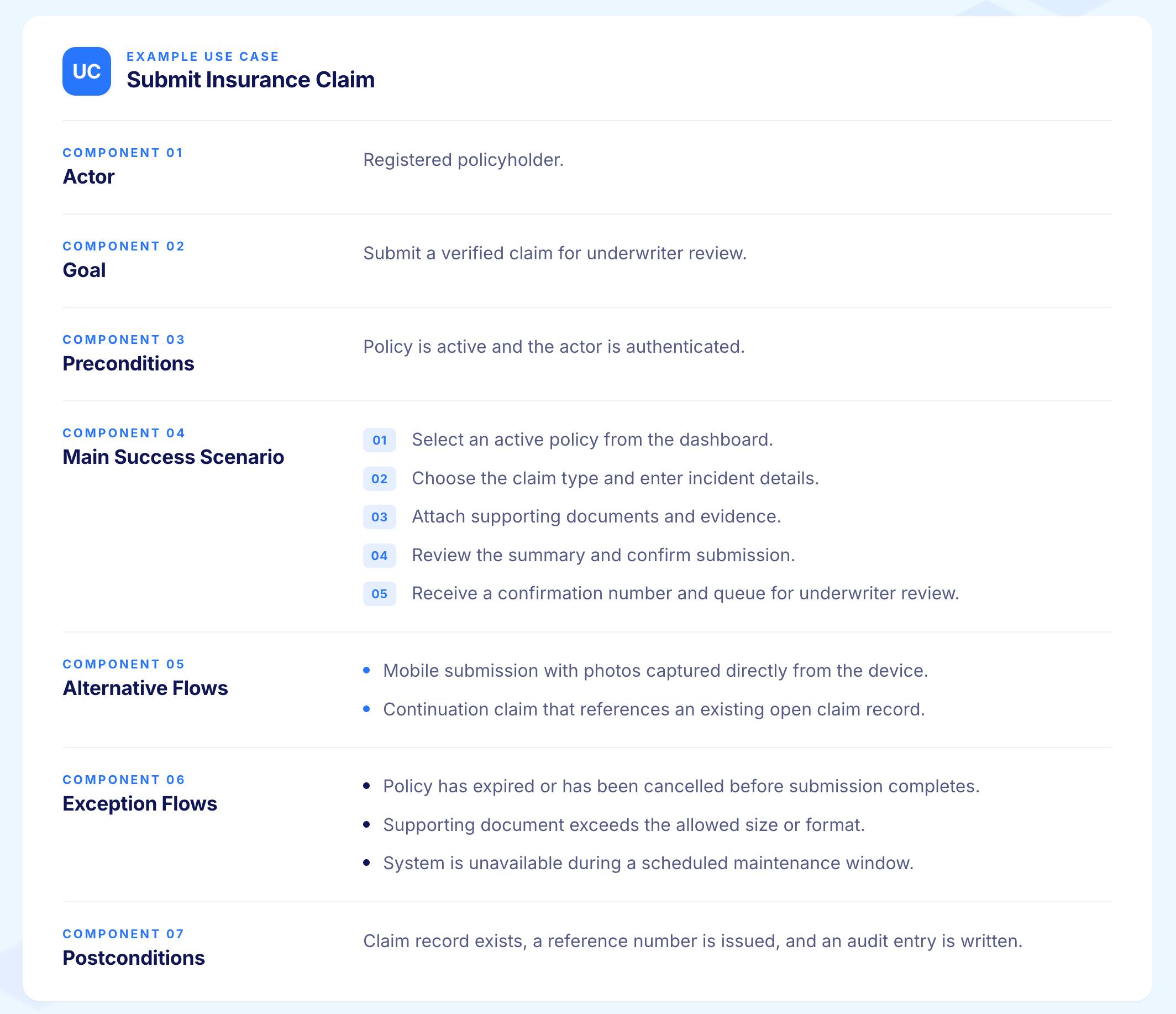
To make the components concrete, here is a complete use case for a claims intake journey at a property and casualty insurer.
Actor: Registered policyholder, authenticated, with at least one active policy
Goal: Lodge a claim record in the system, receive a reference number, and have the claim routed to the correct queue for next-step action
Preconditions: The policyholder has an active policy. The claim incident date falls within the policy coverage window. The policyholder is authenticated.
Main success scenario:
Policyholder selects the affected policy from their active portfolio
Policyholder identifies the incident type from the available categories
Policyholder completes the structured incident description
Policyholder uploads the required supporting documentation
Policyholder confirms the submission
System returns an on-screen confirmation with a claim reference number and routes the claim to the underwriter queue
Alternative flows:
Submission via mobile app (different document upload mechanism, same routing outcome)
Submission of a continuation claim against an existing open record (different routing, same submission process)
Exception flows:
Incident date falls outside the coverage window: system declines the submission and explains the reason clearly
Required documentation is missing: system saves a partial record and prompts the policyholder to return and complete it
Downstream queue service is unavailable: system queues the submission and sends a confirmation once routing succeeds
Postconditions: A claim record exists with the correct status. The policyholder has received a reference number on screen and by email. An audit entry has been written with the submission timestamp and policyholder identity.
What is Use Case Testing?
Use case testing is a black-box test design technique that derives test cases from use cases. Each test verifies that an actor can reach their goal through one of the flows the use case defines. The full set of tests for a use case covers the main success scenario, every alternative flow, and every exception flow.
Use case testing answers one specific question: can the user complete the journey they came here to complete? Other techniques answer different questions.
Component testing answers whether each part of the system works in isolation. Integration testing answers whether the parts work correctly when connected. Use case testing answers whether the whole system works for the user, end to end, across every path the user might take.
Why Use Case Testing Matters
1. It Tests What Actually Breaks in Production
Most production failures are not caused by individual functions failing in isolation. They are caused by complete user journeys breaking: the customer cannot submit the claim, the patient cannot be admitted, the order cannot be approved.
Unit tests and integration tests can all pass while a journey fails, because no test owned the end-to-end behaviour. Use case testing owns the journey.
2. It Catches the Failures That Other Techniques Miss
Component testing verifies that each part works independently. It cannot verify that two parts work correctly together when a real user moves between them. Integration testing verifies that connections between systems are functioning. It does not verify that the full workflow the user takes produces the correct outcome.
Use case testing fills both gaps by verifying the complete journey from the actor's first action to the final postcondition.
3. It Keeps Teams Aligned Across a Complex Organisation
In large enterprise environments, a single customer journey often crosses several teams, several systems, and several release cycles. A claims journey might pass through a digital channel owned by one team, a policy lookup service owned by another, a fraud screening integration owned by a third, and a payment service owned by a fourth. Each team has its own backlog and its own definition of done.
Use case testing is the only technique that verifies the full journey across all of those boundaries.
4. It Produces Test Coverage That Stakeholders Can Read and Confirm
A list of use cases is readable by a product manager, a compliance officer, and a business analyst. A list of 1,400 test case IDs is not.
Use case testing creates a coverage layer that non-technical stakeholders can review and challenge. This matters during release decisions, compliance audits, and requirements reviews.
5. It is the Most Durable Form of Specification a Team Produces
Interfaces change. Code gets rewritten. Frameworks get replaced. The use case, written at the level of what the user wants to achieve, does not change when any of those things happen.
A use case written for a claims submission journey at an insurer will still be valid five years and three UI redesigns later. The implementation changes. The goal does not.
Use Case Testing vs Other Black-Box Techniques
Use case testing sits alongside several other black-box test design techniques. Each technique addresses a different layer of verification and none of them replace the others.
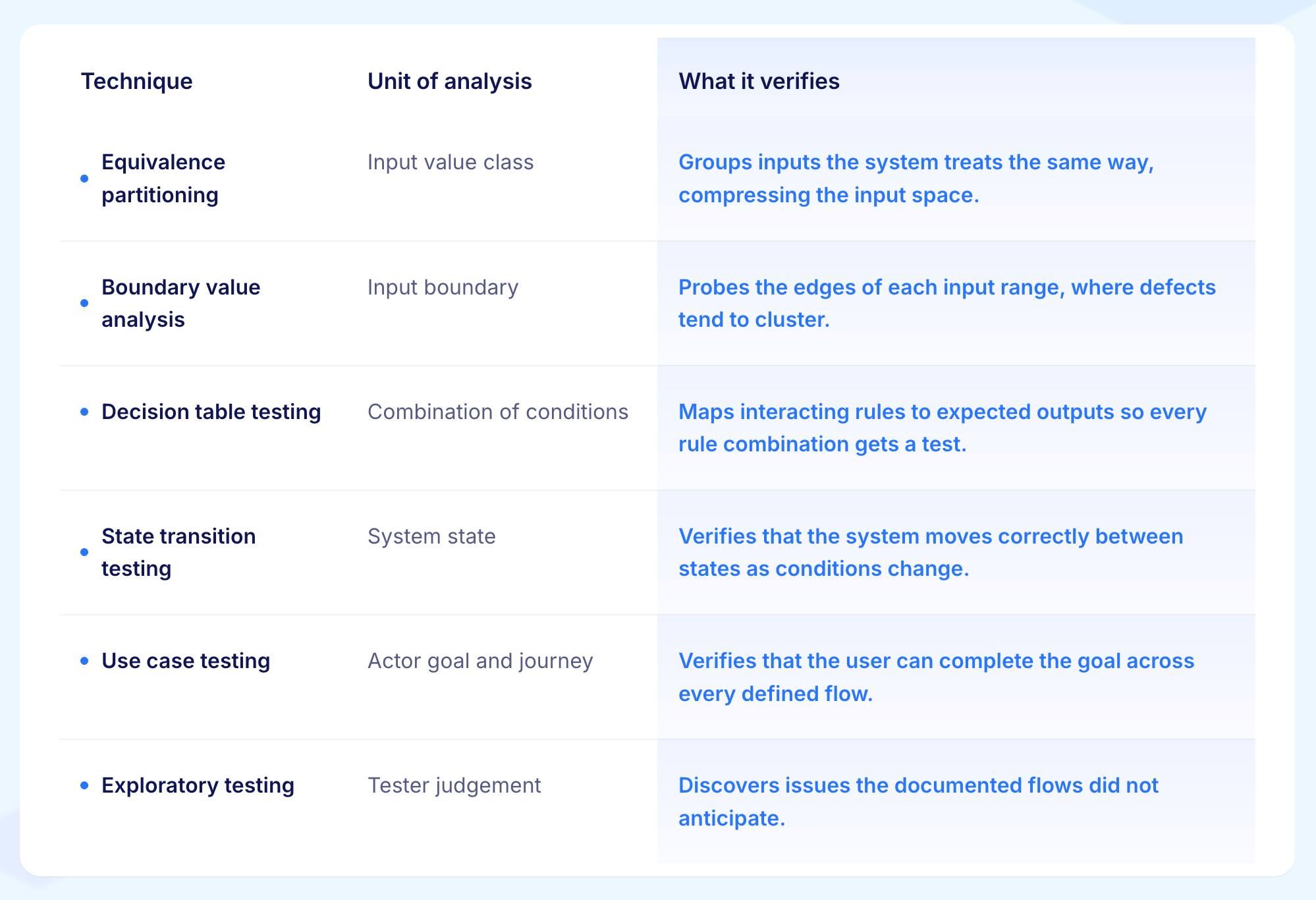
The relationship between these techniques is layered rather than competitive. Within a single step of a use case, equivalence partitioning and boundary value analysis handle the input space.
Across steps in a stateful use case, state transition testing verifies that the system advances correctly. Across interacting rules within a flow, decision table testing organises the combinations.
Use case testing is the integrating layer that holds the rest together: it defines the journey the user is taking, and the other techniques fill in the detail within each step of that journey.
A complete enterprise test programme rarely uses any one technique alone. Use cases define the journey-level coverage. The other techniques add precision within it.
How to Apply Use Case Testing: A Step-by-Step Guide

Step 1: Start From the Use Case, Not the Test Case
What to Do:
Read or write the full use case before writing any test cases
Confirm the use case contains all seven components: actor, goal, preconditions, main success scenario, alternative flows, exception flows, and postconditions
If any component is missing, complete the use case before deriving tests from it
Why it Matters:
Test cases derived from an incomplete use case have gaps by design. If the preconditions are not defined, the test cannot be set up correctly.
If the postconditions are not defined, the test cannot confirm the system reached the right state.
If the exception flows are not defined, the test suite has no coverage for the failures that cause the most production incidents.
Example:
A QA lead preparing to test the claims submission journey reviews the use case and finds that the actor, goal, preconditions, main success scenario, alternative flows, and postconditions are all documented. However, the exception flows are missing entirely.
Before writing a single test case, the QA lead works with the product manager to add three exception flows:
A claim submitted with an incident date outside the coverage window
A claim submitted without the required supporting document
A claim submitted while the downstream routing service is unavailable
Each of those three exception flows becomes a test case. Without this step, all three would have been missing from the test suite. The use case now contains all seven components and test writing begins only at this point.
Step 2: Write One Test for the Main Success Scenario
What to Do:
Write a test case that takes the actor through the main success scenario from start to finish
Set up the preconditions exactly as the use case specifies before the test begins
Verify the postconditions explicitly after the journey completes
Do not add edge cases or input variations to this test: those belong in separate cases
Why it Matters:
The main success scenario test confirms that the most direct path through the use case works under standard conditions. It is the baseline every other test depends on. If the main path fails, the alternative and exception flow tests cannot be interpreted meaningfully because the foundation has not been confirmed.
Example:
Use case: Claims submission
Setup:
Policyholder is authenticated
Policy is active
Claim incident date falls within the coverage window
What the test does: Walks through all six steps of the main flow from policy selection to submission confirmation.
What the test verifies at the end:
Claim record exists in the system with the correct status
Policyholder has received a reference number
Audit entry has been written with the correct timestamp
What this test does not cover: Missing documents and expired policies. Those are separate tests derived from the exception flows.
Step 3: Write One Test for Each Alternative Flow
What to Do:
Write a separate test case for each alternative flow in the use case
Verify that the actor reaches the same goal through the alternative path as through the main path
Check that any journey-specific state is correct on arrival: an alternative flow sometimes produces a different audit trail, a different record structure, or a different notification than the main flow
Why it Matters:
Alternative flows often carry hidden business rules that the main flow does not exercise. A mobile submission may use a different document upload mechanism than a desktop submission. A continuation claim may route differently than a new claim. Both should reach the same goal but the state of the system on arrival may differ. A test suite that only covers the main flow will miss those differences entirely.
Example:
The claims submission use case has two alternative flows.
Alternative flow 1: Submission via mobile app
The difference from the main flow is that the mobile app uses a different document upload mechanism. The test sets up the same preconditions as the main flow test but executes the submission through the mobile interface.
It verifies that the claim record contains the correct document references and that the routing outcome is identical to the main flow result.
Alternative flow 2: Continuation claim against an existing open record
The difference from the main flow is that a new claim is not created. Instead, the submission links to an existing record.
The test sets up an open claim record in the system for the same policyholder and submits a continuation claim referencing it. It verifies that the system identifies the existing record, links the new submission to it, and routes it through the continuation workflow rather than the standard new claim workflow.
Step 4: Write One Test for Each Exception Flow
What to Do:
Write a separate test case for each exception flow in the use case
Verify two things for each exception flow: that the system correctly recognises the exception condition, and that it responds in the way the use case specifies
Check that the system state after an exception is correct: no partial record should be created where one is not supposed to exist, and no record should be left in an inconsistent state
Why it Matters:
Exception flow tests are where most use case test suites earn their place. The majority of user journeys succeed. The failures that reach production and damage customer trust are almost always the exception flows that were never properly tested.
Testing exception flows as carefully as the main flow is the discipline that separates a basic test suite from one that actually protects customers.
Example:
The claims submission use case has three exception flows.
Exception flow 1: Incident date outside the coverage window
The test sets up a policyholder with an active policy but uses an incident date that falls one day before the policy start date. It attempts to submit the claim and verifies two things: the system returns a clear rejection message explaining why the claim cannot be submitted, and no claim record has been created in the system.
Exception flow 2: Missing required document
The test sets up all preconditions correctly but does not upload the required supporting document before submitting.
It verifies that the system saves a partial record, returns a clear message explaining what is still needed, and allows the policyholder to return and complete the submission. It also confirms the partial record can be retrieved.
Exception flow 3: Downstream routing service unavailable
The test sets up a complete, valid claim but simulates the routing service being unavailable at the time of submission. It verifies that the system queues the submission rather than losing it, confirms receipt to the policyholder, and routes the claim correctly once the service recovers.
Step 5: Verify Preconditions and Postconditions in Every Test
What to Do:
Begin every test by confirming that the preconditions are in place before the first step executes
End every test by verifying every postcondition in the use case before marking the test as passed
Treat a test that runs on incorrect precondition state as a failed test, not an inconclusive one
Why it Matters:
A test that runs without its preconditions verified has provided no reliable information. If it fails, the cause could be the system behaving incorrectly or the precondition simply not being in place.
Without confirming the preconditions, those two causes cannot be separated. A test that skips the postcondition check confirms that the user performed the right steps but does not confirm that the system arrived in the right state.
Example:
Use case: Claims submission main success scenario
Precondition checks run before step one:
The test confirms that the policyholder's session token is valid and the role is correct. It queries the policy record and confirms the status is active. It checks that the incident date in the test data falls within the policy start and end dates. All three must be confirmed before the test proceeds to step one.
Postcondition checks run after step six:
The test queries the database to confirm the claim record exists with a reference number matching what was shown on screen. It checks the audit log for an entry containing the submission timestamp and the policyholder identity. It checks the underwriter queue for the claim reference with the status Pending Review.
The test passes only when all three preconditions are confirmed at the start and all three postconditions are confirmed at the end.
Worked Examples From Enterprise Practice
Most examples available online use a login form or a shopping cart. Those examples work for introducing the concept. They do not prepare a QA team for the complexity of enterprise software. The two examples below are drawn from realistic enterprise contexts.
Example 1: Admit a Patient at a Health System
A health system operates an admission platform across multiple hospitals covering elective, emergency, and transfer admissions.
Use case: Admit a patient for an elective procedure
Actor: Admitting clerk, authenticated, with permissions for the relevant facility
Goal: Create an admission record linked to the scheduled procedure, with insurance verification complete and bed assignment recorded
The test set derived from this use case:
Main flow test: Clerk admits a patient who exists in the master record, has a scheduled procedure, has active insurance, and has an available bed in the assigned ward. The test verifies that the admission record is created, the bed shows occupied in the bed management system, insurance disposition is recorded, and the wristband print is triggered.
Alternative flow test 1: Patient is new to the system. The test verifies that the clerk can create the master patient record as part of the admission process without the admission failing or requiring a separate workflow.
Alternative flow test 2: Procedure has been rescheduled since the patient's last check. The test verifies that the clerk is prompted to reconcile the scheduled date before the admission proceeds and that the resulting record reflects the corrected procedure date.
Exception flow test 1: Insurance verification fails during admission. The test verifies that the system flags the record, prompts the clerk to record a self-pay declaration or contact the insurer, and does not block the admission indefinitely.
Exception flow test 2: The bed assigned to the patient is no longer available. The test verifies that the system alerts the clerk, suggests available alternatives in the same ward, and records the final bed assignment correctly.
Exception flow test 3: The scheduled procedure no longer exists in the system when the clerk attempts admission. The test verifies that the system blocks the admission and directs the clerk to verify the schedule before proceeding.
Example 2: Approve a Purchase Order at a Global Manufacturer
A global industrial manufacturer routes purchase orders through an ERP approval workflow with value-tier-based role permissions and budget centre capacity controls.
Use case: Approve a purchase order
Actor: Approver with the role permission appropriate to the order's value tier
Goal: Mark the purchase order as approved, route it for fulfilment, and write the approval audit entry
The test set derived from this use case:
Main flow test: Approver reviews a purchase order within their value tier, the budget centre has available capacity, and the supplier risk flag is clear. The test verifies that the order state advances to approved, an audit record is written with the approver identity and timestamp, and fulfilment routing is triggered.
Alternative flow test 1: Approver approves with conditions by attaching a note that constrains fulfilment. The test verifies that the note is recorded against the order and that the fulfilment team receives the note alongside the approval.
Alternative flow test 2: Approval is delegated by an out-of-office colleague. The test verifies that the delegation chain is recorded in the audit entry and that the delegated approver has the correct permissions for the order's value tier.
Exception flow test 1: The budget centre is over capacity at the time of approval. The test verifies that the system blocks the approval, routes the order for executive review, and records the block reason in the audit entry.
Exception flow test 2: The order value exceeds the approver's role tier. The test verifies that the system requires escalation to a higher-tier approver rather than permitting the approval, and that the escalation is recorded.
Exception flow test 3: The supplier risk flag has been raised since the order was created. The test verifies that the system requires the approver to acknowledge the risk flag explicitly before the approval can proceed, and that the acknowledgement is recorded.
Who Performs Use Case Testing?
Use case testing involves several roles at different stages of the process, and the quality of the output depends on all of them contributing at the right moment.
Business analysts and product managers own the use cases. They write the use case documents, define the actor and the goal, and enumerate the alternative and exception flows.
The quality of the test set depends directly on the quality and completeness of the use case they produce. A use case with no exception flows produces a test set with no exception coverage.
QA engineers derive the test cases from the use cases. They read each flow, define the preconditions and test data required to set up that flow, write the numbered steps, specify the expected results, and confirm the postconditions that must hold at the end. They also identify where the use case is incomplete or ambiguous and flag it for the business analyst before writing tests against it.
Developers benefit from understanding the use cases their code must support, particularly the exception flows, which are the most common source of implementation gaps.
In teams that practice shift-left testing, developers may write or review use case test cases alongside their implementation work.
Stakeholders and product owners review the use case test set to confirm that coverage matches the business requirements.
A stakeholder who can read the list of use cases and confirm that all critical journeys are represented is providing a form of test planning review that no purely technical audit can replicate.
Use Case Testing in Agile Development
Agile development reshapes how use case testing is applied without reducing its value. Three patterns work well in practice.
Use Cases as Acceptance Criteria
In Agile sprints, use case flows often serve as the acceptance criteria for user stories. The main success scenario becomes the primary acceptance criterion.
The alternative flows become additional acceptance criteria. The exception flows become the acceptance criteria that verify the system handles failures gracefully. This framing keeps sprint review conversations focused on whether the user can complete the journey rather than on whether individual components pass their unit tests.
Use Cases Spanning Multiple Sprints
A single use case in enterprise software often corresponds to several user stories delivered across several sprints. The claims submission use case might span a sprint for the intake form, a sprint for document upload, a sprint for the routing integration, and a sprint for the confirmation and audit trail.
Use case testing verifies the journey across all those sprints together, catching the failures that appear only when all the pieces are assembled and a real user tries to move through the full flow.
Behaviour-Driven Development as the Bridge
BDD with Gherkin syntax (Given, When, Then) sits between use cases and test cases in a format that product managers can read and automation frameworks can execute.
A Gherkin scenario derived from a use case flow reads like a use case in plain language and runs like a test case in a CI/CD pipeline. Teams that adopt BDD for their use case flows get documentation that stays current because it runs continuously, rather than use case documents that drift from the implementation over time.
Related Reads: What is Agile Testing? Principles, Types and Best Practices
When Use Case Testing is Not the Right Leading Technique
Use case testing is the right technique for verifying goal-oriented journeys with a defined actor. It is not the right leading technique for every testing context.
1. Early Discovery Work Where the Flows Are Still Forming
When the team is still working out what the user actually needs to do, writing formal use cases too early can lock in a design before its shape is clear.
Early-stage product work is better served by exploratory testing and prototype validation. Use case testing becomes valuable once the flows are stable enough to document.
2. Systems Where the Primary Function is Data Processing Without a Human Actor
Batch processing systems, data pipeline transformations, and scheduled reporting jobs often have no interactive user. The core verification is at the data-contract level rather than the journey level.
Decision table testing and state transition testing tend to be more directly applicable, though use cases can still be written for the operators who configure or monitor such systems.
3. Non-Functional Testing Disciplines
Performance testing, accessibility auditing, and security testing each have their own disciplines that go beyond what use case testing addresses.
Use case testing intersects with all three: a use case has a performance characteristic, an accessibility audit exercises a use case, a security test probes the exception flows of a use case for vulnerabilities.
But use case testing does not replace any of them. A complete test programme runs use case testing alongside specialist non-functional disciplines rather than instead of them.
Common Mistakes in Use Case Testing
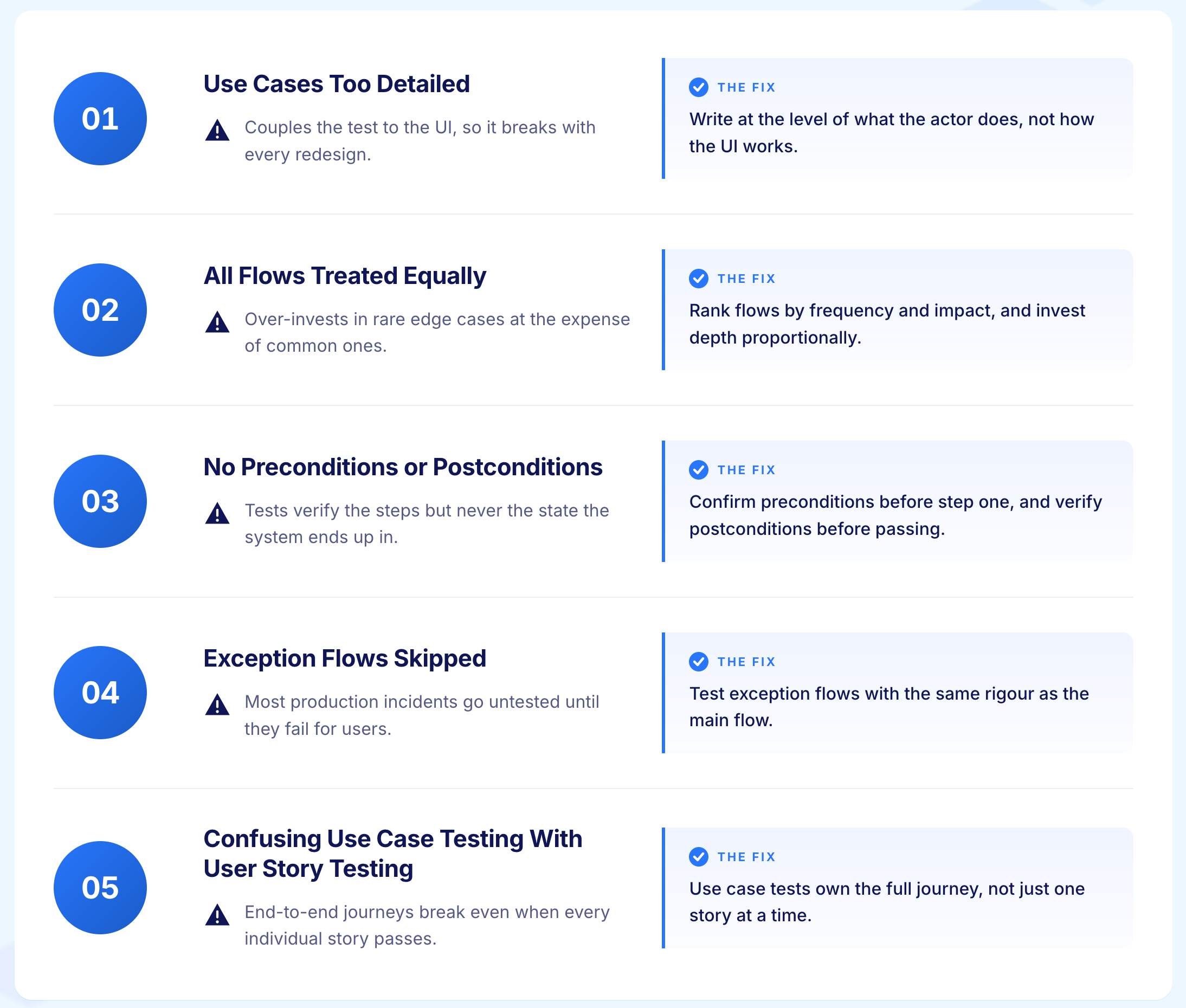
1. Writing Use Cases That Are Too Detailed
A use case is not a test script. A main success scenario with twenty numbered steps, each describing a single click or a single field entry, is not a use case. It is a screen recording of the current interface, and it will need to be rewritten every time the interface changes.
A well-written use case describes each step at the level of what the actor does, not how the current UI lets them do it.
For example: "Policyholder uploads supporting documentation" is a use case step. "Policyholder clicks the Upload button, selects claim_evidence.pdf from the file picker, and clicks Open" is a test case step. The first survives a UI redesign. The second does not.
2. Treating Every Flow as Equally Important
Some flows are exercised by the majority of users every day. Others are exercised by a small number of users in unusual circumstances.
A test programme that allocates the same depth of coverage to a high-frequency main flow and a rare edge case exception flow is not making good use of its resources.
Rank flows by how often they occur and by how much damage they cause when they break. Invest test depth proportionally. The daily high-volume flow and the low-frequency but high-impact exception flow both deserve thorough coverage.
The rare, low-impact edge case can receive lighter treatment.
3. Skipping Preconditions and Postconditions
Many teams document the main flow carefully and omit the preconditions and postconditions. The result is tests that verify the steps the actor took but not the state the system was in before the steps began or the state it reached after they ended.
A test that passes because the precondition happened to be in place, rather than because it was verified and established, is a test whose results cannot be trusted.
A test that passes because the steps were followed but does not check whether the claim record was actually created is a test that would pass even if the system quietly failed to write the record.
4. Skipping Exception Flow Tests
Exception flows receive less attention than main flows because they describe failure modes, and failure modes are less satisfying to test than success paths. But exception flows are where most production incidents originate.
A claims platform that produces a generic error message when a required document is missing, or that creates a partial claim record that cannot be retrieved or completed, causes more customer damage than a system that rejects the submission clearly.
Test exception flows with the same rigour as main flows. The failures that reach production almost never come from the main flow.
5. Confusing Use Case Testing With User Story Testing
A user story acceptance test verifies that a specific piece of functionality was delivered as specified. A use case test verifies that the full journey the user takes works end to end.
Both kinds of test can pass while the journey still fails, because the user story acceptance tests each verify one piece of the journey and no single test owns the whole.
A checkout user story can pass its acceptance tests while the full order placement journey fails at the point where the checkout connects to the payment service. Use case testing owns that failure. User story testing does not.
Best Practices for Use Case Testing
1. Write Use Cases Before Writing Tests
The test derives from the use case. A test written without a use case to anchor it has no clear standard to verify against. The question "did this test pass?" requires the question "pass according to what?" to be answered first. The use case is the answer to that question.
2. Make Every Use Case Testable Before Deriving Tests From it
A use case is testable when the actor is specific enough to set up, the goal is observable rather than subjective, the preconditions are checkable, the main flow is numbered rather than written as a paragraph, the alternative and exception flows each describe a complete journey rather than a variation on one step, and the postconditions are things that can be verified rather than things that can only be assumed.
3. Prioritise High-Value Use Cases
Business-critical journeys deserve deeper test coverage than low-risk peripheral flows. The criteria for priority are frequency (how often users take this journey), business impact (how much it costs when the journey breaks), and complexity (how many alternative and exception flows the journey has).
A claims submission journey at an insurer, a trade execution journey at a bank, and a patient admission journey at a hospital all sit at the top of the priority list. An administrator report export journey sits lower.
4. Keep Use Cases Updated When Business Goals Change
A use case that describes a journey the business no longer supports is worse than no use case at all, because tests derived from it are testing the wrong thing. When requirements change, update the use case first. Then update the tests that derive from it. The use case is the source of truth. The tests follow from it.
5. Test Exception Flows as Carefully as Main Flows
Allocate the same preparation time to an exception flow test as to a main flow test. Write the preconditions as carefully. Specify the expected response as precisely. Verify the postconditions as explicitly. The exception flows are where the most valuable defect detection happens.
6. Combine Use Case Testing With Other Techniques at the Right Layers
Use cases define the journey-level coverage. Equivalence partitioning and boundary value analysis add precision within individual steps.
State transition testing verifies state changes between steps in stateful flows. Exploratory testing discovers the failures the documented flows did not anticipate.
A complete test programme uses all of these, with use case testing providing the frame and the other techniques filling in the detail.
How Virtuoso QA Supports Use Case Testing
Virtuoso QA is built around the principle that the journey the customer takes is the unit of verification that matters most.
Composable testing libraries allow each use case flow to be expressed as a reusable, named test module. A claims submission main flow, a mobile alternative flow, and each exception flow are separate modules that can be assembled into a full use case test suite and reused across every project that involves the same journey.
A use case written once becomes a living test asset rather than a static document.
GENerator reads use cases, requirements, user stories, and BDD scenarios and produces ready-to-run Virtuoso QA journey tests from them. The manual step of translating a use case into a test case happens automatically.
The team reviews the output, adds the edge cases that only domain knowledge can surface, and moves on to the next use case.
Self-healing AI at approximately 95% accuracy keeps use case tests valid as the application changes. When the claims submission form is redesigned and the document upload button moves, the test adapts automatically rather than breaking and waiting for manual repair. The use case still describes the same journey. The test still verifies it.
AI Root Cause Analysis explains test failures in terms of the use case flow that broke rather than the implementation detail that changed. When a claims submission exception flow test fails, the analysis surfaces whether the failure was in the precondition setup, in the system's response to the exception condition, or in the postcondition state.
The QA team knows exactly which part of the use case the system failed to support.
Risk-based execution prioritises use case tests based on what changed in the latest release and which journeys carry the highest business risk. The pipeline gates on the customer outcomes that matter rather than running the full suite uniformly on every commit.

Related Reads
Frequently Asked Questions
What are the components of a use case?
What is the difference between use case testing and user story testing?
Can use case tests be automated?
When should use case testing not be the leading technique?
How does use case testing fit into Agile development?
How does AI change use case testing?