

Blog
Scrum Testing: How it Really Works in Sprints

Published on
August 3, 2026


A practitioner's take on Scrum testing, namely the ceremonies, the Definition of Done, the velocity gap, and the shift AI has forced.
A sprint is roughly fifteen working days. Two go to ceremonies, eight to development, and five, on a good week, to testing. The arithmetic is why Scrum testing keeps drifting toward the end of the sprint, and why the drift produces the failure pattern every QA leader knows by heart, namely the Friday before release, the unfinished story, and the carry-over that quietly becomes next sprint's debt.
Most teams running Scrum think they have a testing problem. What they actually have is a sequencing problem. Testing happens after the code, the code lands at the end of the sprint, and the result is the same shape of failure no matter how good the testers are.
The fix is not more testers. The fix is treating verification as a parallel activity rather than a final stage, and rewriting the Definition of Done so that fix is structural rather than a matter of good intentions.
What follows is a practitioner-level treatment, namely how Scrum and testing relate, the roles and ceremonies where testing lives, the Definition of Done as the spine of the whole discipline, the testing quadrants and rhythms that work, the failure modes that persist, and the way the entire conversation is being reshaped by AI-generated code arriving at machine pace into sprints designed for human pace.
Scrum is an iterative development framework in which a cross-functional team ships a working increment of product at the end of each fixed-length sprint, usually two weeks. It defines three roles, a set of ceremonies, and three artefacts, and everything else is implementation detail. It is a structure rather than a methodology, deliberately light, and the discipline lives in how a team operates inside it rather than in the framework itself.
Scrum testing is the continuous verification that runs alongside development within each sprint, owned by the whole team, and judged against a shared Definition of Done. Three things follow from that, and they are the load-bearing ideas for the rest of this page.
The two words get used interchangeably, and the confusion leaks into how teams set up testing, so it is worth separating them cleanly. Agile is a set of principles for iterative, incremental delivery, and Scrum is one specific framework that implements those principles with named roles, ceremonies, and artefacts.
For a tester the practical difference is where the structure comes from. Agile tells you to test continuously and collaborate closely, but it does not tell you when, and Scrum answers the when with concrete events, namely planning, the daily standup, the review, the retrospective, and refinement. Agile is the intent and Scrum is the timetable, and a testing programme needs the timetable, because "test continuously" only becomes real when it is pinned to specific ceremonies with specific outputs.
Three roles influence whether testing succeeds, and each carries responsibilities the framework prescribes plus others that mature teams add by convention.
Owns the backlog and the acceptance criteria on each story, and the quality of those criteria is the quality of the testing baseline. Vague criteria produce vague tests and uncertain releases, so mature Product Owners write criteria in testable language, often in the Given-When-Then form from Behaviour-Driven Development, so the criterion becomes the seed a test case grows from.
Removes impediments and guards the sprint from scope creep. The role does not own testing, but its effectiveness decides whether testing has room to run in parallel, since a Scrum Master who allows late-sprint scope additions guarantees late-sprint testing compression.
Cross-functional and collectively responsible for the increment, with testers inside the team rather than downstream of it. Developers write unit and integration tests, testers join design reviews and pair on debugging, and both do exploratory and acceptance work.
The roles stay distinct while the activities deliberately overlap, which is the structural break from the old model where QA was a separate function with a hand-off.
The QA role inside a Scrum team has shifted a long way in a decade, and it is shifting again under AI-assisted development, moving steadily away from manual execution and toward the design and stewardship of verification.
A modern QA practitioner tends to own a specific set of things.
Scrum's ceremonies each have a testing role, and skipping that role in any one of them is a leading indicator of a programme about to drift. Taken together they are what pull verification forward from the sprint-end cliff.

Testing sizes the verification work next to the development work, flags stories with unclear acceptance criteria or high test debt, and attaches explicit testing tasks to each story. A story with no testing task is a story that will be tested late or not at all.
In fifteen minutes, testing reports verification progress, surfaces flaky tests or environment issues slowing the team, and flags where development is running ahead of testing in a way that will compress the sprint end.
The honest signal is whether the testing burndown is keeping pace with the development burndown.
Testing makes sure the demo path is fully verified and surfaces any incomplete verification that limits what can be shown, and mature teams use stakeholder feedback here to seed new test cases for edge cases the original criteria missed.
Testing brings data on flaky tests, defect leakage, and escaped defects, and this is where the Definition of Done gets sharpened, with recurring defect patterns becoming new DoD criteria and time-wasting rituals getting retired.
Testing contributes through the Three Amigos pattern, reviewing each story with a developer and the Product Owner before it enters a sprint, which surfaces ambiguity and testability problems at the cheapest possible moment.

The Definition of Done is the team's shared agreement on what "complete" means, and it is both the single most important artefact in a Scrum testing programme and the one most commonly under-invested in.
The difference between a weak one and a strong one is structural, not cosmetic.
A weak DoD lists activities, namely code reviewed, tests written, deployed to staging. Each can be ticked without producing quality, because touching the work is not the same as verifying the outcome.
A strong DoD lists outcomes instead, and those can only be satisfied when the customer-facing system is actually in the state the team intended.
Mature teams treat the DoD as a living artefact, reviewed every retrospective, pruned quarterly, and visible to the whole team rather than buried in a wiki nobody opens. It is also where the customer journey enters Scrum testing as a first-class concern, because adding "customer-critical journey verified end to end" to the DoD is the structural move that drags behaviour verification out of the gaps between sprints and into the sprint itself.
The Three Amigos is the practice of a developer, a tester, and a Product Owner reviewing each upcoming story together before it enters a sprint, and it is one of the highest-leverage habits in Scrum testing. The conversation does three jobs at once.
The pattern costs roughly thirty minutes per story and the return usually shows within two sprints, in the form of fewer late-sprint surprises, lower defect leakage, and shorter cycle time per story.
Most treatments of Scrum testing lean on the Agile Testing Quadrants, so it is worth covering, along with an honest note on where it falls short. The quadrants sort tests along two axes, namely whether they support the team or critique the product, and whether they are technology-facing or business-facing.
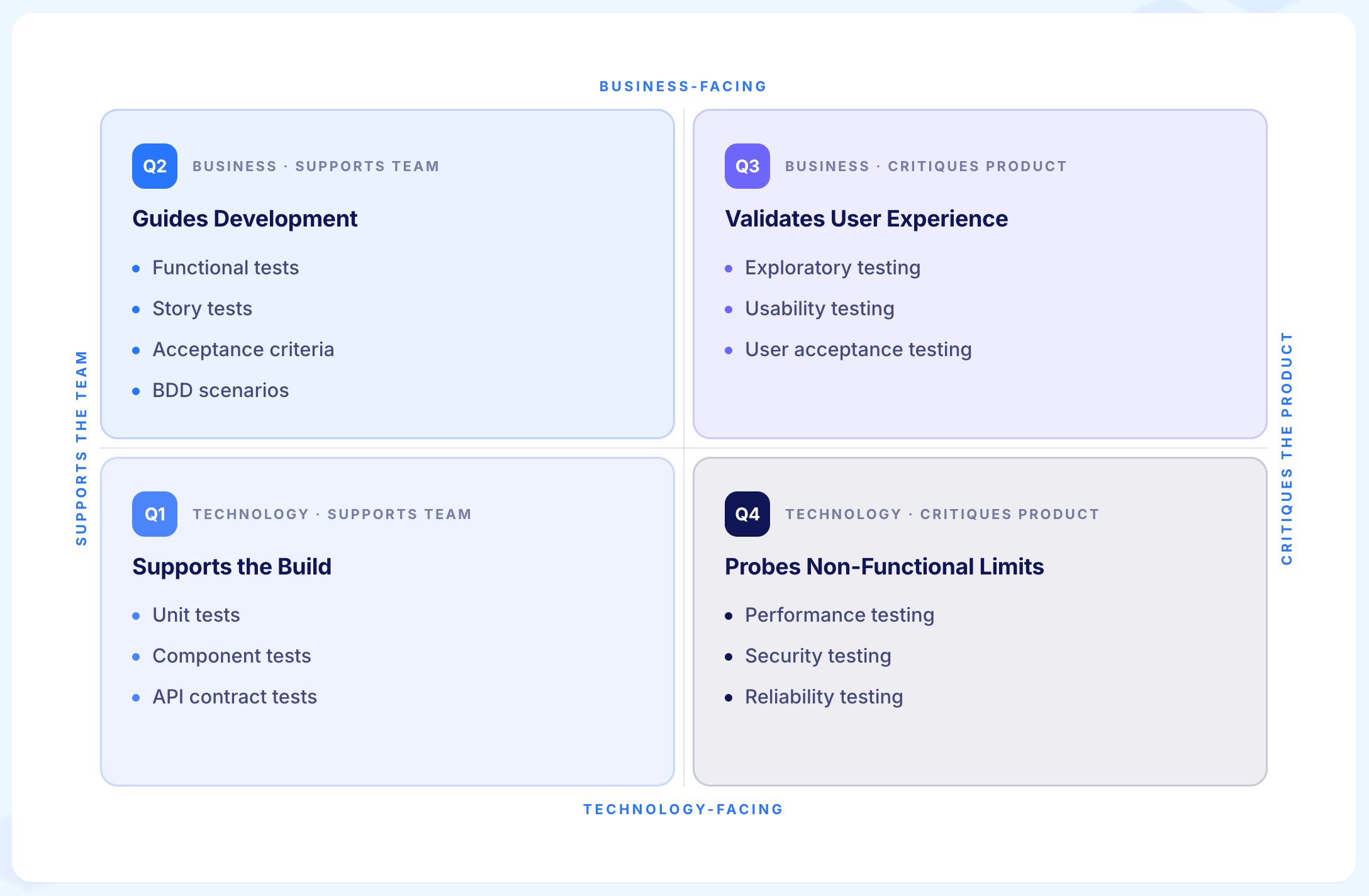
The model is a useful map, and its limit is that it is a taxonomy rather than a rhythm. It tells you what kinds of testing exist but not when they run inside a two-week sprint, and it predates both continuous delivery and AI-assisted development.
Treat it as a checklist of what not to forget, not as a schedule, and pair it with the cadence view below, which is the part that actually keeps a sprint from collapsing at the end.
A sprint can hold several testing types if the team is disciplined about when each runs, and matching the type to the right cadence is what keeps verification parallel to development rather than piled up behind it.

A working programme operates across the whole sprint, not at the end of it, and two patterns capture the discipline. Shift left moves verification earlier, often before code exists, and shift right extends it into and beyond release.
Shift left turns testing from a downstream checker into an upstream contributor, through acceptance criteria authored with the story, Three Amigos reviews before sprint inclusion, test cases written before or alongside the code, static analysis in the developer workflow, and verification at the pull-request level before merge. The defects caught this early are cheaper to fix and rarely escalate into customer-facing incidents.
Shift right closes the gap between what the team verified in staging and what customers actually experience, through continuous behaviour verification of critical journeys in production-like environments, canary releases and feature flags that validate behaviour on a slice of traffic, synthetic monitoring against production, and real user behaviour feeding back into test design.
The two together stretch testing from "during the sprint" to "across the lifecycle."
To know the differences in detail, check our article on Shift Left vs Shift Right Testing: Which Strategy Wins?
The most visible failure in Scrum testing is the velocity gap between development and testing inside the sprint, and the shape is always the same. Development moves quickly through the first eight days, stories pile up in a "ready for testing" column, the tester starts receiving them on day nine, the queue is full by day twelve, and by day fourteen the team is choosing between cutting verification and rolling stories into the next sprint. Both choices are bad.
The gap is structural, not personal. Human verification cannot easily compress to match a development velocity that AI assistance has amplified, so hiring more testers does not fix it. Redesigning the verification architecture does, and three moves close the gap most reliably.
Several patterns show up in nearly every programme that has not yet been course-corrected, and naming them is usually the first step to fixing them.
The most common failure, producing the velocity gap and the carry-over pattern, fixed by embedding testing in the DoD and adopting the Three Amigos.
An activity-based DoD can be satisfied without producing quality, fixed by rewriting it around verifiable outcomes.
A suite that breaks on every refactor is worse than none, because the team stops trusting the signal, fixed by self-healing and disciplined test architecture.
Retrospectives without testing-related action items just repeat the same failures, fixed by closing each one with an explicit DoD or process change.
Even a nominally cross-functional team can recreate the old hand-off by behaviour, fixed by structurally embedding testers in planning, refinement, and review.
Stories pass acceptance criteria while the customer journey fails because the criteria missed the integration, fixed by adding journey verification to the DoD.
AI-assisted development is changing Scrum testing in ways the canonical framework was never designed for, and the changes compound.
They are worth planning for rather than treating as edge cases.
Assistants raise the volume of code per sprint without raising human verification capacity, so the velocity gap widens unless the architecture is reshaped.
Agents rewrite code paths inside the sprint, sometimes silently, so tests written against earlier implementations break or pass for the wrong reasons, and the brittleness of the regression layer becomes a sprint-level problem rather than a release-level one.
An AI refactor can preserve the contract while shifting behaviour, so acceptance criteria pass while customer journeys fail, which is the argument for expanding the DoD to include journey verification.
The same agentic capability that produces code can produce verification, so the unit of testing effort shifts from writing tests toward defining outcomes.
The direction of travel is clear enough. Scrum testing is moving from a sprint-scoped activity toward a continuous behaviour-verification discipline that runs across sprints, is owned by the whole team, and leans on a platform that scales the way development now does.

The reframe now underway is from testing as a sprint-scoped activity to verification as a continuous discipline that runs across sprints and supports release decisions close to real time. The sprint stays, the ceremonies stay, and the Definition of Done stays. What changes is the layer at which testing operates.
Test execution moves from the end of the sprint to every pull request, coverage measurement moves from statement and branch to behaviour and journey, and verification ownership moves from the tester to the team, with the platform underneath doing the work humans cannot scale to
. A team operating this way shows three tells, namely a Definition of Done that includes journey verification, a Sprint Review that can demonstrate the customer-critical flows working end to end, and a retrospective that discusses behaviour coverage rather than test count.
That is the shift from activity-based to outcome-based Scrum testing.
The patterns above condense into a working list, and the value is in applying it consistently rather than in any single item.
The recurring problem in Scrum testing is that human verification cannot compress to match a development velocity that AI has amplified, so the sprint keeps ending with a testing queue and a hard choice. Closing that gap means reshaping the verification architecture so it scales the way development does, which is where the platform is aimed. A few specifics matter for Scrum in particular.
Every AI action is proposed for review, executed by a deterministic engine, and recorded, so the autonomy stays governed, and the tests run across a broad cross-browser grid.

Three directions look likely, and they point the same way rather than being settled fact.
Teams that adopt this early compound an advantage that grows quarter on quarter. Teams that wait tend to find their sprint cadence drifting further out of step with the velocity their development organisation now runs at.

Try Virtuoso QA in Action
See how Virtuoso QA transforms plain English into fully executable tests within seconds.
