Blog
Test Closure Report Explained and How to Write One

Abhilash
Published on

Table of contents
Lorem ipsum
Lorem ipsum
Lorem ipsum
Lorem ipsum
Lorem ipsum
Here is a situation most QA teams will recognise. The sprint ends. The release ships or holds. A few days later, someone opens a document template, fills in the test counts, attaches the defect log, and files the test closure report in a shared folder. Nobody reads it. The next sprint begins.
The report existed. It did not function.
A test closure report that functions is a different thing from a test closure report that exists. The difference is not length or detail or formatting. The difference is whether the report was built to inform a decision or built to satisfy a process. Most teams are building the second kind and calling it the first.
What is a Test Closure Report?
A test closure report is a document that records what was tested, what was found, what was fixed, and what risk remains when testing concludes for a given release. Its job is to give whoever is making the release decision a clear picture of the quality of the software going out the door.
That is the job. Not documentation for its own sake. Not a record for a future audit. Not a summary of how hard the team worked. The job is to support a release decision with evidence.
You will hear test closure report, test summary report, and test completion report used interchangeably. They overlap but are not identical.
A test summary covers what was tested. A test completion report covers what was achieved. A test closure report covers both of those plus the residual risk picture and the recommendation for the release decision. Of the three, test closure report is the most complete and the most useful framing.
Two Ways Teams Run Test Closure
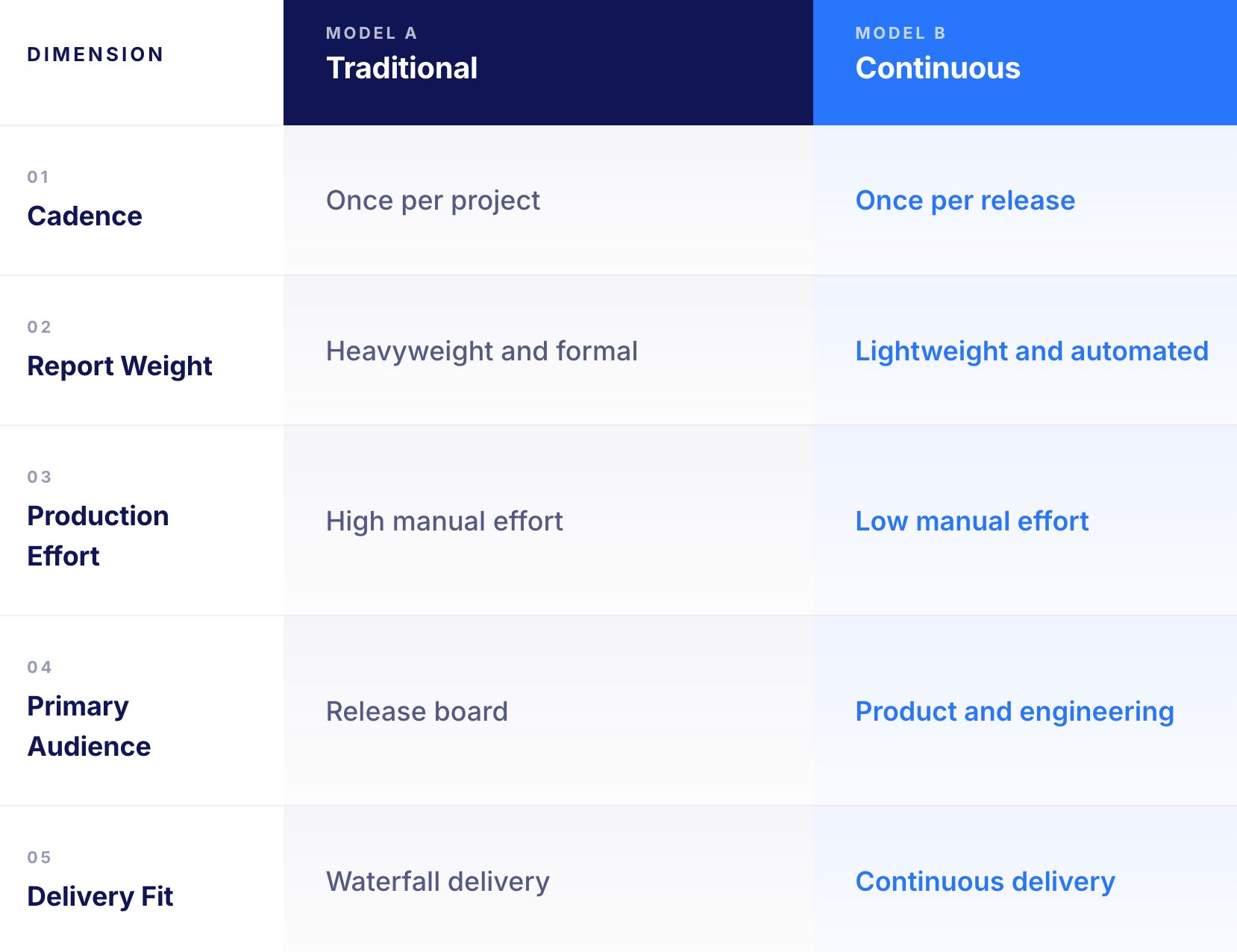
The right approach to test closure depends on how the team delivers software, not on what a process standard says.
The Traditional Model
Treats closure as a once-per-project event at the end of a testing phase. The report is thorough, formal, and produced for a release board that meets on a defined cadence. It is designed to survive an audit and to serve as a permanent record of the project's testing activity. This model fits teams that operate with a distinct testing phase that has a clear start and end.
The Continuous Model
Treats closure as a once-per-release event in a delivery pipeline that runs weekly or daily. The report is lightweight and produced quickly, largely from data the test platform already holds.
It is tailored for a release conversation between product, engineering, and business stakeholders who meet on a sprint cadence. This model fits teams running continuous delivery where the release decision happens frequently and the team cannot afford to spend days producing a report.
Teams that run continuous delivery while writing waterfall-era closure reports produce reports nobody reads. The cadence and the format have to match the way the team actually works.
What a Test Closure Report Should Contain
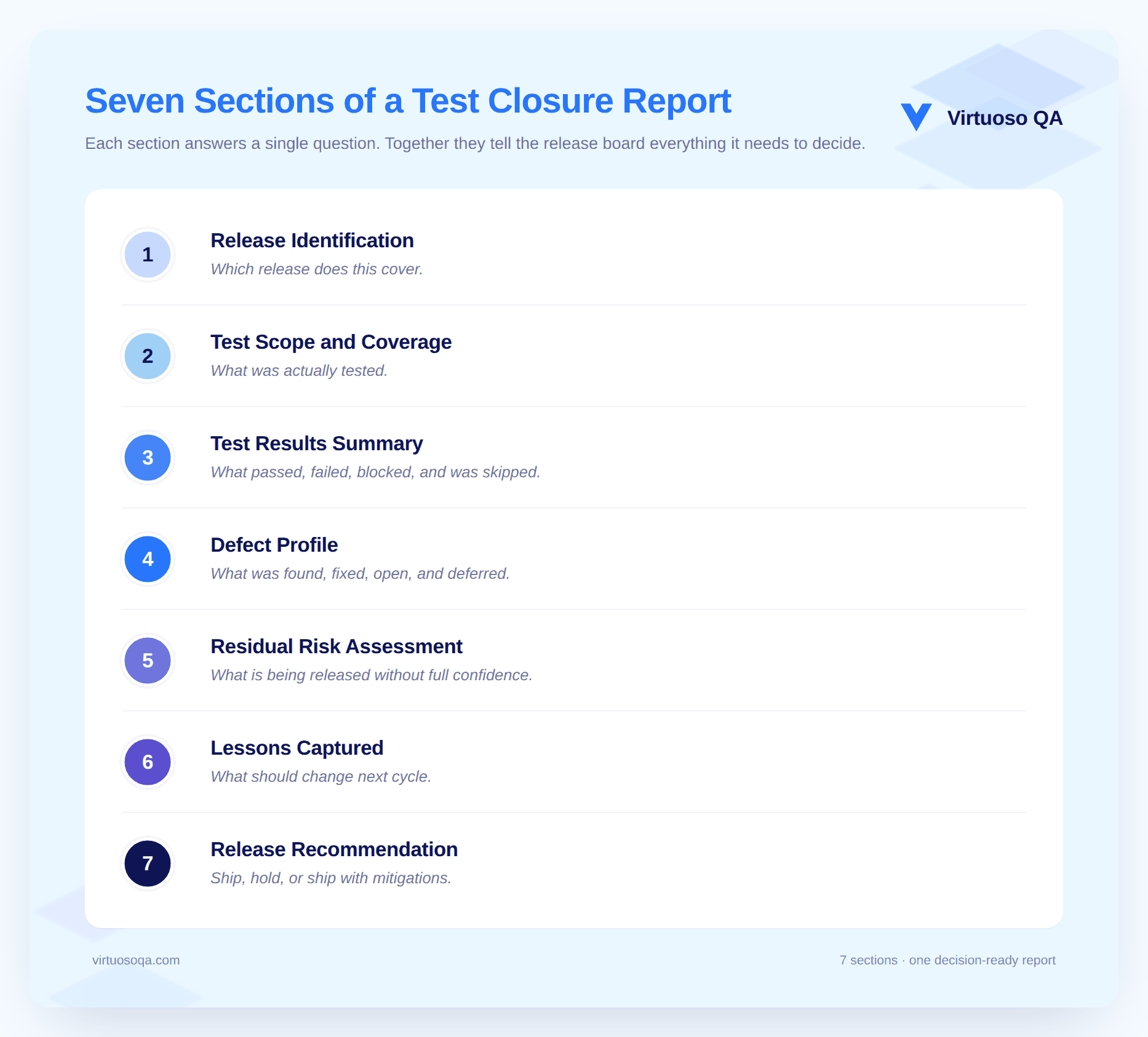
A closure report that drives decisions has fewer sections than the standard template, and those sections carry more weight. Here is what belongs and why.
1. Release Identification
The first section of the report identifies the release being closed with enough specificity that there is no ambiguity about what was tested. This means the version number, the build identifier the testing was conducted against, the release date, and a short scope summary covering what the release contained.
The section is intentionally short because its only function is unambiguous identification rather than substantive analysis.
2. Test Scope and Coverage
The scope and coverage section answers the question that matters most before a release decision: what did the team actually test, and how much of what mattered was covered? The most useful framing is coverage by requirement criticality rather than by raw test case count, which means reporting what percentage of business-critical requirements were verified, what percentage of high-priority customer journeys were tested end to end, and where the gaps remain at each criticality level.
A raw test case count is not coverage. One hundred test cases covering peripheral UI edge cases and zero tests on the payment flow is not coverage of anything that matters.
Coverage must be reported in relation to what was in scope and weighted by how important each requirement actually is to the customer and the business.
3. Test Results Summary
The results summary presents what passed, what failed, what was blocked, and what was not executed during the testing cycle, with each category given enough context to be useful rather than just counted.
Failed tests should be listed alongside their associated defects and the current status of each. Blocked tests should identify the specific blocker that prevented execution. Tests that were not run at all need a clear reason for the omission and an honest statement of what that gap means for the release.
The pass rate on its own is close to useless without this context. A 97 percent pass rate where the three percent failures sit on the most critical user journey is a fundamentally different situation from a 97 percent pass rate where the failures sit on a rarely used configuration screen, and the summary needs to make that distinction visible to anyone reading it.
4. Defect Profile
The defect profile section covers how many defects were found during the testing cycle, how many were fixed before closure, how many remain open, and how many have been formally deferred to a later release. This includes a severity distribution, the status of each defect at the time of the report, and a view of how the defect count changed during the testing period rather than just a snapshot of where it stands now.
Deferred defects deserve particular attention within this section. Each deferred item should carry a stated reason for the deferral and an honest statement of the risk the team is accepting by choosing to defer rather than resolve before release.
5. Residual Risk Assessment
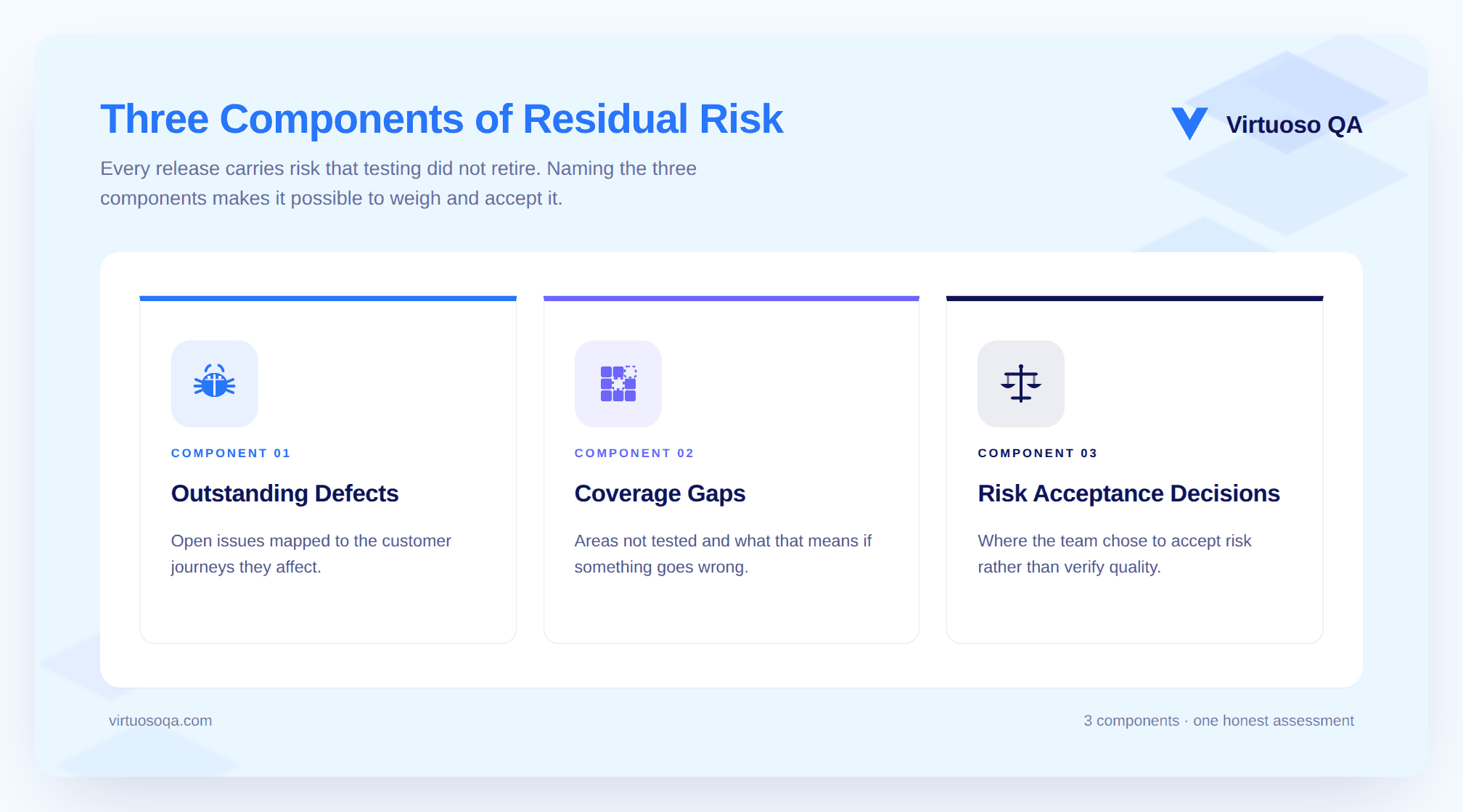
This is the section most closure reports do not include and the section that release stakeholders need most. Residual risk is what the team is releasing without complete confidence in, and it covers outstanding defects mapped to the customer journeys they affect, known coverage gaps and what they mean for the customer if something goes wrong in those areas, and any place where the team made a deliberate risk acceptance decision rather than a quality confirmation.
A closure report that does not name residual risk explicitly is asking the release stakeholder to infer it from the rest of the document, and that inference is often wrong. The release stakeholder may assume that the absence of a stated risk means the absence of actual risk, and it does not.
It means the risk was present but not stated, which is a meaningfully worse situation than a risk that is named and understood.
6. Lessons Captured
The lessons section captures what the team learned during the testing cycle that should change how testing works in the next one. This is not a celebration of effort or a list of accomplishments. It is a forward-looking record of things that went wrong, things that went unexpectedly right, test cases that proved unreliable in practice, coverage areas that came up thinner than intended, and tooling or process gaps that surfaced during execution.
Teams that skip this section miss the only structural opportunity in the closure rhythm to convert experience into improvement, and the cost of skipping it compounds over time as the same issues recur in subsequent cycles without a shared record of what caused them.
7. Release Recommendation
The report's final section should state the team's recommendation clearly and without equivocation: release, release with named mitigations in place, or hold for named reasons. The reasoning behind the recommendation should connect directly to the residual risk assessment and the defect profile rather than restating the results summary in different words.
A closure report that buries the recommendation on the final page or omits it entirely has failed at its most fundamental function. The recommendation does not bind the release authority, and the decision ultimately rests with whoever holds that responsibility. But the report should give that person a clear, reasoned position from the team closest to the testing outcome, not leave them to construct one from the data themselves.
The Metrics Worth Keeping and the Ones to Drop
Most closure report templates carry metrics that look rigorous and say nothing useful. Getting to a sharper report means being willing to drop the familiar numbers and replace them with ones that actually connect to customer outcomes.
Keep these:
Coverage of business-critical requirements, expressed as a percentage of verified against scoped
Coverage of key customer journeys, expressed as a percentage of journeys tested end to end
Outstanding defects by severity, mapped to the journeys they affect
Deferred defects with the risk acceptance decision documented for each
How recently each test was last run successfully, not just whether it passed in this cycle
Flakiness rate by application area, so the release stakeholder knows which signals to trust
Time from defect detection to defect resolution, as a measure of the team's ability to respond to findings
Drop these:
Total test cases executed, as a count without coverage context
Hours of testing effort, which measures input not outcome
Raw pass rate without journey-level breakdown
Number of test cases written this cycle, which measures production not value
Defects per tester, which incentivises the wrong behaviour
The resistance to dropping familiar metrics is real. Teams that have reported effort hours for years feel exposed when that number disappears. The discomfort is worth tolerating, because a shorter list of better-chosen metrics produces a more useful report than a long list of available ones that carry no predictive value for the release decision.
How to Write a Test Closure Report Step by Step
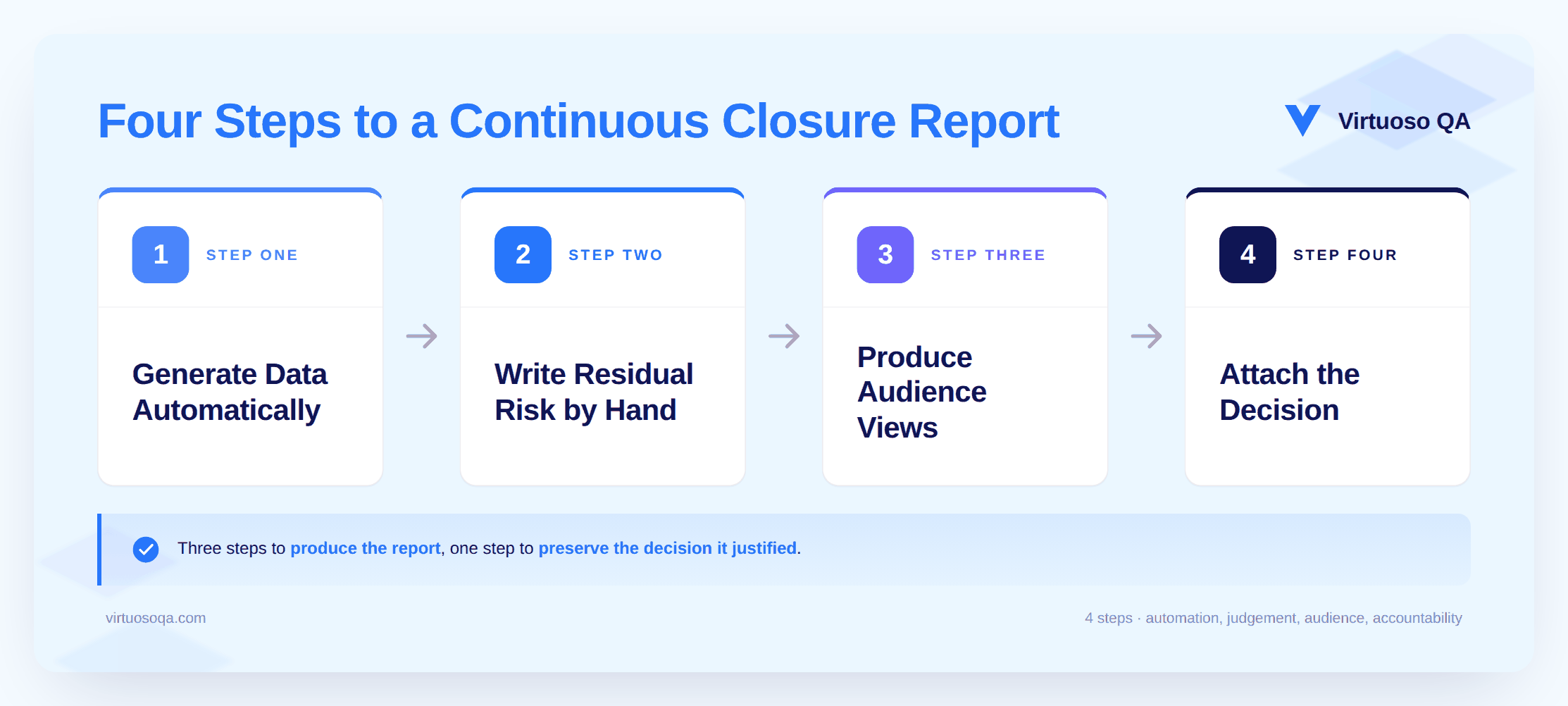
Step 1: Generate the Data Automatically
Modern test management platforms produce most of a closure report from execution data, defect tracking integrations, and traceability links. Coverage percentages, pass and fail breakdowns, defect distribution by severity, and trend lines across the testing period do not need to be assembled manually by the team.
That work should already be done by the platform, and any team spending significant time pulling this data together by hand is paying a production cost that should not exist.
Step 2: Write the Residual Risk Assessment by Hand
This is the section no platform can generate on behalf of the team. A senior practitioner needs to review the open defects, the blocked tests, the deferred items, and the known coverage gaps, and write a plain-language statement of what the team is releasing without full confidence in, along with an honest assessment of the customer impact if something goes wrong in those areas.
This is the section that requires human judgement rather than data aggregation, and it is where the production time should be concentrated.
Step 3: Produce Views for Different Audiences from the Same Data
The release authority needs the executive summary covering scope, coverage, residual risk, and recommendation in two pages at most. Engineering needs the diagnostic view covering defects by component, coverage gaps by area, flakiness signals, and process observations.
Business stakeholders need the risk view covering which customer journeys are affected by outstanding issues, what has been mitigated, and what remains open.
Each of these views is a filter on the same underlying data rather than a separate document, and producing them from a single source rather than writing three separate reports keeps the effort proportionate to the cadence.
Step 4: Attach the Decision to the Report
When the release authority makes the call, that decision should go into the record alongside the report that informed it. The closure report stops being a static document at that point and becomes part of the release history, retrievable for future retrospective review and for the next-cycle team to understand what was accepted at the previous release boundary.
The production process is short by design. A closure report that takes a week to assemble is too expensive to produce at release cadence, and the effort has to fit the delivery rhythm the business actually operates at.
A Practical Checklist Before You File the Report
Identification and Coverage
The release, version, and build are clearly identified so there is no question about which release the report covers
Coverage is reported by requirement criticality rather than by raw test case count
Failed tests are mapped to the specific customer journeys they affect rather than simply listed by status
Risk and Recommendation
Outstanding defects include their customer impact written in plain language that a non-technical stakeholder can read and act on
Residual risk is named clearly with a plain statement of what the team is accepting by proceeding with the release
The release recommendation appears in the first two pages rather than being buried at the end of the document
Metrics that measure input rather than outcome have been removed from the template
AI-generated draft content has been read and verified by a practitioner before the report is filed
Process and Archiving
The report supports at least two distinct audience views rather than being written once for a general reader
Lessons from this cycle are captured in a way that the next cycle's team can actually use
The report will be archived with the release decision attached so the record is complete
The data behind the report was current at the moment the release decision was made rather than pulled together after the fact
Where Virtuoso QA Fits in the Test Closure Picture
The fastest way to produce a closure report at release cadence is to have the underlying data already current when the report is needed, rather than assembling it from scattered sources at the end of each cycle.
Virtuoso QA maintains the data a closure report depends on continuously throughout the testing programme. Coverage against requirements and use cases, defect linkages, execution history, flakiness signals, and quality trends across releases are held in the platform rather than reconstructed manually when the release conversation begins. When the team needs to produce the report, the data is already there and current rather than several hours away from being ready.
AI Root Cause Analysis maps failures to the specific requirements and customer journeys they affect, which provides the evidence base for the residual risk assessment that most teams spend the most time writing by hand.
Natural Language test authoring keeps test cases readable to the product managers, business analysts, and stakeholders who participate in the release decision rather than only to the engineers who wrote them, which means the traceability between what was specified and what was tested is visible to the full release audience.
CI/CD integrations with Jenkins, GitHub Actions, Azure DevOps, and GitLab connect the test layer to issue tracking and requirements systems so the traceability the closure report depends on is maintained as a by-product of normal testing activity rather than reconstructed at the end of the cycle.
The closure report becomes a view onto a continuously maintained record rather than a document assembled once per release from wherever the data happens to live.
Test Closure Report Sample Template
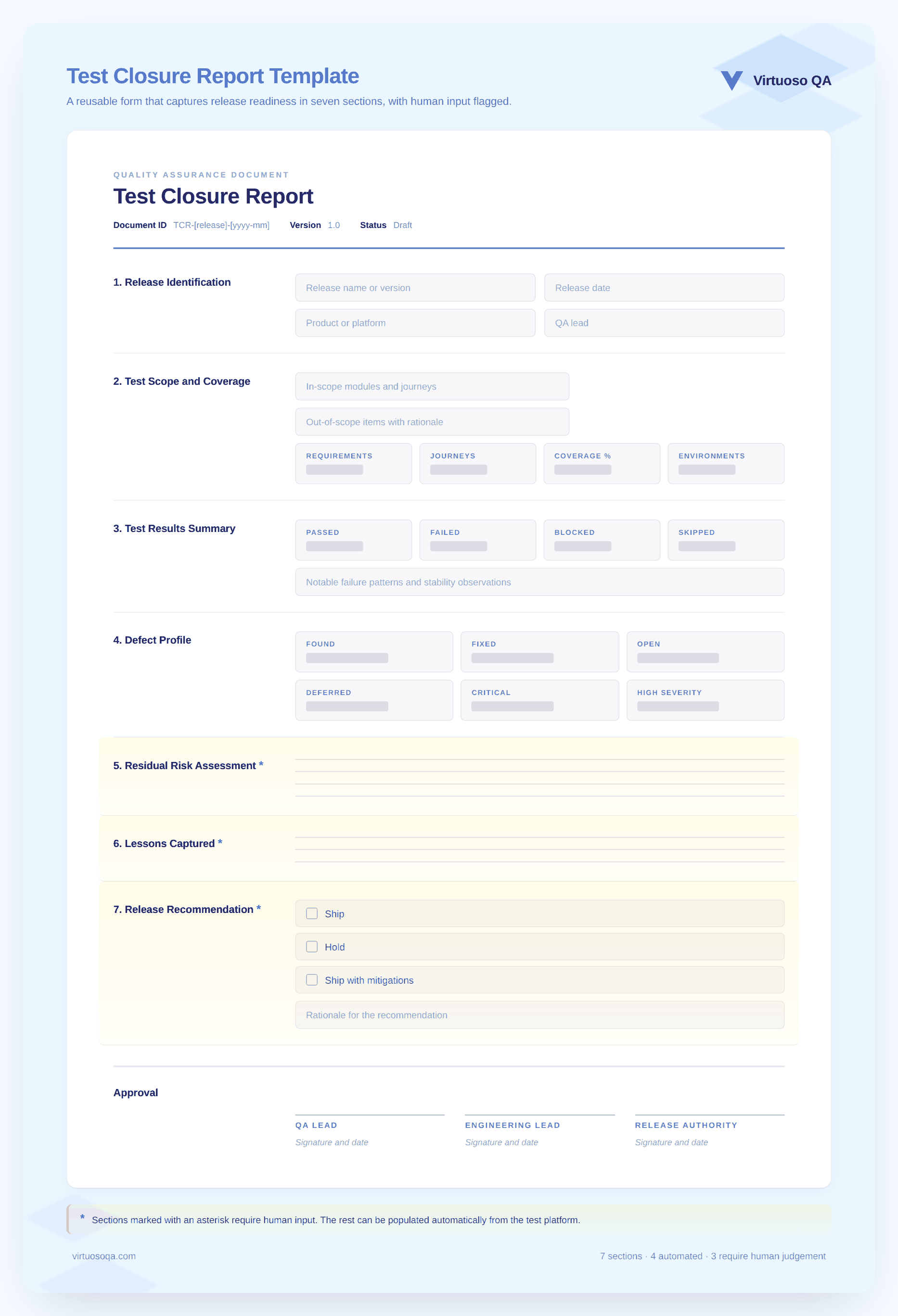
The structure below works for teams running continuous delivery at sprint cadence. Teams on longer release cycles can expand each section. The sections marked with an asterisk require human judgement and cannot be generated automatically from platform data.
Related Reads
Frequently Asked Questions
What is the difference between a test closure report and a test summary report?
What are the components of a test closure report?
Who writes the test closure report?
When is a test closure report produced?
What is residual risk and why does it matter in test closure?
Can a test closure report be automated?