Blog
Equivalence Partitioning: How to Test More With Fewer Cases

Abhilash
Published on

Table of contents
Lorem ipsum
Lorem ipsum
Lorem ipsum
Lorem ipsum
Lorem ipsum
What is Equivalence Partitioning?
Equivalence partitioning, also called equivalence class partitioning, is a black-box testing technique that divides input data into valid and invalid partitions, where every value in a partition is expected to be treated the same way by the system. The technique lets a team test one representative value from each partition rather than every possible input, which reduces the number of test cases while keeping coverage effective.
The core idea rests on three simple moves. It divides input data into partitions where each partition represents similar behaviour, it selects one representative value from each partition for testing, and it reduces the total number of test cases while maintaining good coverage. If one value in a partition exposes a defect, the others in that partition are likely to expose it too, and if one value passes, the others are likely to pass as well, which is what makes a single representative trustworthy.
Guidelines for Defining Equivalence Classes
The way equivalence classes are defined depends on the type of input, since each input type has its own natural valid and invalid partitions. The table below gives the working pattern for the input types most testers encounter.
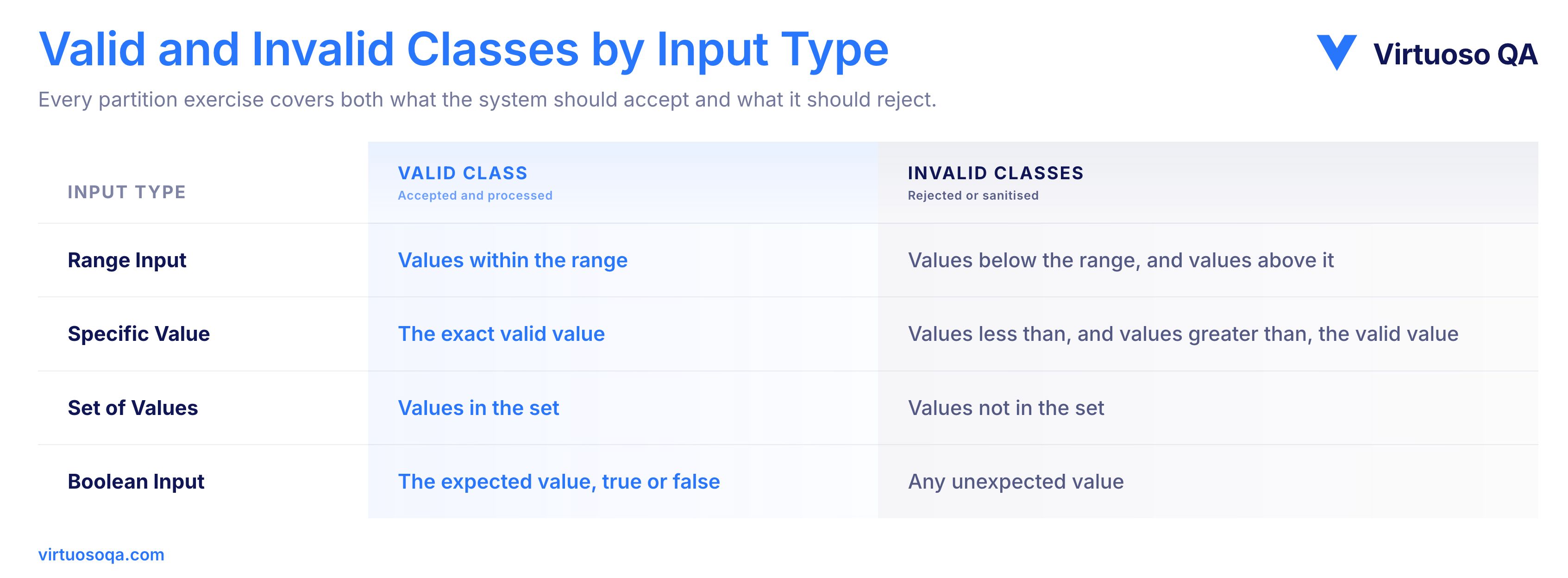
The pattern is consistent across types, namely one valid class capturing what the system should accept, and one or more invalid classes capturing what it should reject. Getting the invalid classes right matters as much as the valid one, because error handling is where a surprising share of production defects live.
The Two Types of Equivalence Classes
Testers categorise values into two primary kinds of class, and a complete test design needs both.
A valid equivalence class is an input range or set the system should accept and process correctly, because it complies with the defined requirements.
For a password field that requires eight to twenty characters, any string between eight and twenty characters is a valid class, and testing one representative gives confidence that the system behaves correctly for the whole range.
An invalid equivalence class is an input range or set the system should reject or handle differently, because it violates the requirements.
For the same password field, a string shorter than eight characters is one invalid class and a string longer than twenty is another, and testing a representative from each verifies that the system correctly blocks or errors on disallowed input.
A Worked Example With Test Cases
A concrete example makes the technique visible. Consider a college admission form where the percentage field accepts values between 50 and 90 only, and anything outside that range should trigger an error.
Using equivalence partitioning, the input divides into three classes.
Invalid class one, percentage below 50.
Valid class, percentage between 50 and 90 inclusive.
Invalid class two, percentage above 90.
Selecting one representative value from each class produces a small, efficient set of test cases that covers the whole input domain.
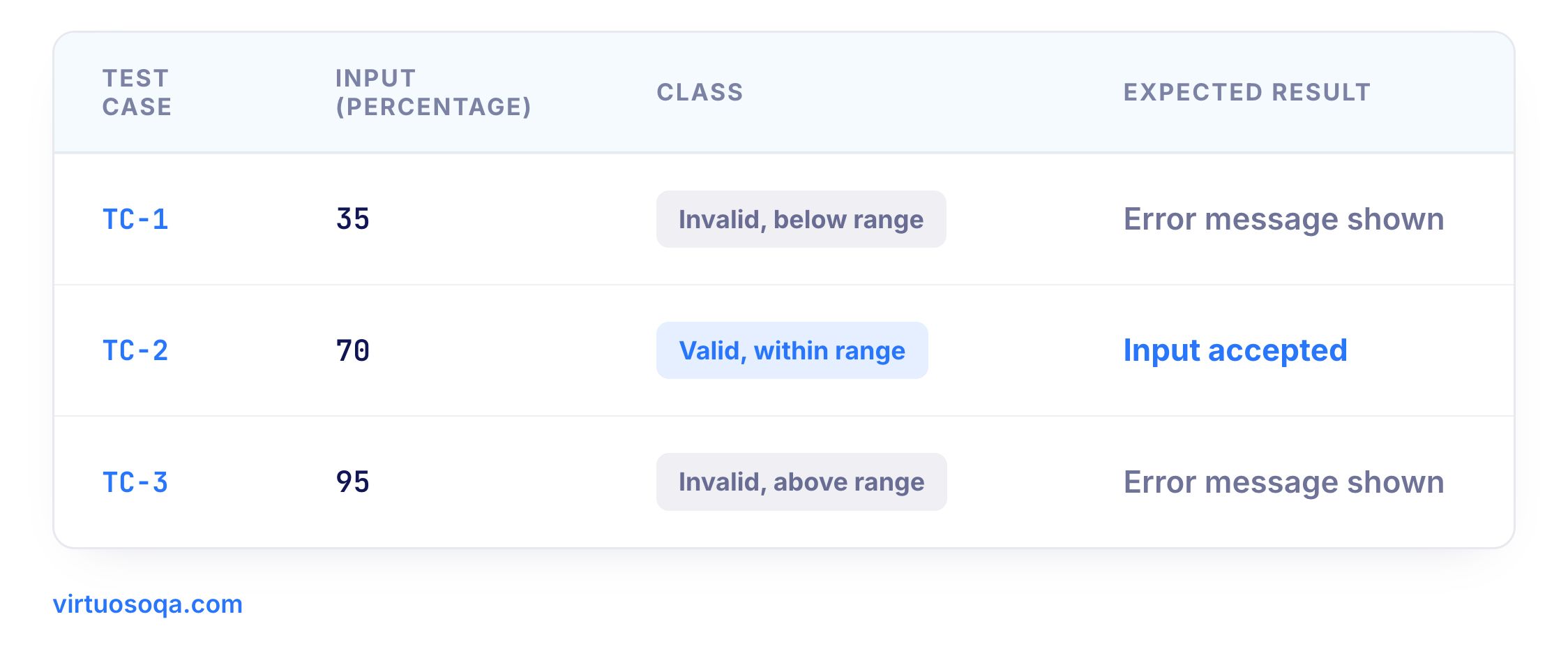
Three test cases stand in for the entire range of possible percentage inputs. Without partitioning, a tester might feel obliged to try dozens of values, yet these three exercise every distinct behaviour the field can produce, which is the efficiency the technique is designed to deliver.

The Steps of Equivalence Partitioning
Applying the technique well follows a structured sequence, and each step feeds the next.
Identify the input fields, determining every input variable that needs testing.
Define the input ranges or conditions, understanding what counts as valid and invalid for each input.
Divide the inputs into equivalence classes, grouping them into valid and invalid partitions.
Select representative values, choosing one value from each partition to stand for the whole.
Design the test cases, building each around a selected value with a clear expected result.
Execute and validate, running the cases and comparing the actual results against the expected ones.

When to Use Equivalence Partitioning
The technique earns its place in several recurring situations, and recognising them is the fastest way to know when to reach for it.
When inputs have clear ranges or categories, such as an age field that accepts eighteen to sixty-five, which yields one valid class and two invalid ones.
When the system behaves uniformly across a range, such as a flat shipping cost for parcels between nought and five kilograms, where a single test at three kilograms covers the class.
When you need to cut redundant tests without losing coverage, such as a field accepting one to a thousand, where a representative or two per partition replaces testing every number.
When designing tests early from requirements or API specs, such as an API that returns 200-level codes for success and 400-level codes for client errors, which partitions cleanly by status-code range.
When pairing with boundary value analysis for edge coverage, where the partitions cover valid, too short, and too long, and boundary tests then hit the exact edges.
The Limitations of Equivalence Partitioning
The technique is efficient, but it is not complete on its own, and honest testers keep its limits in view.
It may miss boundary defects when used alone, which is why it is almost always paired with boundary value analysis.
It depends on correct partitioning, so incorrect grouping can leave real defects untested.
It does not cover combinations of inputs, so interactions between fields fall outside its scope.
It is less effective for complex or interdependent logic, where the behaviour of one input depends on the state of another.
The recurring theme is that equivalence partitioning reduces test volume by assuming uniform behaviour within a class, and that assumption is exactly where its blind spots live. A partition defined too broadly hides the very defect a narrower partition would have caught.
Equivalence Partitioning and Boundary Value Analysis
The single most important pairing in black-box test design is equivalence partitioning with boundary value analysis, because the two cover each other's weaknesses precisely.
Equivalence partitioning decides which classes exist and picks a representative from the middle of each, which is efficient but blind to the edges, whereas boundary value analysis tests the values at, just below, and just above each class boundary, which is where defects cluster most.
For the college percentage field, partitioning gives the three classes and a representative for each, while boundary analysis adds tests at 49, 50, 90, and 91, the exact points where an off-by-one error or a wrong comparison operator would hide.
Used together, they produce a test set that is both small and hard to slip a defect past. Our [boundary value analysis](internal link) page covers that complementary technique in full.

How Equivalence Partitioning Fits With Other Black-Box Techniques
Equivalence partitioning works best as part of a wider test-design strategy, and each neighbouring technique fills a gap that partitioning alone cannot.
Boundary value analysis tests the values at and immediately around each class edge, which is where defects cluster most, so it is the natural complement to partitioning for almost any range-based input and should be paired with it as a matter of routine.
Decision table testing maps combinations of multiple conditions to their expected outputs, which makes it the technique to reach for when behaviour depends on several interacting inputs rather than on a single field in isolation.
State transition testing validates how a system behaves across its different states and the events that move it between them, which matters when the validity of an input depends on the system's current state, such as a field that only becomes active after login.
Use case testing confirms end-to-end functionality along real user journeys, and it fits best after class-level validation is done, using the partition-derived test data to confirm that the whole workflow holds together.
Cause-effect graphing converts a specification into a graph that links input conditions to outcomes through Boolean operators and then derives test cases from the resulting decision table, which makes it the technique to reach for when several conditions interact to select an outcome and you need to see the combinations laid out explicitly.
Equivalence Partitioning in AI-Powered Testing
As AI-driven test automation becomes mainstream, equivalence partitioning has not been retired, it has been absorbed. Modern AI-powered platforms can analyse an input domain, identify the equivalence classes automatically, and generate representative test cases, which removes much of the manual effort that test design used to demand.
Pairing partitioning with boundary value analysis, once a manual discipline, can now happen automatically during generation, and when those tests run inside a CI/CD pipeline on every commit, the classic technique delivers rapid, shift-left feedback at a scale hand-authored tests could never reach.
The underlying logic is unchanged, which is the point. The thinking behind equivalence partitioning, namely that inputs fall into classes that behave alike, is exactly the reasoning an intelligent generation engine applies when it decides which inputs are worth testing. The technique moved from the tester's notepad into the platform, but the idea is the same one testers have relied on for decades.
How Virtuoso QA Fits
Virtuoso QA authors tests in plain English against the behaviour a system is meant to exhibit, which makes the reasoning behind equivalence partitioning natural to express directly.
A tester states the valid and invalid conditions for an input in readable terms, and the platform exercises them as part of a customer journey rather than as an isolated field check, so partition-level validation and end-to-end verification live in the same test.
Self-healing then keeps those tests aligned as the interface changes, so the classes a team defined once keep being verified as the application evolves.

Best Practices for Equivalence Partitioning
A few disciplines separate partitioning that works from partitioning that gives false confidence.
Define clear partitions based on the actual requirements and input conditions, rather than on assumptions about the data.
Include both valid and invalid classes, since error handling is tested only by the invalid ones.
Select genuinely representative values from each partition, not values that sit suspiciously close to a boundary and blur which class they belong to.
Avoid overlapping partitions, because a value that could belong to two classes makes a failure ambiguous.
Pair partitioning with boundary value analysis as a matter of routine, since the two together catch what either misses alone.
Frequently Asked Questions
What is Equivalence Partitioning in Software Testing?
What is the Difference Between Equivalence Partitioning and Boundary Value Analysis?
What Are Valid and Invalid Equivalence Classes?
How Does Equivalence Partitioning Reduce the Number of Test Cases?
Can Equivalence Partitioning Be Used for Non-Numeric Inputs?
What Are the Limitations of Equivalence Partitioning?