

Blog
22 Best API Automation Testing Tools in 2026

Published on
June 16, 2026


The 22 best API automation testing tools for 2026, grouped by job, with features, pros, and cons to help you pick the right one for your stack.
APIs now carry the majority of traffic on the modern web, which means the quality of your APIs sets the ceiling for the quality of everything built on top of them. This guide breaks down the 22 best API automation testing tools for 2026, grouped by the job each one does best rather than ranked one to twenty-two, so you can match a tool to your actual stack, team, and risk profile.
Each entry covers its features, its pros, and its cons, followed by a clear framework for choosing.
You can pour months into a polished interface, but if the API behind the search box or the payment button buckles under load or mishandles a bad request, the whole experience falls over with it. The API is where your application talks to its own backend, to partners, and increasingly to AI agents, and every one of those conversations is a place something can break.
The stakes have climbed sharply. APIs now handle huge percent of web traffic, and that makes them the single largest surface attackers probe.
Akamai's State of the Internet research found that 87 percent of organisations dealt with an API security incident during 2025, with daily API attacks per organisation more than doubling year on year. An untested endpoint is no longer just a quality gap; it is an open door.
Manual checking cannot keep pace with that reality. Teams shipping on modern release cycles need API tests that run automatically on every commit, catch regressions before they reach staging, and validate behaviour, performance, and security together. The tools below are how that gets done.
An API automation testing tool sends requests to your endpoints, inspects the responses, and checks them against the contract your API is supposed to honour, all without a person clicking through by hand. The good ones do this at scale, across environments, and inside your delivery pipeline.
The reasons teams invest in them are consistent:
Different tools are built for different jobs, so it helps to know the categories before you compare names:
Most mature teams end up combining several tools across these categories rather than expecting one to do everything.
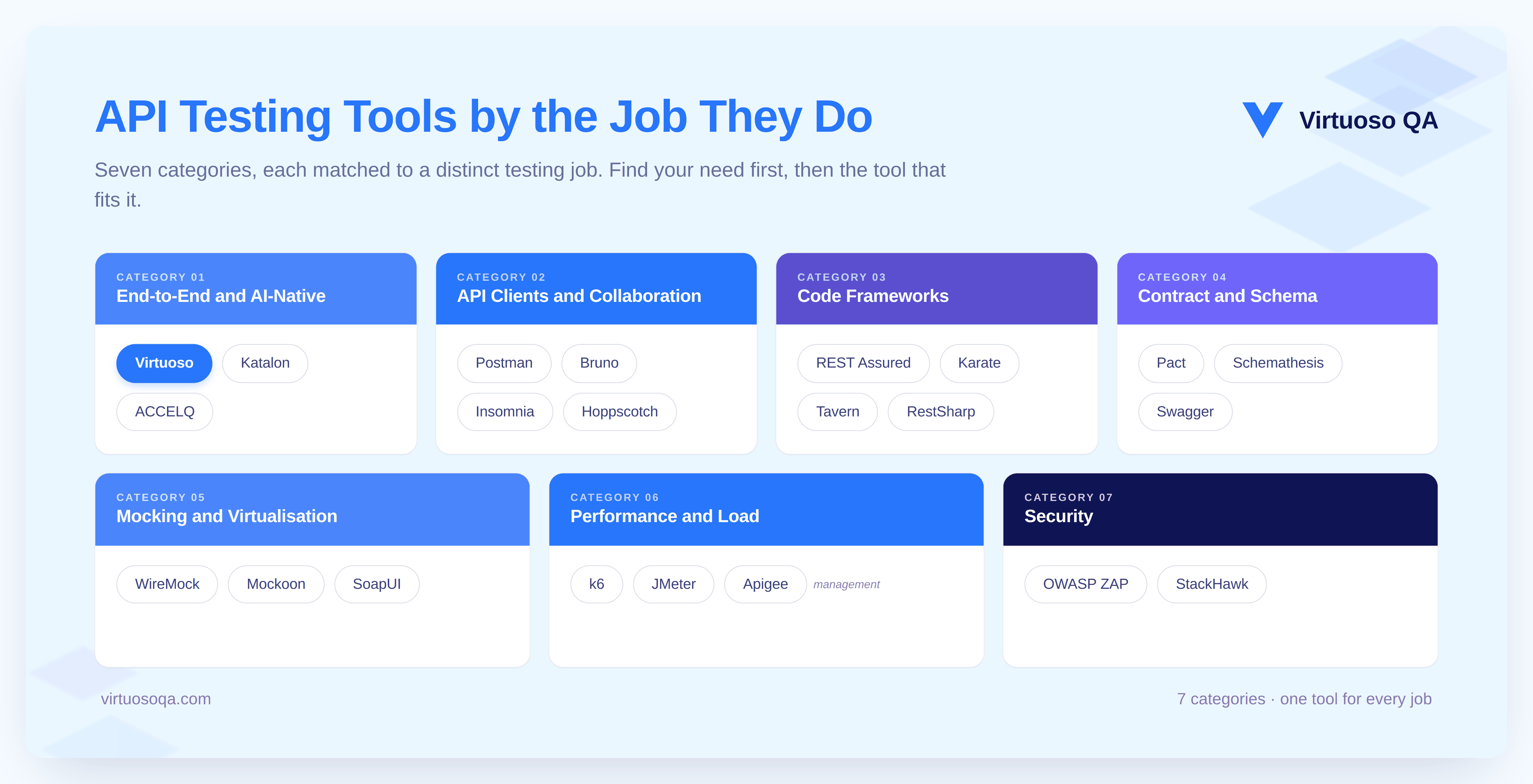
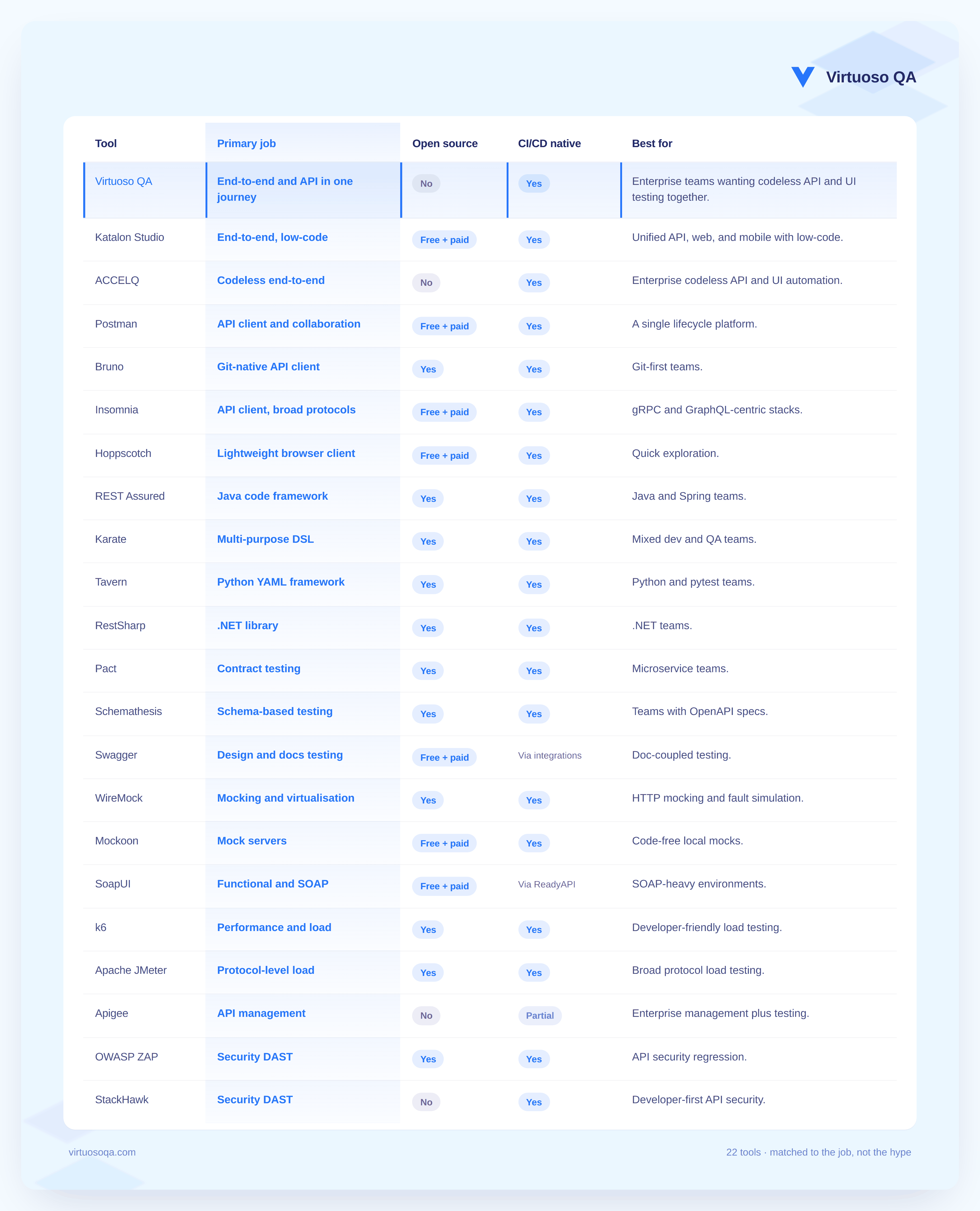
Rather than a forced ranking, the tools are grouped by what you are trying to accomplish. Find the job that matches your need, then compare the options inside it.
The groups run from end-to-end and AI-native platforms through to security, and each tool is broken down into its features, its pros, and its cons so you can weigh it quickly.
End-to-end and AI-native platforms
These tools test APIs as part of a wider quality strategy, usually alongside the interface, and increasingly use AI to author and maintain tests.
Virtuoso QA is an AI-native end-to-end test automation platform where API testing lives inside the same journey as UI actions and database checks, so a single test can drive the interface, fire the API call, and verify the data behind it in one pass.
Tests are authored in plain English through Natural Language Programming, which means QA engineers and non-developers alike can build and maintain API coverage without writing or babysitting scripts.
What sets it apart for API work is that the platform is AI-native rather than AI-bolted, so tests adapt to change rather than simply finding a different way to click.
Katalon is a low-code platform that covers API, web, mobile, and desktop testing in one place, with a visual request builder and an assertion engine for REST, SOAP, and GraphQL.
It suits teams that want a single environment across test types without committing to pure scripting.
ACCELQ is a codeless, AI-powered platform that unifies API, UI, and end-to-end validation in a single workflow, aimed at enterprise-scale regression.
API Clients and Collaboration Tools
These are the tools you reach for to explore, inspect, and share APIs, often before a single automated test is written.
Postman remains the default starting point for most teams, organising and sharing requests through Collections and Workspaces and running them in CI/CD through Newman or the CLI.
Bruno is the most interesting Postman alternative for teams that want everything in Git, storing collections as plain-text files in the repository with no cloud sync or account required.
Insomnia is a developer-friendly client with broad protocol coverage and both local and cloud storage modes.
Hoppscotch is a lightweight, open-source, browser-based client that needs no install and can be self-hosted.
Code-Based API Automation Frameworks
When click-and-check is not enough, these frameworks give you automated, repeatable, pipeline-friendly tests in code.
REST Assured is the Java standard for REST API testing, producing readable tests that live alongside application code.
Karate combines API testing, mocking, performance testing, and UI automation in one framework, using a Gherkin-style DSL that needs no step definitions.
Tavern is a pytest-based framework that uses concise YAML to define tests, running them as pytest tests.
RestSharp is a .NET library for making HTTP calls to REST APIs, handling serialisation and authentication with minimal code.
Contract and Schema-Based Testing
This category is underrepresented in most lists and one of the most valuable for microservice teams, because it tests whether an API honours the contract consumers depend on, not just whether an endpoint returns 200.
Pact is the standard for consumer-driven contract testing, letting the consumer define what it expects and the provider verify it independently.
Schemathesis generates test cases automatically from an OpenAPI or GraphQL schema and checks for crashes, schema violations, and validation bypasses.
Swagger centres on API design and documentation through the OpenAPI specification, with interactive docs you can test endpoints from.
Mocking and service virtualisation
These tools simulate endpoints so testing is not blocked by dependencies that are unstable or not yet built.
WireMock is the go-to for HTTP mocking and service virtualisation, supporting request matching, dynamic responses, and fault injection.
Mockoon creates mock REST APIs locally with no code, deployable through a CLI, Docker image, or libraries.
SoapUI is a long-standing tool for functional, regression, and load testing of SOAP and REST APIs, with strong Groovy-based assertion flexibility.

Performance and Load Testing
k6 is where most teams start for performance testing today, with a JavaScript-based scripting model that integrates naturally into CI/CD.
JMeter is the battle-tested option for protocol-level load testing, with a huge plugin ecosystem.
Apigee is Google Cloud's full-lifecycle API management platform rather than a dedicated testing tool, but it earns a place for its testing-adjacent capabilities.
Security Testing
ZAP is the open-source standard for dynamic security testing, with API-specific scanning that fits CI/CD.
Features
Pros
Cons
StackHawk is a developer-first DAST platform built for API security in CI/CD, mapped to the OWASP API Security Top 10.
There is no single best tool, only the best fit for your architecture, team, and risk profile.
Work through these questions in order:
Map your protocols (REST, SOAP, GraphQL, gRPC, async) and the testing types that matter most (functional, load, security, contract). The tool's strengths should line up with your biggest gaps.
Code-first frameworks like REST Assured and Tavern suit engineering-heavy teams, while codeless and low-code platforms like Virtuoso QA, Katalon, and Postman let QA and non-developers contribute. Match the tool to the people, not the other way round.
A tool that runs headless on every build beats a more capable one that only runs when someone remembers. Confirm CLI, Docker, and CI/CD support before committing.
As your API surface grows, brittle tests become the bottleneck. Self-healing and AI-assisted maintenance, as in Virtuoso QA and Katalon, pay back over time.
Many strong options are open source, but enterprise governance, single sign-on, and vendor support often justify a commercial tool.
A common and effective pattern is to combine tools: an open-source framework for flexible functional testing, a dedicated platform for security or performance, and an end-to-end platform to tie API and UI coverage together.
Because API tests can run before the interface exists, they catch defects when they are cheapest, so wire functional and regression tests into every build.
Run security scans in the pipeline so vulnerabilities surface beside other failures rather than weeks later in a separate review.
Data that mirrors real usage uncovers issues artificial sets miss, so lean on data-driven testing with external sources.
Generate docs from specs and validate schemas in CI to catch drift before it breaks consumers.
You will never cover every path, so focus on the journeys where failure costs the most, and let AI-assisted generation and self-healing absorb the maintenance load.
Microservices multiply the number of independently testable pieces, so combine contract testing with integration tests and use mocks to isolate unstable dependencies.
APIs are prime targets for injection, broken authentication, and unauthorised access, so make security scanning continuous rather than occasional.
Incomplete docs stall testing and schema changes break tests, so generate specs from code or docs from specs and automate schema validation in CI.
As the API surface grows, brittle scripts become the bottleneck, which is exactly where AI-native self-healing earns its keep.

Try Virtuoso QA in Action
See how Virtuoso QA transforms plain English into fully executable tests within seconds.
