Blog
Reusable Test Cases: The Five-Layer Reuse Stack

Modhana Priya
Published on

Table of contents
Lorem ipsum
Lorem ipsum
Lorem ipsum
Lorem ipsum
Lorem ipsum
Building reusable test cases is not a hygiene practice, it is a capital decision. A team that designs its test estate for reuse builds an appreciating asset that compounds across releases, environments, and applications, while a team that builds bespoke tests pays rent every release and forgets the answer between cycles.
The shift from reusable test cases to composable test modules is the operational form the discipline takes in the AI era, when codebases move too fast for any other shape to keep up.
A Scene Most Quality Leaders Will Recognise
Consider a pattern quality leaders in scaled product organisations will recognise.
A regression suite at a mid-sized retail bank is rebuilt three times in twenty months, not because the application changes that much, but because each rebuild is led by a different team. The original QA team rotated out, a consulting firm filled the gap, and an in-house team replaced the consultants after the contract ended.
Each rebuild starts from a clean slate, each misses some edge cases the previous version had caught, and each is presented to leadership as comprehensive regression coverage. None of them is the same coverage as the last one.
The bank ends up paying for the same coverage three times and getting variable quality each time. The fault is not effort, since the teams worked hard. The fault is asset design. The test estate was never built to be reused, so every rebuild was a separate construction project rather than an inheritance.
There is an old management aphorism that what gets measured gets managed. The more useful version for test engineering is that what gets owned gets reused.
A test estate that nobody owns becomes a sunk cost, and a test estate that someone owns and designs for reuse becomes an asset on the engineering balance sheet.
This guide sets out the discipline behind that shift, namely why reusable test cases matter in capital terms, the five layers where reuse compounds, the seven strategies that work, the anti-patterns that quietly destroy reuse, the metrics to track, and the modern operational form the practice has taken.
What Are Reusable Test Cases?
Reusable test cases are test assets designed to be applied across multiple test cycles, environments, applications, and teams without significant modification.
A reusable test case pays back its design cost on first reuse and accrues value at near-zero marginal cost on every subsequent reuse, so the practice treats tests as appreciating assets rather than one-off expenses.
Why Reusable Test Cases Are a Capital Question
The most common framing of reusability is operational, meaning build modular tests, use parameters, centralise the repository. The advice is true and incomplete. The more useful framing is financial.
A test asset that is used once has the economics of a consumable, and a test asset that is used a hundred times has the economics of a tool, so the same forty hours of design effort produces dramatically different returns depending on which one the team is building.
Three economic consequences follow from treating tests as assets rather than expenses.
Reusable assets compound: A reusable module pays back its design cost on its first reuse and then accrues value at zero marginal cost on every subsequent reuse, whereas a bespoke test pays back its design cost only once and then becomes a maintenance liability.
A test estate built on reusable test cases gets cheaper to maintain over time even as it grows, and a test estate built on bespoke tests gets more expensive to maintain over time even when it does not grow.
Reusable assets carry knowledge across people: The bank in the opening scene rebuilt the regression suite three times because the knowledge of what to test left with the people who built it.
A reusable, owned, named, documented test asset is a knowledge artefact that survives turnover, while a bespoke test is a private skill that walks out the door with the engineer.
Reusable assets shorten the path to new applications: A new application, a new environment, or a newly acquired business each start cold under the bespoke model, whereas under the asset model they inherit the reusable library and start with a meaningful portion of coverage already in place, so time to first verified release drops from quarters to weeks.
Every bespoke test is rent, and every reusable test case is equity.

The Reuse Stack, Five Layers Where Reusability Compounds
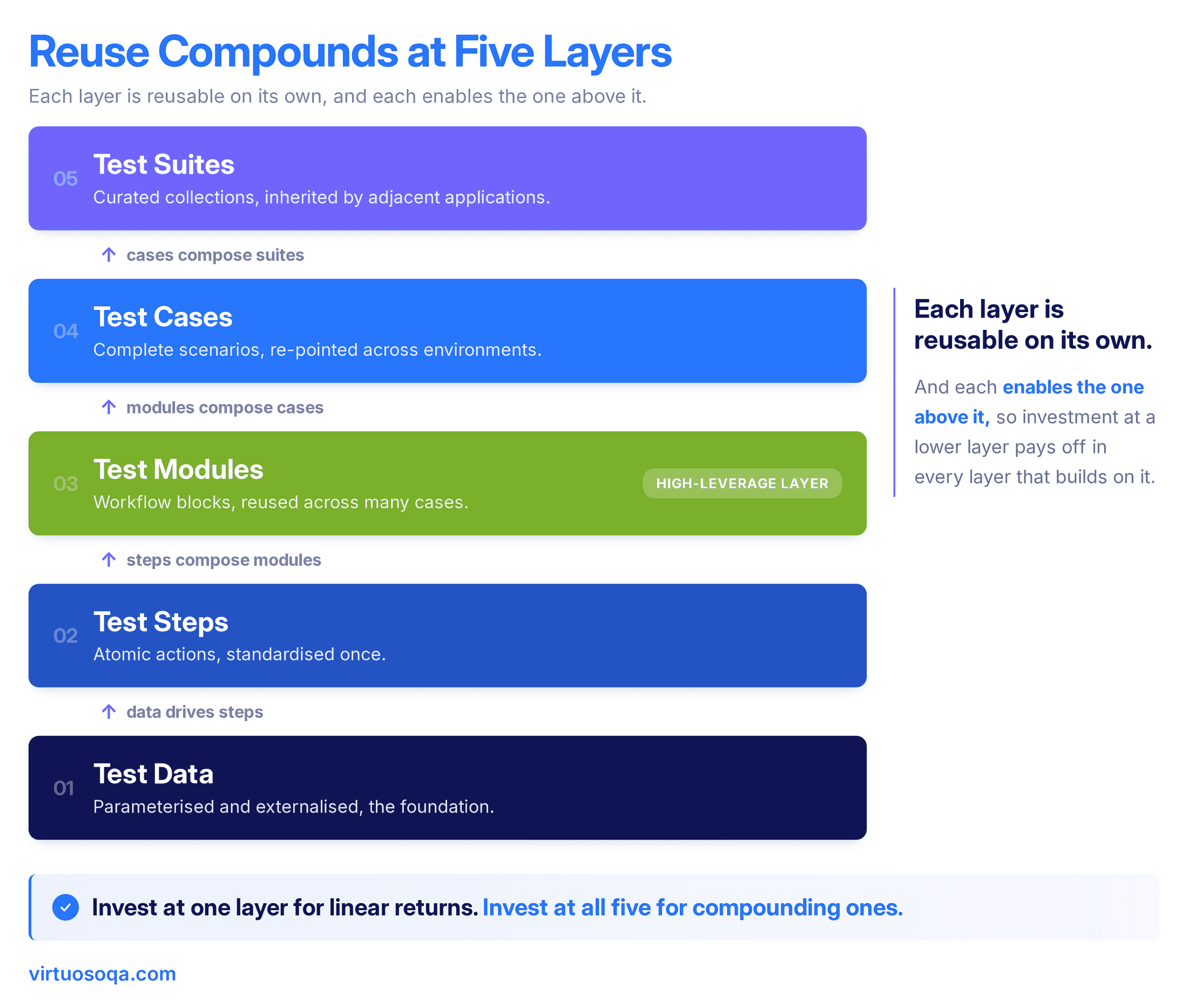
Reusability is not one thing. It happens at five distinct layers of the test estate, each with different mechanics, governance, and returns, and a serious practice invests at every layer.
Layer 1: Test Data
The foundation. Reusable test data is parameterised, externalised, and managed independently of the test logic that consumes it.
The discipline is that data sets live in a dedicated test data management system rather than embedded in test scripts, and variables such as customer IDs, account balances, locales, and dates are injected at runtime, so the same logic can run against ten data scenarios without rewriting a single line.
The payoff is that one test definition covers ten boundary conditions, twenty data combinations, or thirty locale variants, so coverage multiplies without authorship cost.
Layer 2: Test Steps
The atomic layer. Reusable steps are standardised, named, and stored in a shared step library, so a "click the submit button" step or a "verify the confirmation message" step exists once and is called everywhere.
The discipline is a curated library of atomic actions with clear naming conventions and ownership, where engineers compose tests by selecting steps rather than writing them.
The payoff is consistency of behaviour across the estate, since when the underlying action changes, the step library is updated in one place and every test using that step inherits the change.
Layer 3: Test Modules
The composable layer. A test module is a reusable workflow block, such as a login sequence, an add-to-cart flow, a claim submission, or a checkout journey, combining steps into meaningful business actions.
The discipline is that workflows are factored out as named modules with defined inputs, outputs, and behaviour, so a login module accepts credentials, returns a session state, and is reusable across every test that needs an authenticated session.
The payoff is business-level reuse, since modules map to what users actually do, which makes them natural units of verification and durable across UI changes.
Layer 4: Test Cases
The scenario layer. A reusable test case verifies a complete user scenario, such as the happy path of an end-to-end purchase, a specific failure mode in claims processing, or a regression check on a payment workflow.
The discipline is that test cases are composed of modules and named for the scenario they verify, so the same case can be re-pointed at different environments such as staging, UAT, or production smoke without rewriting.
The payoff is scenario-level reuse, since regression cycles inherit the previous cycle's test cases rather than rebuilding them, and environment differences are handled by configuration rather than duplication.
Layer 5: Test Suites
The orchestration layer. A reusable test suite is a curated collection of test cases arranged for a specific purpose, such as a smoke suite, a regression suite, a release-readiness suite, or an acceptance suite.
The discipline is that suites are first-class artefacts with their own ownership, scheduling, and reporting, so a suite assembled for a critical workflow can be inherited by adjacent applications that share that workflow.
The payoff is programme-level reuse, since new applications, acquired businesses, and adjacent product lines inherit suites rather than building them, and coverage compounds at the highest level of the stack.
The stack reads top to bottom or bottom to top. A suite is composed of test cases, which are composed of modules, which are composed of steps, which operate on data. Each layer is reusable on its own, and each enables the layers above it, so a practice that invests at every layer gets compounding returns, while a practice that invests at one layer, typically layer three or four in isolation, gets linear returns at best.
A Worked Example, One Module Across Many Cases
The compounding is easiest to see in a single module. Consider a "log in as a returning customer" module, factored out once with a defined input, the customer tier, and a defined output, an authenticated session. It combines four steps, namely navigate to the login page, enter credentials, submit, and verify the dashboard loads.
That one module is then consumed by the checkout test case, the account-settings test case, the order-history test case, the saved-payment-methods test case, and a dozen others, since almost every authenticated journey begins with a login. When the login flow changes, for instance a new two-factor prompt is added, the module is updated once and all fifteen consuming cases inherit the fix.
Under a bespoke model, that same change would mean editing the login steps in fifteen separate tests, finding all fifteen, and hoping none were missed. The module turns fifteen edits into one, and that ratio is the whole argument for reusable test cases expressed in a single change.
Seven Strategies That Actually Compound
A reusable test estate is not the accidental output of good intentions, it is the deliberate outcome of seven disciplines applied consistently.
1. Architect for Reuse Before Writing a Test
The most expensive mistake in test design is to write tests first and try to refactor them into reusable assets later, since the structure that emerges from bespoke design rarely composes cleanly.
The discipline that works is to define the step library, the module library, and the naming convention before writing the first test in a new application, spending a week on architecture that pays back inside the first quarter.
2. Modularise at the Workflow Level, Not Just the Step Level
Step-level reuse is the easy form and module-level reuse is the high-leverage form, since a login sequence reused across two hundred tests delivers more compounding value than a click-button step reused across two thousand.
The discipline is to factor out reusable workflow modules with meaningful business names, such as "log in as a Gold-tier customer" rather than "fill_form_a," because business actions are what survive UI changes.
3. Separate Test Data From Test Logic
Embedded test data is the silent killer of reusability, since a hardcoded customer ID, a fixed date, or a baked-in currency value locks the test to a single scenario and environment.
The discipline is that every value that varies by environment, data condition, or locale is externalised and injected at runtime, so the test logic contains no fixed values that change across runs.
4. Centralise Discoverability, Not Just Storage
A repository is not a library, since storing tests in a shared location does not make them findable, and findability requires taxonomy, search, tagging, owners, versions, and usage signals.
The discipline is that every reusable asset is named consistently, tagged by application and workflow, owned by a named person, and listed in a searchable catalogue, so an engineer finds the existing module in under two minutes, because if they cannot, they will build their own and the asset count doubles without the coverage doubling.
5. Standardise the Taxonomy
Inconsistent naming destroys reuse silently, since two modules that do the same thing under different names live as duplicates, and three teams using three terms for the same workflow each rebuild it.
The discipline is a published naming convention applied at module, case, and suite level, policed in code review rather than in policy documents, so a non-conforming name is rejected at merge rather than flagged in retrospective.
6. Assign Ownership to Every Reusable Asset
A library full of orphan assets becomes a library full of stale assets, and the fix is ownership.
The discipline is that every reusable module, case, and suite has a named owner responsible for maintaining it, deprecating it when it no longer serves, and answering questions about it, with ownership published in the catalogue and reassigned rather than silently abandoned when the owner leaves.
7. Refactor as a First-Class Activity
Reusability decays, since modules drift from current behaviour, test data goes out of date, and naming conventions get fudged under deadline pressure, so without active maintenance the library entropies into a museum.
The discipline is refactor cycles scheduled into the release rhythm rather than deferred to "when there is time," such as a monthly refactor day, a quarterly library review, and a yearly architecture revisit, funded as part of normal capacity.
Anti-Patterns That Destroy Reusability Quietly
Six patterns appear repeatedly in audits of test estates that were supposed to be reusable and turned out not to be.
Copy-paste reuse: An engineer finds an existing test close to what they need, copies it, modifies it locally, and saves the copy under a new name, so the original asset is not extended, the new asset is not reusable, and the library grows by one item with no compounding value.
Selector-bound tests: Tests written against UI selectors such as specific element IDs, CSS paths, or XPath expressions break whenever the UI changes, and each break requires manual intervention, so the estate becomes a maintenance burden whose cost grows faster than its coverage.
Embedded test data: Hardcoded values inside test logic, such as a specific account number, a fixed date, or a baked-in locale, mean the test cannot be reused in another environment, data condition, or locale without modification.
Implicit dependencies: Tests that depend on a specific order, environment state, or data condition not declared in the test definition pass in their original context and fail everywhere else, so reuse becomes impossible to verify because the dependencies are invisible.
No ownership: A module sits in the library with no owner, so when it breaks nobody fixes it and when the underlying behaviour changes nobody updates it, and within two quarters every test depending on it fails for reasons nobody can diagnose, so the module becomes unmaintainable and the tests get rewritten from scratch.
No retirement discipline: Dead tests accumulate, modules for retired features stay in the library, and test cases for sunset products keep running and failing, so the signal-to-noise ratio degrades to the point where engineers ignore failures. A reusable library needs deletion as much as creation, and retirement is part of the practice rather than a sign of failure.
When Not to Over-Invest in Reuse
A page that argues for reuse throughout owes the reader the honest boundary, which is that not every test should be built for reuse, and treating reusability as a universal mandate produces its own waste. The architecture effort that pays back handsomely on a durable, frequently-run suite is wasted on a test that will run a handful of times and then be discarded.
There are three cases where bespoke is the right call.
A throwaway test written to reproduce and confirm a single bug fix, which has served its purpose once the fix ships and does not belong in the permanent library.
A spike or exploratory automation written to probe a design question, where the goal is the answer rather than a durable asset.
A test for a feature already scheduled for retirement, where investing in a reusable module for something being sunset next quarter is effort spent on a depreciating asset.
The judgment is the same capital logic that runs through the rest of this page, namely that reuse is an investment, and an investment only makes sense where the asset will be used enough to repay it.
The discipline is not to make everything reusable, it is to make the right things reusable and to recognise the difference deliberately rather than by accident.
How to Measure Reusability
What gets owned gets reused, and what gets tracked gets improved. Five metrics turn reusability from an aspiration into a tracked discipline, and the numbers below are working rules of thumb rather than researched benchmarks, useful as directional targets rather than as precise thresholds.
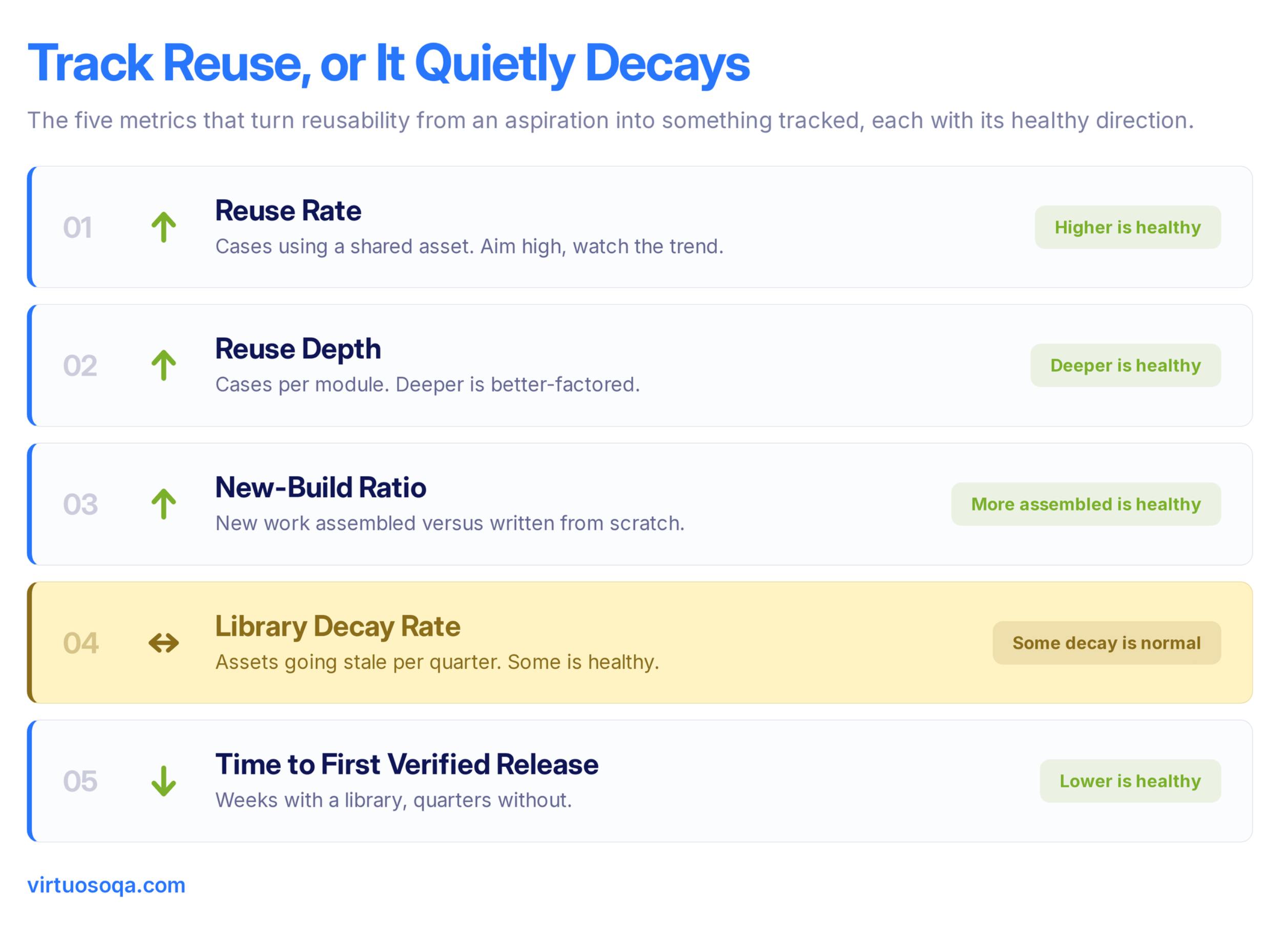
Reuse rate: The proportion of test cases that use at least one shared module or step from the library. A low reuse rate, as a rough guide under thirty percent, indicates a bespoke practice with little compounding, while a healthy one, above roughly seventy percent, indicates a library-led practice, and the trend over quarters matters more than the absolute number.
Reuse Depth: The average number of test cases consuming each reusable module. Shallow depth, where modules are used once or twice, suggests they are too specific or too poorly discoverable, while deep depth, where modules are used dozens of times, indicates they are well-factored and well-known.
New-build ratio: The proportion of new test cases in a quarter built primarily from existing modules versus written from scratch. A healthy practice trends toward majority reuse for new cases, a fifty-fifty split is a warning sign for a mid-sized estate, and under a quarter reuse on new work signals the library is failing.
Library decay rate: The proportion of reusable assets that become stale, orphaned, or deprecated per quarter. Some decay is healthy as features retire and workflows evolve, while excessive decay, as a rough guide over ten percent per quarter, indicates ownership gaps or insufficient maintenance.
Time to first verified release on a new application: The interval between starting test design for a new application and the first regression-quality release. A practice with a strong reusable library can stand up coverage in weeks, while a practice without one takes quarters, which makes this the clearest external signal of reusability maturity.
The Modern Shift, From Reusable Test Cases to Composable Test Modules
The phrase "reusable test cases" carries a generation of habits from the era of manual test cases stored in spreadsheets, then test management tools, then early automation frameworks. The vocabulary has aged, and the practice it points at has evolved. Three shifts define the modern operational form.
From the test case as the primary unit to the module as the primary unit. Classical reusability treats the test case as the unit of reuse, while modern composable testing treats the module as the unit, so a test case is assembled from modules and the module is what compounds.
A practice that thinks in test cases reuses cases, while a practice that thinks in modules composes them into effectively unlimited combinations of cases.
From parameterisation to natural-language authoring. Classical reusability achieves data variation through parameterisation, which requires technical authoring, while modern composable testing achieves it through natural-language authoring with business-named inputs that any practitioner can write.
The library is no longer a developer artefact but a shared asset across QA, engineering, product, and increasingly operations.
From scripted reuse to self-healing reuse. Classical reusability is fragile, since a module breaks when the UI changes, while self-healing absorbs the break and keeps the module valid across structural drift.
A reusable module that self-heals across UI changes survives refactors, and a reusable module that does not decays faster than the library can maintain it.
The modern form of reusable test cases is composable testing with self-healing on a behaviour-led platform, and the vocabulary is simply catching up to the practice.
How Virtuoso QA Enables Composable Reuse
Five design decisions in Virtuoso QA map directly to the five layers of the Reuse Stack.
Test data, treated as a first-class layer, with parameterised sets externalised from test logic driving the same test across multiple scenarios and environments.
A step library of atomic actions that ships with the platform, so common operations such as click, verify, navigate, and assert are standardised and consistent across the practice.
Composable modules at the workflow level, letting practitioners build login sequences, checkout flows, and claim submissions once and reuse them across hundreds of test cases.
Test case composition through plain-English authoring, so cases are written in business language that maps directly to modules and can be re-pointed at different environments and applications through configuration.
Suite-level orchestration with environment-aware execution, so a regression suite assembled for one application can be inherited and adapted for adjacent applications that share the underlying workflows.
Self-healing absorbs UI drift across every layer of the stack, so when the application is refactored, modules continue to verify the workflow and coverage built in one quarter survives into the next. The practice it enables is shorter to describe than the product line behind it, namely a test estate that compounds, a library that pays back every quarter, and a regression suite that the bank in the opening scene would never have had to rebuild.

Related Reads
Frequently Asked Questions
Why Are Reusable Test Cases Important?
How Do You Make Test Cases Reusable?
What Is the Difference Between Reusable and Modular Test Cases?
How Does Composable Testing Improve Reusable Test Cases?
How Often Should Reusable Test Cases Be Reviewed?
What Is a Good Test Case Reuse Rate?