

Blog
Managing Test Cases: Best Practices for Modern QA Teams

Published on
March 17, 2026


Master test case management from creation to maintenance. Explore AI-powered tools, Agile workflows, and enterprise strategies that cut costs and scale QA.
Test case management is the backbone of any effective quality assurance strategy. It determines whether your testing effort scales with your product or collapses under its own weight. Organisations that implement structured test case management alongside AI native automation report reductions in maintenance effort and faster test delivery. This guide breaks down everything you need to know, from fundamental concepts to enterprise implementation strategies.
Test case management is the systematic process of creating, organising, tracking, executing, and maintaining test cases throughout the software development lifecycle. It encompasses every activity involved in ensuring that your test assets remain accurate, traceable, and aligned with evolving business requirements.
At its core, test case management answers three questions that every QA team faces daily. First, what needs to be tested? Second, what has already been tested? Third, what were the results?
These questions sound simple. But at enterprise scale, where teams manage thousands of test cases across dozens of applications with frequent release cycles, the answers become extraordinarily complex. A single enterprise application like SAP S/4HANA or Salesforce can require thousands of test scenarios spanning multiple modules, integrations, and user roles. Without structured management, test assets become disorganised, duplicated, and ultimately unreliable.
The consequences of poor test case management ripple across the entire development lifecycle. Teams waste time recreating tests that already exist. Critical scenarios get missed because no one can find them. Regression suites grow bloated with redundant or outdated cases. And when production defects surface, there is no traceability to determine whether the scenario was ever tested.
Research consistently shows that 73% of test automation projects fail to deliver expected ROI. While many factors contribute to this statistic, disorganised test case management is one of the most common and most preventable root causes.
Test case management is not exclusive to large QA departments. Any team responsible for software quality benefits from it, though what works at ten test cases looks nothing like what works at ten thousand.
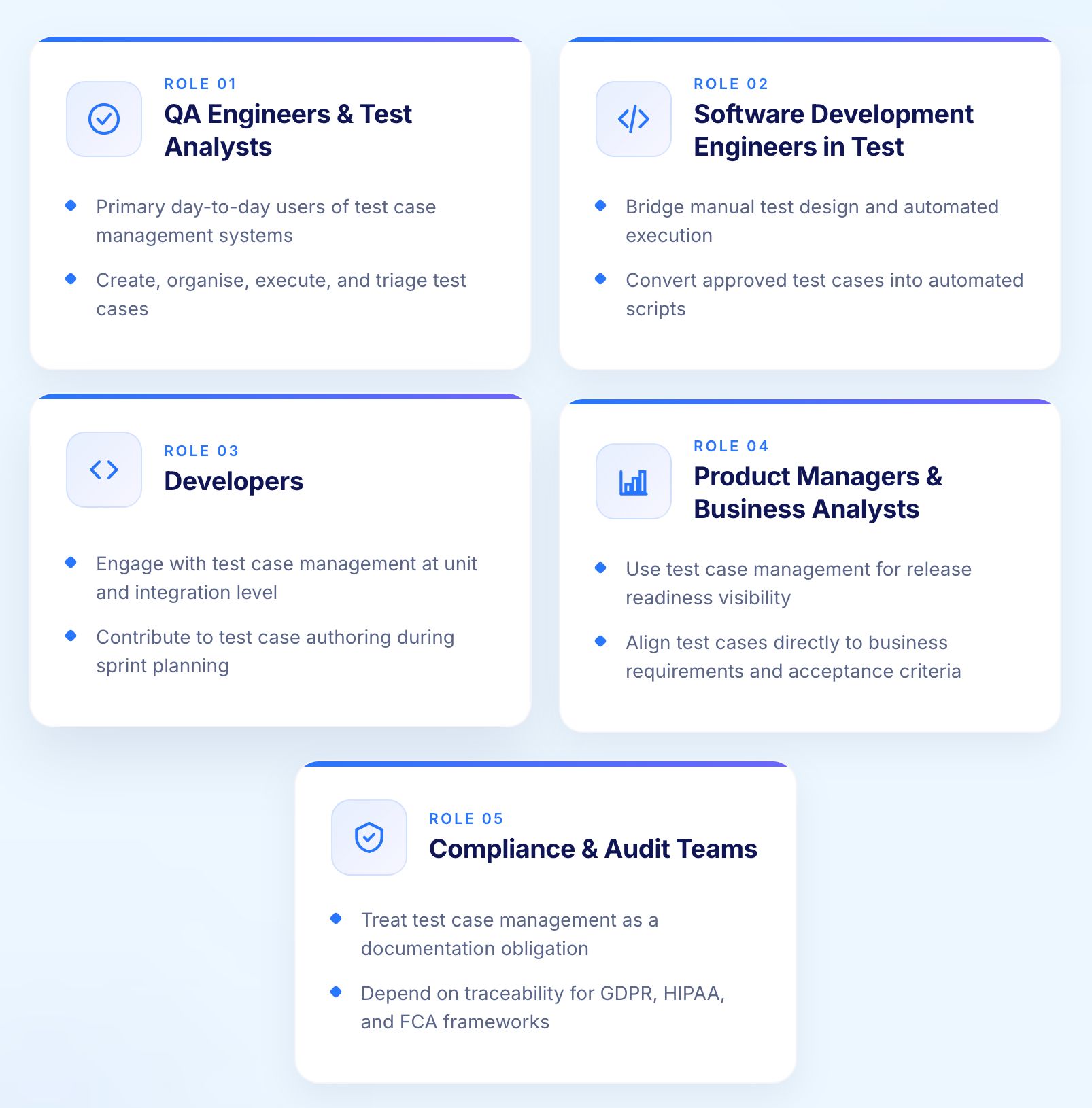
Small Teams and Solo Developers
Test management and test case management are often used interchangeably. They are not the same thing.
The distinction matters when selecting tools and assigning responsibility. A QA manager owns test management. The entire QA team participates in test case management. Confusing the two leads to gaps in both governance and execution.
Both disciplines share a common goal: ensuring the right tests run at the right time with traceable results. Effective test case management is a prerequisite for effective test management. You cannot report on testing progress if your individual test assets are disorganised, duplicated, or out of date.

Every effective test case starts with a clear structure. A well designed test case includes a unique identifier, a descriptive title, preconditions that define the starting state, step by step instructions, expected results for each step, and the actual results captured during execution.
The traditional approach involves QA analysts writing test cases manually, often in spreadsheets or dedicated tools. This works at small scale. But when your application portfolio grows to include enterprise systems like Oracle Cloud, Dynamics 365, or Workday, manual test case creation becomes the single biggest bottleneck in your release cycle.
AI native test platforms have fundamentally changed this equation. Natural Language Programming allows testers to write test cases in plain English rather than code, reducing authoring time from 8 to 12 hours per 30 step test to approximately 45 minutes. Virtuoso QA's StepIQ takes this further by autonomously generating test steps based on application context and user behaviour, making test creation accessible to business analysts and domain experts who understand what needs to be tested but lack coding skills.
Organisation is where most teams start to struggle. As test suites grow, finding the right test case for the right scenario becomes increasingly difficult without a clear organisational hierarchy.
The most scalable approach organises test assets into four layers. Test repositories serve as the central storage layer where all test assets live. Within repositories, test suites group related cases by feature, module, or business process. Individual test cases contain the specific validation logic, and test steps define the granular actions within each case.
The most successful enterprise teams organise test cases around business processes rather than technical modules. Instead of grouping by "Login Module" or "Payment Gateway," they structure around end to end journeys like "Order to Cash," "Procure to Pay," or "Hire to Retire." This approach aligns testing with business outcomes and makes it far easier for stakeholders to understand coverage and gaps.
Composable testing takes this concept to the next level. By building reusable test components that can be assembled into complete journeys, teams create a library of modular building blocks. A single checkout component, for example, can be reused across hundreds of test journeys without duplication.
Execution management ensures that the right tests run at the right time against the right environments. This involves scheduling test runs, assigning them to testers or automation frameworks, monitoring progress in real time, and collecting results for analysis.
Modern execution tracking goes far beyond simple pass or fail status. AI powered Root Cause Analysis examines failures at the element level, providing screenshots, DOM snapshots, network logs, and performance metrics to pinpoint exactly why a test failed. This eliminates the hours teams typically spend manually triaging failures and distinguishing genuine defects from environmental issues or test flakiness.
Cross browser and cross device execution adds another dimension. Enterprise applications must function correctly across 2,000 or more OS, browser, and device combinations. Executing test cases across all these configurations manually would require enormous resources. Cloud based execution grids handle this automatically, running test suites in parallel across every required configuration without additional infrastructure setup.
Maintenance is where traditional test case management breaks down entirely. Every time the application under test changes, affected test cases need updating. In fast moving Agile and DevOps environments where applications change weekly or even daily, maintenance consumes the majority of QA effort.
The numbers tell the story. Teams using traditional Selenium based frameworks report spending 60% to 80% of their automation effort on maintenance rather than creating new tests. This creates a death spiral: more tests mean more maintenance, which means less time for new tests, which eventually leads to abandoned automation initiatives.
AI powered self healing fundamentally solves this problem. When application elements change, such as updated IDs, restructured DOM trees, or modified CSS selectors, self healing technology automatically identifies and updates the affected test steps.

Effective test case management follows a repeatable six-stage cycle:
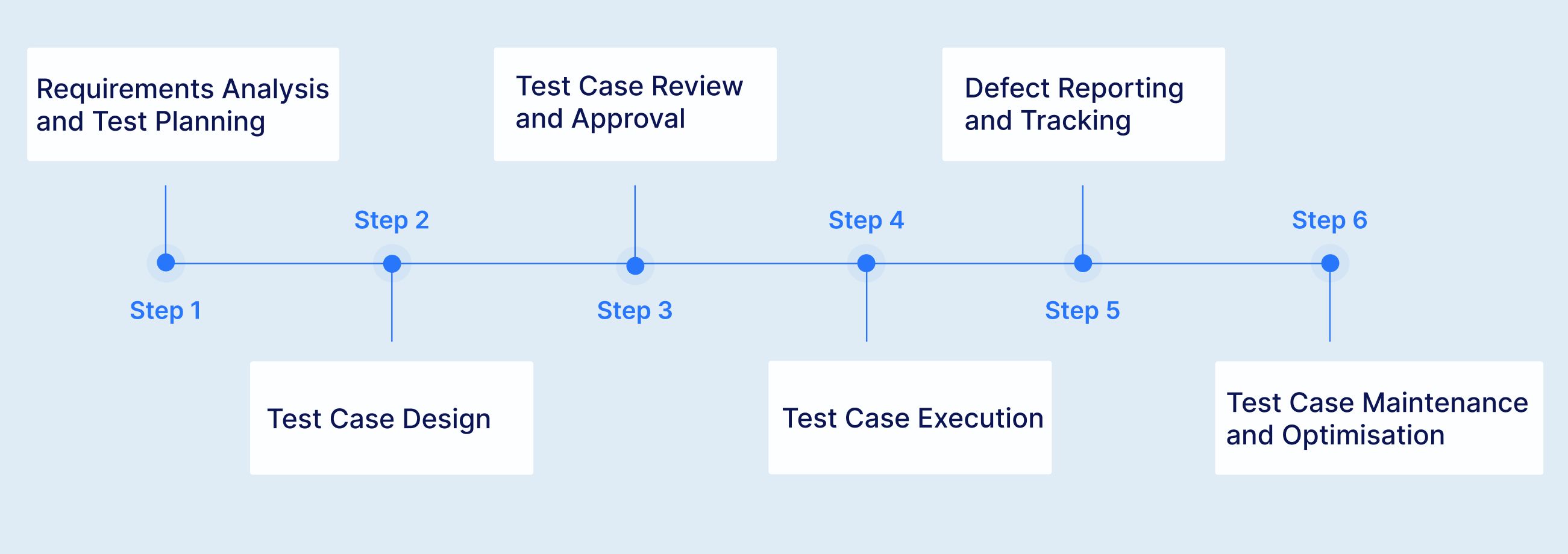
Effective test case management begins before a single test is written. Start by analysing business requirements, user stories, and acceptance criteria to identify what needs testing. Map each requirement to planned test cases to establish traceability, ensuring that every business need has corresponding validation.
Design test cases based on the requirements mapped in Step 1. Apply proven techniques including equivalence partitioning, boundary value analysis, decision tables, and state transition testing to ensure thorough coverage without unnecessary redundancy. Each test case should validate a specific scenario and produce a clear pass or fail outcome.
Before execution, test cases should undergo peer review. This catches gaps in coverage, identifies redundant scenarios, and ensures that expected results are clearly defined. In regulated industries like financial services and healthcare, formal review and approval workflows are often mandatory for audit compliance.
Execute test cases according to the test plan. This may involve manual execution, automated execution, or a combination of both. Track each execution against specific builds, environments, and configurations. Record actual results, capture evidence (screenshots, logs), and flag any deviations from expected behaviour.
When test cases fail, link the failure directly to a defect in your issue tracker. This creates bidirectional traceability between test failures and defects, making it easy to verify fixes and track resolution progress. Integration with tools like Jira ensures that defect information flows seamlessly between QA and development teams.
Continuously review and update test cases to reflect application changes, new requirements, and lessons learned from previous cycles. Remove obsolete cases, consolidate duplicates, and refine test data. This is where AI native test platforms provide the most significant advantage, automatically adapting test cases to application changes rather than requiring manual updates.
Traditional test case management was designed for project-based, phase-gated delivery. Agile and CI/CD pipelines break both of those assumptions. Test cases cannot be created in a big-bang design phase and maintained in a quarterly review cycle when the application changes every two weeks.
In agile environments, test cases are created alongside user stories during sprint planning, not after development completes. Each user story should have corresponding test cases defined before a single line of code is written. This links acceptance criteria directly to test scenarios and prevents the coverage gaps that form when testing is treated as a downstream activity.
Test cases in agile must be lightweight and modular. A composable approach, where common workflows like login, checkout, or data submission are built once and reused across stories, prevents the duplication that makes sprint-level maintenance unmanageable.
Test cases integrated with CI/CD pipelines execute automatically on every code commit, pull request, or scheduled interval. Rather than managing test runs manually, teams configure execution plans that trigger the right test cases against the right environment at each stage of the pipeline.
Integration with tools like Jenkins, Azure DevOps, GitHub Actions, and GitLab ensures that test case results gate deployments in real time. A failing test case blocks the pipeline immediately, before the defect travels further through the delivery cycle.
The biggest test case management challenge in CI/CD is currency. When the application deploys multiple times per week, test cases written against last week's UI can produce false failures that erode trust in the pipeline.
AI-powered self-healing addresses this directly. Rather than relying on manual review cycles to update affected test cases, self-healing technology detects when application changes have broken element identification and adapts automatically. This keeps test cases accurate and executable without human intervention at every deployment.
For a deeper look at structuring automation within sprint cycles, see our guide to Agile Test Automation
The integration of large language models and machine learning into test case management represents the most significant shift in QA methodology in decades. Traditional management approaches assumed that humans would always be responsible for every aspect of test lifecycle governance. AI fundamentally changes that assumption.
LLM based test generation analyses application structure, user flows, and business requirements to automatically create comprehensive test cases. Rather than a QA analyst spending hours manually writing each scenario, AI generates test cases from application context in minutes. Virtuoso QA's GENerator technology can convert existing test suites from legacy tools like Tosca, Selenium, or TestComplete into modern natural language test cases, eliminating months of manual migration effort.
AI analyses execution history, defect data, and code change impact to determine which test cases should run first. High risk areas receive priority, while stable features with consistent pass rates may be deferred. This risk based approach ensures that limited testing time is spent where it matters most, a critical capability when sprint cycles compress testing windows.
Machine learning models identify test cases likely to fail due to upcoming application changes before those changes even deploy. This proactive approach replaces the reactive cycle of "deploy, break, fix" with a preventive model that keeps test suites healthy continuously.
AI native platforms eliminate the boundary between test management and test automation. When test cases are written in natural language, they serve simultaneously as documentation, requirements traceability artifacts, and executable automation. Business stakeholders can read and understand test cases without technical translation, and the same natural language steps execute directly against the application during automated runs.

The right tool depends on team size, technical maturity, integration requirements, and whether you are managing manual testing, automated testing, or both.
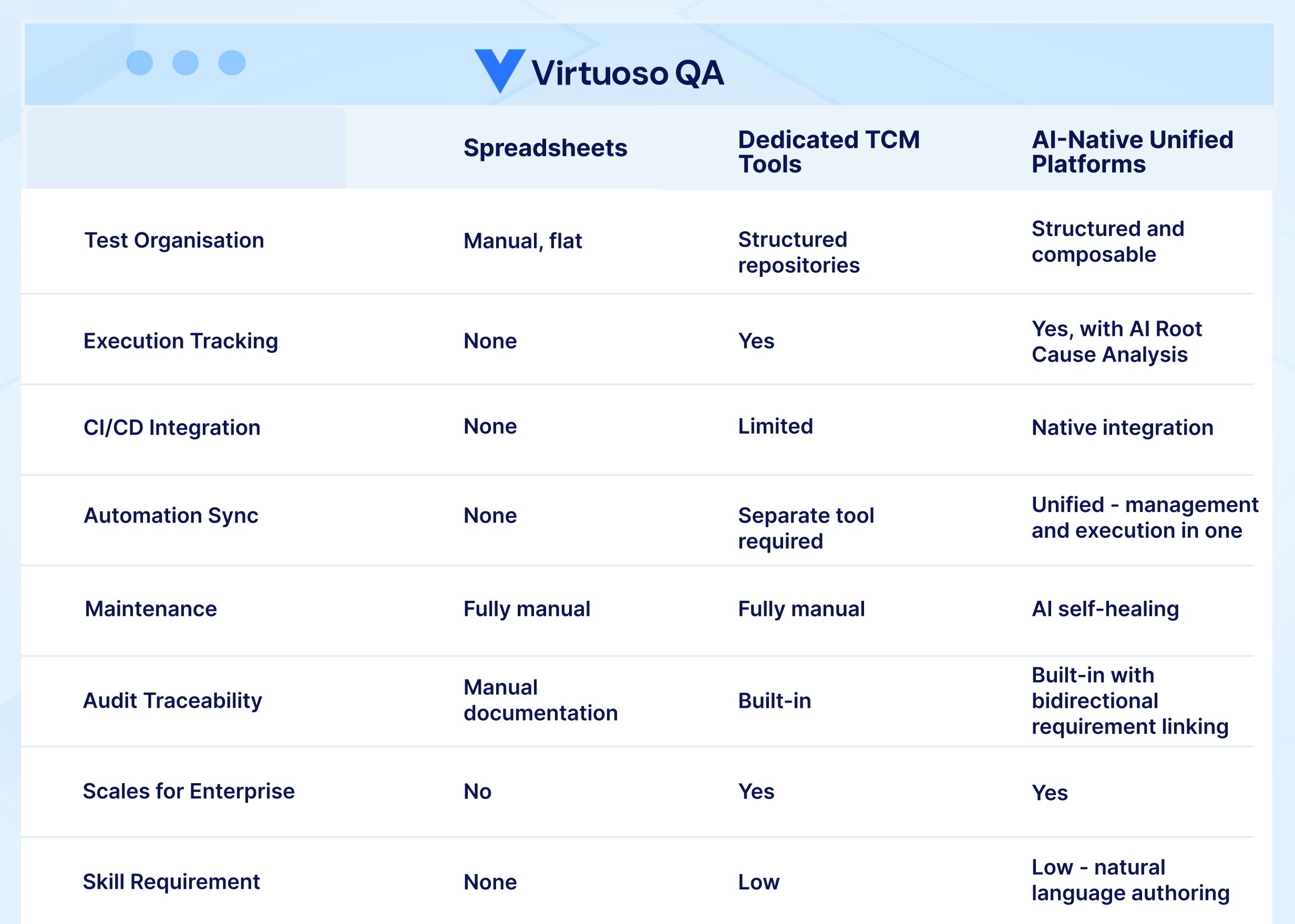
Works for teams with fewer than 50 test cases and a single tester. Fast to set up, no onboarding, no cost.
Breaks down quickly because:
Spreadsheets are a starting point, not a destination.
Purpose-built tools solve the organisation, execution tracking, and reporting problems spreadsheets cannot handle.
The core limitation of dedicated platforms is the gap between what is documented and what actually runs. Test cases live in TestRail. Automated tests live in Selenium or Cypress. Keeping the two synchronised requires constant manual effort and they frequently drift apart.
AI-native test platforms close this gap by treating test case management and test automation as one discipline:
Virtuoso QA operates on this model. Test cases authored in plain English through StepIQ execute directly against the application. Results feed into connected platforms including TestRail, Xray, and Azure Test Plans through native integrations, so existing reporting workflows are preserved. For teams migrating from Selenium, Tosca, or TestComplete, GENerator converts legacy scripts into natural language test cases automatically, removing months of manual migration effort.

Consistent naming makes test cases searchable and understandable at a glance. Include the feature area, scenario type, and specific condition in each name. "Login_ValidCredentials_SuccessfulRedirect" communicates far more than "TC_0042."
Every test case should trace back to a specific business requirement. This bidirectional link ensures complete coverage, simplifies impact analysis when requirements change, and provides auditors with clear evidence of validation in regulated environments.
Each test case should validate one specific scenario. Avoid creating monolithic tests that check multiple conditions in a single flow. Atomic tests are easier to maintain, produce clearer results when they fail, and enable more precise reporting.
Test cases evolve alongside the application. Maintain version history to track changes, understand why modifications were made, and revert if needed. Platforms with built in versioning handle this automatically, while spreadsheet based teams must implement manual controls.
Not all test cases carry equal weight. Classify cases by risk level and business impact, then allocate execution time accordingly. Critical payment workflows deserve more rigorous testing than cosmetic UI preferences. AI powered prioritisation automates this classification based on historical data and change impact analysis.
Test suites grow over time, and not all growth is healthy. Schedule regular reviews to identify obsolete, redundant, or consistently passing test cases that no longer provide value. Lean test suites execute faster, fail less often for irrelevant reasons, and provide clearer signals about application quality.
Enterprise applications present unique test case management challenges that standard approaches cannot address.
ERP implementations involve thousands of configurable business processes spanning finance, procurement, manufacturing, and human resources. Test case management for SAP S/4HANA requires mapping tests to specific configuration variants, handling complex master data dependencies, and managing cases across multiple organisational units. Composable test libraries with pre built ERP process tests reduce the management overhead from months of setup to days of configuration.
Salesforce releases three major updates annually, each potentially affecting thousands of customisations. Test case management must account for dynamic Lightning components, custom objects, validation rules, and workflow automations. Enterprise teams managing Salesforce testing have achieved 83% first time pass rates by combining structured test case management with AI native automation that adapts to the platform's dynamic interface.
The Unified Interface architecture and regular wave releases create constant change. Test cases must cover standard modules, ISV solutions, custom extensions, and their interactions. Teams using AI powered management across Dynamics 365 estates report 81% reductions in maintenance effort compared to manual approaches.
In regulated industries, test case management is not just a quality practice. It is an audit obligation. Financial services, healthcare, insurance, and public sector organisations must demonstrate that software changes were tested, that tests were approved, and that results were recorded before any change reached production.
Regulatory frameworks including GDPR, HIPAA, FCA guidelines, and ISO 25010 all require some form of documented evidence that testing occurred. Specifically, auditors look for traceability from business requirements to test cases, documented test results with timestamps, approval workflows before test execution or production deployment, and evidence that defects were identified, tracked, and resolved.
A test case management system that cannot produce this evidence creates compliance risk, regardless of how well the underlying testing was performed.
Audit-ready test case management requires bidirectional traceability, from requirement to test case, and from test execution result back to the requirement. Every test case needs an approval state, an execution history, and a link to any defects it identified.
Integrations with Jira, Xray, TestRail, and Azure Test Plans ensure that this traceability is maintained automatically as tests execute, rather than requiring manual documentation after the fact. When an auditor asks "how was this requirement validated?", the answer should be one click away.
Track the percentage of requirements with associated test cases, the percentage of test cases that have been executed in the current cycle, and the distribution of cases across risk categories. Coverage gaps indicate areas where test case management needs attention.
Measure test case creation time, execution time, and maintenance time per case. Declining creation and maintenance times indicate that your management processes are maturing.
Monitor defect detection rates by test case category, false failure rates, and the ratio of test cases that catch genuine defects versus those that consistently pass. Low detection rates may indicate that test cases need redesign rather than more volume.
Assess the percentage of requirements with linked test cases, the percentage of defects traceable to specific cases, and the completeness of execution evidence. Strong traceability indicates mature test case management practices.
Test case management is evolving from a documentation discipline into an intelligent, automated practice. AI does not replace the need for thoughtful test strategy, but it eliminates the mechanical overhead that has traditionally consumed QA resources.
The shift from code based test scripts to natural language test cases makes management accessible to the entire project team, not just technical specialists. Business analysts, product owners, and domain experts can participate directly in test governance, improving coverage quality and reducing the communication gaps that cause missed scenarios.
Organisations that embrace this evolution position themselves to scale testing alongside development velocity without proportionally scaling headcount. Those that remain anchored to spreadsheets and manual processes will find themselves increasingly unable to keep pace.


Try Virtuoso QA in Action
See how Virtuoso QA transforms plain English into fully executable tests within seconds.
