Blog
What Are Self Healing Regression Tests & How Do They Work?

Adwitiya Pandey
Published on

Table of contents
Lorem ipsum
Lorem ipsum
Lorem ipsum
Lorem ipsum
Lorem ipsum
Test maintenance kills automation initiatives. Organizations invest months building comprehensive regression suites only to watch them crumble as applications evolve. Element locators break. Page structures change. API responses shift. Teams spend 60% of their time fixing tests instead of creating coverage. Self healing regression tests solve this fundamental problem by automatically adapting when applications change. This guide explains how self healing works, why traditional approaches fail, and how to implement maintenance free regression testing.
The Maintenance Crisis in Test Automation
The numbers tell the story. 73% of test automation projects fail to deliver ROI. 68% of automation initiatives are abandoned within 18 months. The culprit is not poor technology choices or inadequate skills. It is maintenance.
Every automated test contains assumptions about application structure. Element IDs. CSS selectors. XPath expressions. API response formats. When applications change, these assumptions break. Tests fail not because functionality broke, but because the test no longer knows how to interact with the application.
Consider a typical enterprise scenario. A QA team builds 500 regression tests over six months. Each test averages 30 steps. The application undergoes a UI redesign. CSS frameworks change. Element hierarchies restructure. 40% of tests fail immediately. Not due to defects. Due to broken locators.
The team faces an impossible choice. Fix 200 tests manually, consuming weeks of effort. Or skip regression testing and deploy with unknown risk. Neither option is acceptable. Both occur daily across thousands of organizations.
Why Traditional Locator Strategies Fail
The Fragility of XPath and CSS Selectors
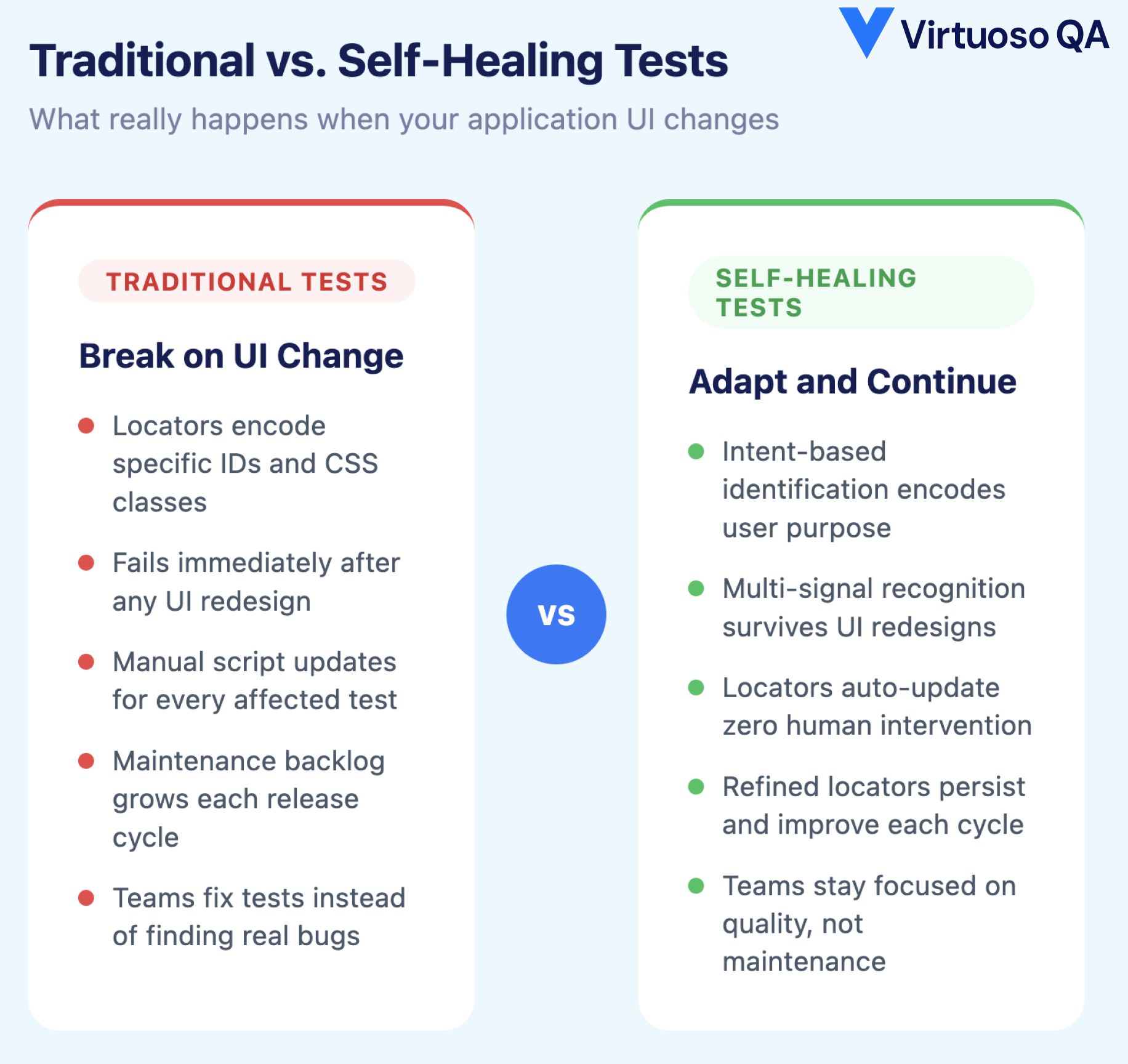
Traditional test automation relies on locators to identify elements. Click this button. Enter text in this field. Verify this label. Locators specify which element to interact with.
XPath expressions navigate document structure. They describe paths through HTML hierarchies. Change the hierarchy, break the path. Add a wrapper div, invalidate the selector.
CSS selectors target elements by attributes, classes, and relationships. They depend on implementation details that frequently change. Redesign the styling, break the selectors.
Both approaches share a fundamental flaw: they describe how to find elements, not what elements represent. They encode structure rather than intent.
The ID Dependency Trap
Best practices recommend using element IDs for stable locators. IDs should uniquely identify elements across page changes. But IDs are developer conveniences, not testing contracts.
Modern frontend frameworks generate dynamic IDs. React components receive runtime identifiers. Angular elements get framework prefixed IDs. Vue components hash their selectors. Stable IDs become moving targets.
Even when IDs exist, they change. Developers refactor code. They rename components. They reorganize modules. Each change potentially breaks tests that depended on previous identifiers.
The Page Object Pattern Limitations
Page object patterns abstract locators into reusable classes. They centralize element definitions. They reduce duplication. But they do not eliminate maintenance.
Page objects shift maintenance location, not maintenance effort. Instead of fixing locators across 50 tests, you fix them in one page object. But you still fix them. And you must know which page objects require updates. And you must validate that updates work across all consuming tests.
Complex applications have dozens of page objects. Tracking dependencies between page objects and tests requires sophisticated management. Most teams lack visibility into these relationships.
How Self Healing Tests Work
Self healing tests automatically adapt when applications change. They do not break when element structures evolve. They do not require manual updates after UI redesigns. They maintain stability across application versions.
1. Intent Based Element Identification
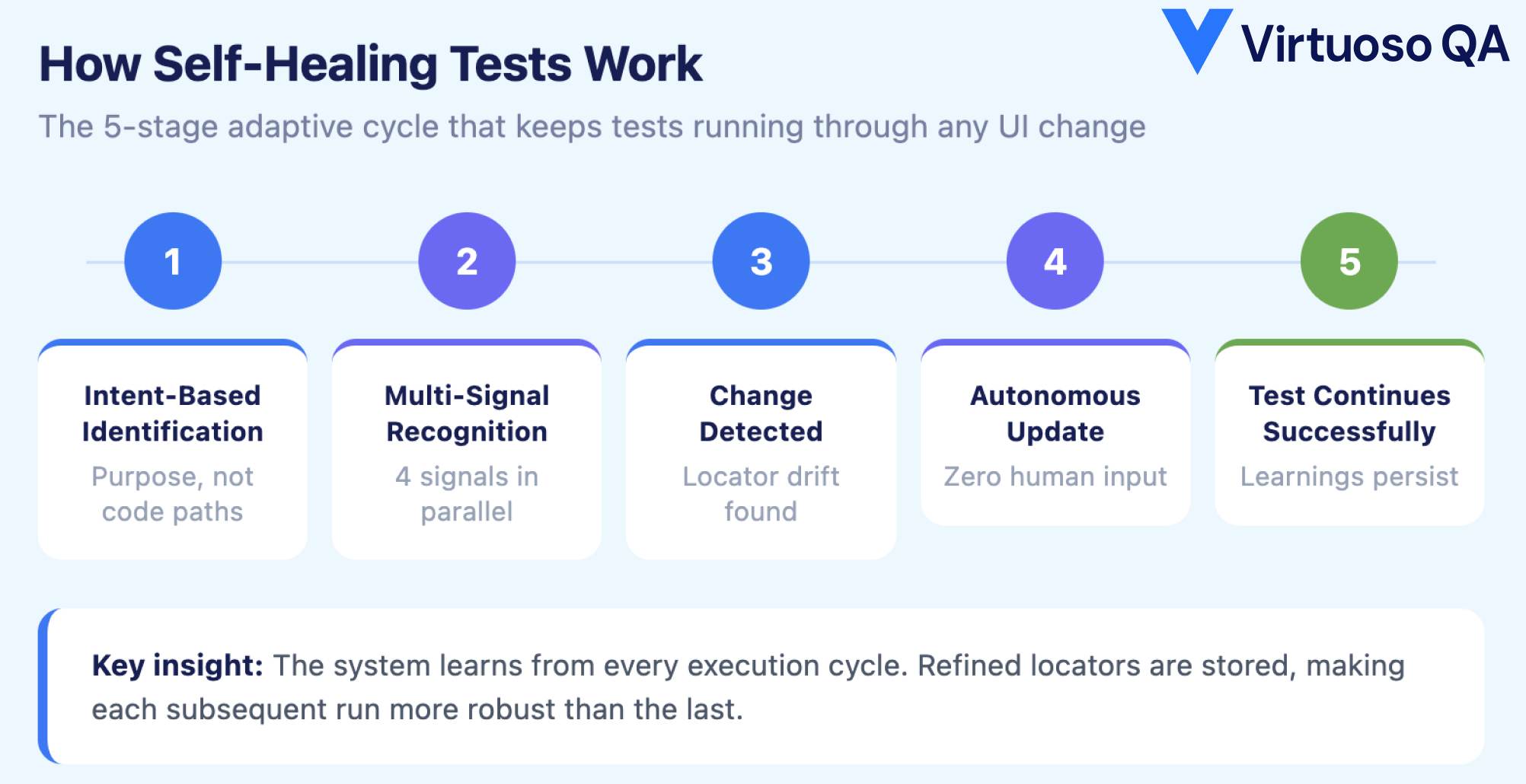
Self healing begins with understanding intent. What is this test trying to accomplish? Not which specific element to click, but what user action to perform.
Traditional locators encode implementation: click element with ID "submit-btn-v2". Intent based identification encodes purpose: click the submit button.
When applications change, implementations change but purposes remain. The submit button might get a new ID, new class, new position, new styling. But it is still the submit button. Intent based systems recognize this continuity.
2. Multi Signal Element Recognition
Self healing systems identify elements using multiple signals simultaneously. No single signal provides complete reliability. Combining signals creates robust identification.
Visual analysis examines element appearance. Size, color, position, styling. Elements that look like buttons are probably buttons. Elements that look like text fields probably accept input.
DOM structure examines document hierarchies. Parent relationships. Sibling patterns. Ancestor chains. Elements in similar structural positions across versions are likely equivalent.
Contextual data examines surrounding content. Labels adjacent to inputs. Headers above sections. Text within or near elements. Context provides semantic meaning.
Behavioral patterns examine element interactions. Clickable elements. Focusable elements. Scrollable elements. Behavior reveals element purpose.
When any single signal fails, others compensate. The system maintains identification even when individual attributes change dramatically.
3. Autonomous Locator Updates
When self healing systems detect element changes, they update locators automatically. They do not fail tests. They do not require human intervention. They adapt and continue.
The process occurs during execution. Test step specifies clicking a button. System searches for the button using multi signal identification. System finds the button despite changed locators. System updates internal locator records. Test continues successfully.
After execution, updated locators persist. Subsequent runs benefit from refined identification. The system learns from each execution cycle.
4. Confidence Scoring
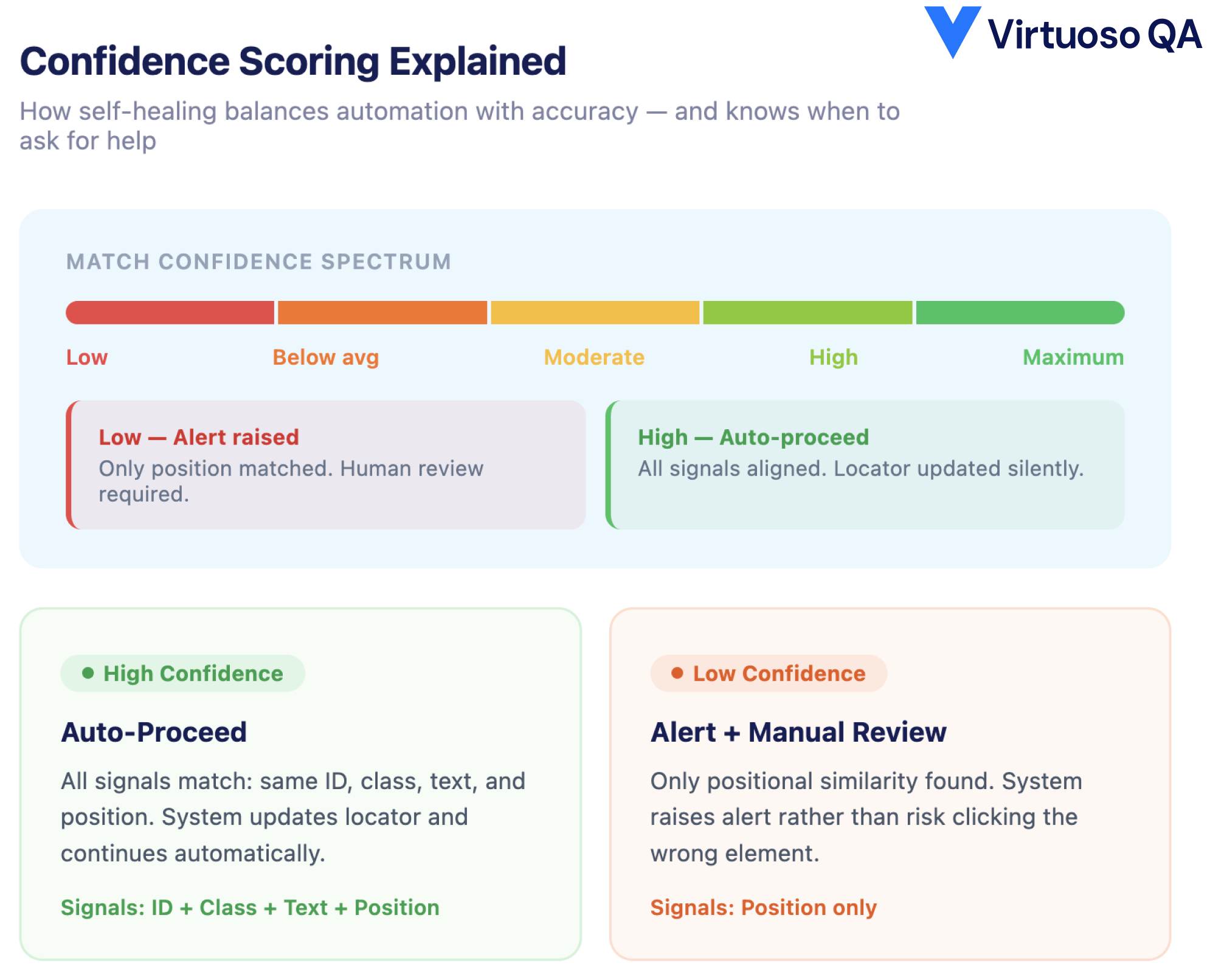
Not all element matches are equal. A button with identical ID, class, text, and position represents high confidence. A button with only positional similarity represents lower confidence.
Self healing systems calculate confidence scores for element matches. High confidence matches proceed automatically. Low confidence matches can trigger alerts or manual review.
This approach prevents false positives. The system will not click random elements hoping they are correct. It applies appropriate skepticism while maintaining automation benefits.
The Architecture of Self Healing Automation
AI Native vs AI Bolted Approaches
Self healing capabilities exist across a spectrum. Understanding architectural differences helps evaluate solutions.
AI bolted systems add self healing to traditional automation frameworks. They maintain conventional locator approaches as primary identification. AI provides fallback when primary locators fail.
These systems achieve 40% to 50% maintenance reduction. They catch obvious locator failures. But they retain fundamental brittleness. They still encode implementation details in test scripts. They still break when applications change significantly.
AI native systems build self healing into foundational architecture. They never rely solely on traditional locators. AI powered identification is primary, not fallback.
These systems achieve 80% to 95% maintenance reduction. They handle UI redesigns without intervention. They adapt to structural changes automatically. They understand test intent rather than memorizing element addresses.
The architectural difference is not incremental. It is categorical. Adding self healing to brittle foundations produces incremental improvement. Building self healing into foundations produces transformation.
The Self Healing Pipeline
Self healing operates through continuous pipeline stages.
Observation captures element characteristics during test authoring. The system records visual properties, DOM attributes, contextual relationships, and behavioral patterns. It builds comprehensive element profiles rather than simple locators.
Identification locates elements during test execution. The system applies multi signal recognition using stored profiles. It generates confidence scored matches. It selects optimal matches based on combined signals.
Adaptation updates element profiles when applications change. Changed attributes trigger profile updates. New patterns are incorporated. Obsolete patterns are deprecated.
Learning improves identification over time. Success patterns reinforce effective signals. Failure patterns reduce ineffective signals. The system becomes more accurate with usage.
Integration with Test Frameworks
Self healing integrates at the element interaction layer. Test scripts specify actions and targets. The self healing layer resolves targets to elements. Test frameworks execute resolved actions.
This architecture enables self healing across testing patterns. Keyword driven tests benefit. Behavior driven tests benefit. Data driven tests benefit. The healing layer operates beneath script implementation.

Measuring Self Healing Effectiveness
1. Maintenance Reduction Metrics
Locator Stability Rate measures how often tests execute without locator failures. Self healing systems should achieve 95%+ stability even during active development.
Automatic Repair Rate measures how often self healing resolves issues without human intervention. Target 80%+ automatic resolution for locator related failures.
Mean Time to Repair measures how quickly locator issues are resolved. Self healing should reduce repair time from hours to seconds.
Maintenance Time Percentage measures effort spent maintaining versus creating tests. Traditional automation consumes 60%+ on maintenance. Self healing should reduce this below 15%.
2. Quality Metrics
Self healing must not sacrifice reliability for convenience. Track these quality indicators.
False Positive Rate measures incorrect element identification. Tests should not pass by interacting with wrong elements. Target below 1% false positive identification.
False Negative Rate measures missed element identification. Tests should not fail when elements are identifiable. Target below 5% false negative identification.
Confidence Score Distribution reveals identification reliability. Healthy systems show high confidence scores for most identifications. Consistently low confidence indicates identification problems.
3. Business Impact Metrics
Ultimately, self healing delivers business value. Measure outcomes.
Test Coverage Growth measures automation expansion. Teams freed from maintenance should invest in coverage. Track new tests created per sprint.
Release Velocity measures deployment frequency. Reliable regression testing enables confident releases. Track deployments per time period.
Defect Escape Rate measures production issues. Stable regression testing should catch defects. Track issues discovered post deployment.
Implementing Self Healing Regression Tests
1. Assessment Phase
Begin by understanding current maintenance burden. Audit existing test suites. Measure failure rates by cause. Identify tests failing due to locator issues versus genuine defects.
Quantify maintenance effort. Track time spent updating tests after application changes. Calculate percentage of QA capacity consumed by maintenance.
Document application change patterns. How frequently does the UI evolve? What triggers locator breaks? Where do most maintenance issues occur?
2. Platform Selection
Evaluate self healing platforms against your requirements. Consider architectural approach. Is self healing native or bolted on? Evaluate identification capabilities. What signals does the system use?
Assess enterprise requirements. Does the platform support your technology stack? Does it integrate with your CI/CD pipeline? Does it meet security and compliance requirements?
Request proof of concept environments. Test against your actual applications. Measure healing effectiveness on your locator change patterns.
3. Migration Strategy
Do not attempt wholesale migration. Transition incrementally. Select pilot scope based on maintenance burden. Target tests that break frequently.
Recreate pilot tests using self healing platform. Execute tests against current application version. Introduce application changes. Measure healing effectiveness.
Expand scope based on pilot results. Migrate additional test suites progressively. Maintain parallel execution during transition to validate equivalence.
4. Optimization Practices
Maximize self healing effectiveness through test design practices.
Write intention revealing tests: Describe what the test validates, not how it validates. Self healing systems interpret intent better than implementation details.
Use descriptive element references: Reference elements by purpose. The login button. The search field. The cart total. Descriptive references provide semantic context for identification.
Avoid over specification: Do not constrain element identification unnecessarily. Specifying exact pixel positions prevents healing when positions change.
Validate healing updates: Review automatically updated locators periodically. Ensure healing changes align with intended elements. Correct any drift.

Self Healing in Enterprise Environments
1. Handling Complex Enterprise Applications
Enterprise applications present unique self healing challenges. Custom frameworks. Legacy technologies. Complex authentication. Multi tenant architectures.
Salesforce applications use dynamic Lightning components. Element IDs change between sessions. Self healing systems must identify elements by purpose rather than generated identifiers. Organizations testing Salesforce report moving from below 20% first time pass rate to 83% with AI native self healing.
SAP interfaces combine traditional and modern UI patterns. Screen layouts vary by customization. Element structures differ between implementations. Self healing systems must adapt to customer specific configurations.
Healthcare applications require precise validation. Incorrect element identification could validate wrong patient data. Self healing systems must maintain high confidence thresholds for critical healthcare workflows.
Financial systems demand audit compliance. Every element interaction must be traceable. Self healing systems must log identification decisions and confidence scores for regulatory review.
2. Scale Considerations
Enterprise regression suites contain thousands of tests. Self healing must perform at scale.
Execution performance should not degrade with suite size. Identification algorithms should be computationally efficient. Caching should optimize repeated identifications.
Learning scalability should improve with data volume. More tests provide more learning opportunities. Systems should leverage cross test learning to improve identification accuracy.
Maintenance visibility should span entire suites. Dashboards should surface healing activity across all tests. Analytics should identify problem areas requiring attention.
3. Security and Compliance
Self healing systems interact with application elements. Security review is essential.
Data handling must comply with policies. Element profiles may contain application data. Ensure appropriate data classification and protection.
Access controls must enforce permissions. Not all team members should modify healing configurations. Role based access protects system integrity.
Audit logging must capture healing activity. Regulatory environments require demonstrating test validity. Healing logs provide necessary evidence.
The Future of Self Healing Testing
Self healing continues evolving. Current capabilities represent early maturity. Future developments will expand effectiveness.
1. Predictive Healing
Current systems heal reactively after locator breaks. Future systems will heal predictively before breaks occur. Analyzing application code changes, they will anticipate locator impacts and update proactively.
2. Cross Application Learning
Current systems learn within application contexts. Future systems will learn across applications. Patterns effective in one application will transfer to others. New applications will benefit from accumulated learning.
3. Continuous Adaptation
Current systems update locators during test execution. Future systems will adapt continuously as applications evolve. Integration with development processes will enable real time synchronization.
Eliminate Test Maintenance with Virtuoso QA
Self healing is not a feature Virtuoso QA bolts onto existing automation. It is the foundation the platform is built on. Every test authored in Virtuoso QA uses intent-based identification, multi-signal element recognition, and autonomous locator updates from the first execution.
StepIQ generates test steps autonomously by analysing your application. Natural language authoring means anyone on the team can create and maintain regression tests. AI root cause analysis diagnoses the failures that self healing cannot resolve, reducing debugging time.

Related Reads
Frequently Asked Questions
How much maintenance reduction can self healing provide?
Does self healing work with dynamic web applications?
Can self healing handle enterprise applications like Salesforce?
How accurate is self healing element identification?
How do I measure self healing effectiveness?
What happens when self healing cannot identify an element?