Blog
Test Case Review - Steps, Checklist, Types and Best Practices

Modhana Priya
Published on

Table of contents
Lorem ipsum
Lorem ipsum
Lorem ipsum
Lorem ipsum
Lorem ipsum
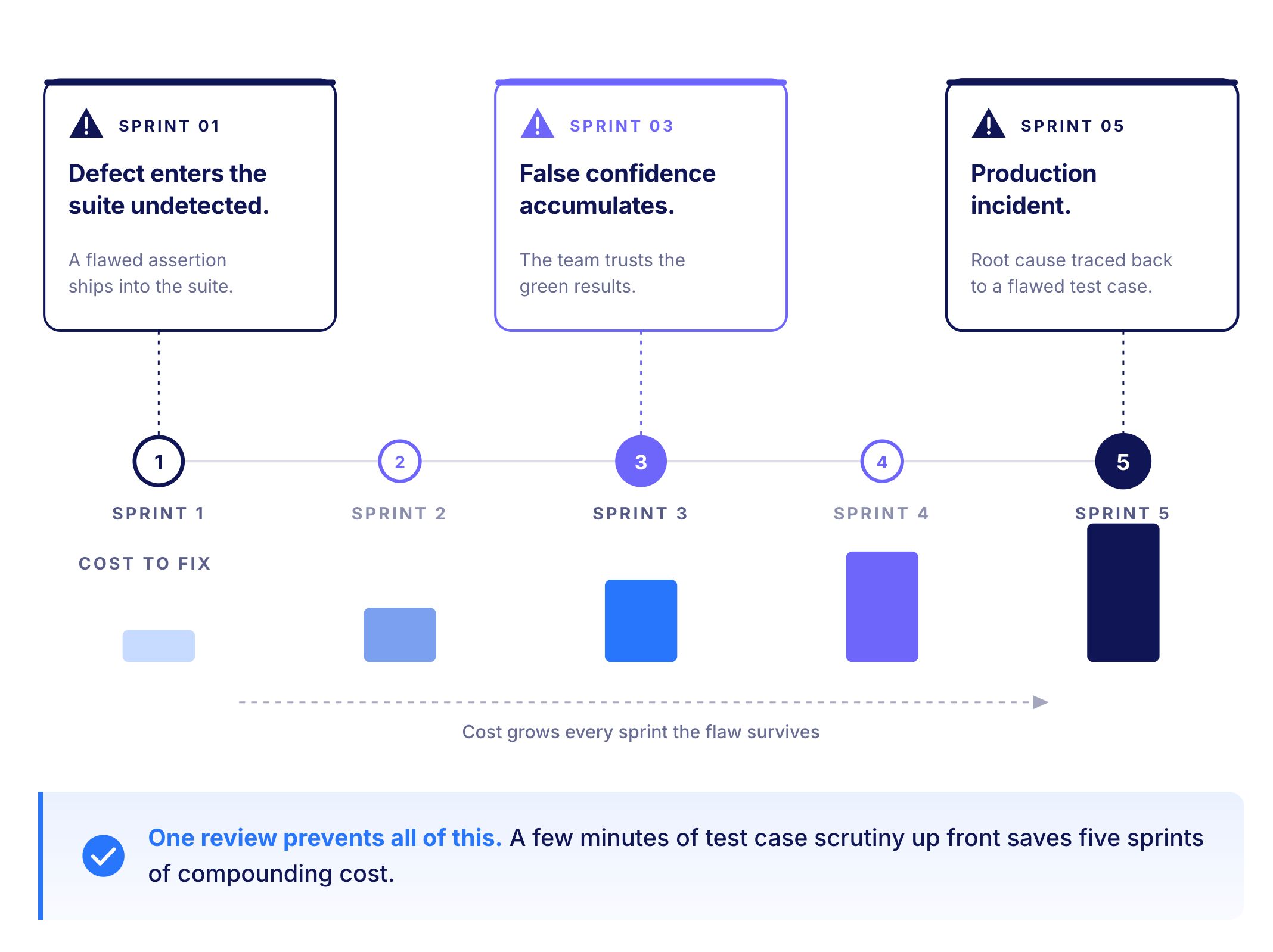
A defect in production code costs one fix. A defect in a test case costs that same fix multiplied by every time the test runs, plus all the false confidence it quietly produces in between.
Test case review is the quality gate that stops a broken test case from entering the suite in the first place. Done well, it protects both the application and the test estate. Done badly or skipped entirely, it lets flawed tests run forever while the team trusts results that mean nothing.
This guide covers why test case review matters, the six dimensions every review must address, a practical checklist to run through each time, the four review types and when to use each, how to handle AI-generated test cases, and the most common mistakes teams make.
What is Test Case Review?
Test case review is the structured examination of a test case by someone other than its author, conducted before the test case is added to the active suite. The reviewer checks that the test case is correct, complete, clear, maintainable, traceable, and executable.
The output is one of three decisions:
Approved
Approved with minor changes
Rejected for rework
Why Test Case Review Matters
Most teams understand why reviewing code matters. Fewer treat test case review with the same discipline. The reason it deserves equal attention is the compounding cost of a defective test case left in the suite.
False negatives: A test case with a flawed assertion passes on a broken implementation. The team believes the behaviour has been verified. The defect reaches production. The test gave false confidence every time it ran.
False positives: A test case with a broken setup fails on a working implementation. The team spends time investigating a non-defect, sometimes changing application code that was never broken. Every investigation is time spent on a problem the test created rather than a problem the application has.
Suite degradation: A test case that fails unpredictably trains the team to ignore its results. Real failures hide inside the noise. The suite stops being a reliable signal.
Review interrupts the compounding before it starts. The cost of a thorough review is small and paid once. The cost of a flawed test case running indefinitely is large and paid repeatedly.
The Six Dimensions of a Test Case Review
A review that covers all six dimensions produces a test case that is reliable, readable, and maintainable. A review that skips any one of them leaves a gap regardless of how much time was spent.
1. Correctness
Does the test verify the right behaviour for the right reason?
A test case can be well-written, clearly structured, and completely wrong. Correctness asks whether the expected result matches the requirement rather than the current implementation, whether the assertions are specific enough to fail when behaviour drifts, whether the preconditions are accurate and achievable in the test environment, and whether the test data is realistic rather than placeholder data.
A test case that asserts "the page loads" is not testing correctness. A test case that asserts "the policy renewal confirmation reference matches the expected format and appears in the underwriter queue within five seconds" is.
2. Completeness
Does the test cover all the paths it was intended to cover?
Completeness asks whether the happy path is covered with realistic data, whether negative and error cases address the failure modes the requirement specifies, whether boundary conditions are covered at numeric and length limits, and whether state-dependent cases are included where the system carries state between actions.
Completeness is not about testing every possible input combination. A test suite that attempts that is unworkable. Completeness is about covering the failure modes that matter, particularly the ones the requirement explicitly specifies.
Related Read: What is Boundary Value Analysis in Software Testing?
3. Clarity
Can anyone on the team run this test identically without asking the author?
Clarity asks whether the test title communicates intent at a glance, whether steps are written in language any team member can follow, whether any implicit domain knowledge is required to execute the test, and whether comments are included where a step needs explanation.
A test case that "the author knows how to run" is not clear. Ambiguity in a test case is a defect. If two engineers executing the same test case would produce different actions, the test case needs rewriting before it enters the suite.
4. Maintainability
Will this test stay working as the application changes?
Maintainability asks whether selectors and locators are stable across reasonable UI changes, whether test data is set up dynamically rather than hard-coded, whether dependencies on other tests are explicit and minimal, and whether the test fails in a way that points clearly to the cause rather than producing a generic error.
Maintainability is where most test suites accumulate hidden cost. A test case that breaks on every cosmetic UI change consumes engineering hours on every release indefinitely.
5. Traceability
Is this test connected to the requirement it verifies?
Traceability asks whether the test case is linked to its requirement, user story, or use case, whether it is linked to the acceptance criteria it addresses, whether the owning journey or scenario is identified, and whether the link will survive a renumbering or refactor of the requirements.
An orphaned test case, one with no traceable connection to a business requirement, is one of the cheapest to delete and one of the easiest to leave running indefinitely producing results nobody acts on.
Related Read: Requirements Traceability Matrix (RTM) Explained
6. Executability
Can this test actually run, right now, in the available environment?
Executability asks whether the test can run in the available environments, whether setup and teardown leave the environment clean after each run, whether the test avoids depending on state outside its control, and whether it can run in parallel without affecting other tests.
A test case that has never been executed has not been fully reviewed. The reviewer's final check is to confirm the test can run and has run at least once successfully before it enters the suite.
Related Read: Parallel Test Execution for 10x Faster Testing
The Test Case Review Checklist
The six dimensions above define what a good test case looks like. The checklist below is how you verify it during an actual review.
Think of the dimensions as the standard and the checklist as the tool you use to measure against that standard. Each dimension maps to a set of specific questions a reviewer can answer with a yes or no.
Working through the checklist is what turns the six-dimension framework from a concept into a repeatable practice.
1. Correctness
The expected result matches the requirement, not just the current implementation
Assertions are specific enough to fail when behaviour drifts
Preconditions are accurate and achievable in the test environment
Test data is realistic, not placeholder data that would not appear in production
Assertions cover the outcome the user cares about, not only the technical state change
2. Completeness
The happy path is covered with at least one realistic data set
Negative cases cover the failure modes the requirement specifies
Boundary cases address numeric, length, and timing limits
State-dependent cases are written where the system carries state between actions
Concurrency cases are written for paths where multiple users or processes can act at the same time
3. Clarity
The title summarises what the test verifies at a glance
Steps are written in language any team member can follow without asking the author
No implicit domain or system knowledge is required to execute
Comments are added where a step needs explanation
Language is consistent with team conventions
4. Maintainability
Selectors and locators are stable across reasonable UI changes
Test data is set up dynamically, not hard-coded
Dependencies on other tests are explicit and minimal
Failure messages identify the cause clearly
Shared components or libraries are used where they exist
5. Traceability
The test case is linked to its requirement, user story, or use case
It is linked to the acceptance criteria it verifies
The owning journey or scenario is identified
The version under review is identifiable in the test management system
6. Executability
The test case has run successfully at least once before review
Setup and teardown leave the environment clean after each run
The test does not depend on state outside its control
Parallel execution is supported or the constraint is documented
A reviewer who works through the full checklist completes a thorough review. A reviewer who skips dimensions completes a faster review and a worse one.
How to Conduct a Test Case Review: Step by Step

Step 1: Prepare Before the Review Starts
What to Do:
Collect the requirement, user story, or acceptance criteria the test case is supposed to verify before opening the test case
Have a copy of the test design guidelines or team conventions available
Note any areas of the system the test touches that have changed recently
Why it Matters:
A reviewer who goes in without the source requirements cannot verify correctness. The most common review failure is approving a test case that tests the current implementation rather than the documented requirement, and that failure is only visible if the reviewer knows what the requirement says.
Example:
A reviewer is asked to review a test case for the direct debit setup journey in a banking application. Before opening the test case, the reviewer pulls up the acceptance criteria from the relevant user story, which specifies that the confirmation screen must display the debit reference number and the first collection date.
The test case only checks that the confirmation screen loads. Without the acceptance criteria in hand, the reviewer would likely have missed the gap.
Step 2: Apply the Six Dimensions in Order
What to Do:
Work through the checklist one dimension at a time. Do not read the test case end to end and form a general impression.
Record a specific note for each dimension before moving to the next
Do not approve a test case until all six dimensions are addressed
Why it Matters:
General impressions miss specific gaps. A reviewer who reads a test case and forms a broad view tends to catch obvious problems and miss subtle ones. Dimension-by-dimension review forces attention to the areas where most defects actually live: correctness of assertions and completeness of negative cases.
Example:
A reviewer works through a payment processing test case dimension by dimension.
Correctness: the assertion checks the payment status field
Completeness: the happy path is covered, but there is no negative case for a declined card
Clarity: all steps are clear
Maintainability: the card number is hard-coded in the test data
Traceability: the test is linked to the requirement
Executability: the test has run once successfully
The reviewer raises two issues: missing declined card test case and hard-coded test data. Both would have been easy to miss in a general read-through.
Step 3: Record Findings With Enough Detail to Act On
What to Do:
Write a specific note for each issue found, identifying the dimension, the step or assertion affected, and what needs to change
Distinguish between issues that require rework before approval and minor suggestions that can be addressed later
Avoid vague comments like "check this" or "needs improvement"
Why it Matters:
A review finding that the author cannot act on is a review finding that does not get fixed. Specific notes produce specific fixes. Vague notes produce conversations that reconstruct the intent of the reviewer weeks after the review took place.
Example:
Instead of writing "the assertions are weak," the reviewer writes: "Step 4 assertion checks only that the confirmation page loads. It should also verify that the reference number displayed matches the one returned by the API and that the first collection date shown matches the date specified in the test data. Rework required before approval."
The author can act on this immediately without needing to follow up.
Step 4: Decide: Approve, Revise, or Rewrite
What to Do:
Approve if all six dimensions are satisfied and any minor suggestions are noted for the author
Send back for revision if the test case has the right intent but flawed execution in one or two dimensions
Request a rewrite if the test case has the wrong intent or a structure that cannot be fixed through revision
Why it Matters:
The mistake to avoid is endless revision of a test case that is fundamentally misconceived. Three review cycles on the same test case usually means a structural problem that revision will not solve.
At that point a clean rewrite costs less than another round of revision. The opposite mistake is rejecting a test case with sound intent and minor execution issues. That one deserves the revision, not the bin.
Example:
A test case for a claims submission journey has the right intent but the preconditions assume a user role that does not exist in the test environment and the assertions check only that the form submits rather than that the claim appears in the adjuster queue. The reviewer sends it back for revision with specific notes on both issues.
A second test case for the same journey asserts that the claim reference number is a positive integer, which would pass on any non-empty response. The intent is wrong. The reviewer requests a rewrite.
Step 5: Verify the Fix Before Final Approval
What to Do:
When a revised test case comes back, check specifically that the issues raised in the previous review have been addressed
Do not re-review dimensions that were already approved unless the revision touches them
Confirm the test has been executed at least once after the revision before final approval
Why it Matters:
A revision that addresses the review comments in a way that introduces a new problem is still a defective test case. Focused re-review on the changed areas, combined with a confirmation that the test runs, closes the loop properly rather than treating the revision as automatic approval.
Example:
A test case comes back after revision. The reviewer checks the two specific issues raised: the preconditions now reference a user role that exists in the test environment, and the assertion now checks that the claim reference number appears in the adjuster queue with a Pending status.
Both issues are resolved. The reviewer confirms the test ran successfully in the staging environment and approves.

Review Types and When to Use Each
The term test case review covers several distinct approaches. Using the right one for the situation saves time and produces better results.
Peer review is the lightest form. One team member reviews another's test case asynchronously and either approves or sends it back with notes. The reviewer applies the checklist informally. Peer review is the right default for low-risk test cases, incremental additions, and routine maintenance updates.
Walkthrough is a structured but informal session where the author walks the reviewer through the test case in real time. The author explains the intent. The reviewer asks questions and identifies gaps as they go.
Walkthroughs work well for moderately complex test cases and for test cases that touch parts of the system the reviewer is less familiar with.
Inspection is the formal end of the range. A defined process with a moderator, multiple reviewers, a prepared checklist, and a documented outcome. Inspections are reserved for high-risk test cases, critical journey tests, and test cases that will govern a regulatory or compliance-relevant verification.
Management review focuses on the test case's fit within the overall coverage strategy rather than its individual quality. The reviewer asks whether it duplicates existing coverage, whether it should be automated, and whether it signals a structural gap in the suite.
A mature team uses all four. The choice calibrates to the risk and complexity of the test case being reviewed.
Who Should Review Test Cases
Different reviewers bring different things to a review. A single reviewer covering all roles produces a faster review and a less complete one.
Peer testers review for technical accuracy, step clarity, and coverage of edge cases they have encountered in practice. They are the most useful reviewer for correctness and completeness.
Developers confirm whether the preconditions are achievable in the implementation and whether the test data assumptions match how the code actually works. They are the most useful reviewer for executability and for catching plausible-but-wrong setups.
Business analysts and product owners verify that the test case covers what the requirement actually asks for rather than what the developer or tester understood the requirement to ask for. They are the most useful reviewer for correctness and traceability.
Test leads and managers review for fit within the overall coverage strategy, duplication of existing cases, and whether the test case should be automated, restructured, or retired. They are the most useful reviewer for strategic alignment.
Not every test case needs all four reviewers. The risk and complexity of the test case determines which combination is worth the time.
Common Mistakes in Test Case Review
1. Lazy Approval
The reviewer reads the title, scans the steps, and approves. The test case enters the suite without substantive verification. This is the most common failure and the one that produces the most compounding damage.
2. Surface Checks Only
The reviewer corrects spelling, formatting, and naming conventions but does not engage with whether the test case verifies the right behaviour. The test case looks tidy and is still wrong.
3. Author Defence
The author treats reviewer feedback as criticism rather than collaboration. The review becomes a negotiation rather than a quality gate. Specific, behaviour-focused feedback is harder to defend against than vague impressions.
4. Reviewer Overload
A single senior reviewer receives every test case. Throughput drops, review lead times rise, and reviews become rubber stamps to clear the queue. Distributing review load across the team maintains throughput and quality.
5. No Strategic View
The reviewer evaluates each test case in isolation without asking whether it duplicates existing coverage, fits the broader strategy, or signals a structural gap. Individual test case quality and suite-level quality are different things and both need attention.
6 Best Practices for Test Case Review
1. Distribute the Review Load
A review culture where one person reviews everything is a culture where reviews gradually stop happening. Build review into the team's workflow as a shared responsibility rather than a senior engineer's side task.
2. Use the Checklist Every Time
The value of a checklist is consistency. A reviewer who applies the six dimensions on routine test cases catches the gaps they would have missed in a general read-through. Consistency matters more than speed.
3. Keep Findings Specific and Actionable
Vague feedback produces vague fixes. Every finding should name the dimension, the step or assertion affected, and exactly what needs to change.
A reviewer who writes "assertions are weak" is generating a conversation. A reviewer who writes "Step 4 should verify the reference number matches the API response, not just that the page loads" is generating a fix.
4. Review AI-Generated Tests With More Scrutiny on Correctness
The completeness dimension also needs explicit attention because AI-generated test cases can look thorough while missing boundary and state-dependent cases entirely.
5. Treat Three Revision Cycles as a Signal to Rewrite
A test case that has been through three rounds of revision without approval has a structural problem. At that point the cost of a clean rewrite is lower than the cost of another round.
6. Run the Test Before Submitting for Review
A test case that has never been executed cannot satisfy the executability dimension. Running the test once before submission removes a category of avoidable review findings and saves the reviewer's time.
How Virtuoso QA Supports Test Case Review
Test case review works better when the platform supports it rather than working against it.
Virtuoso QA's natural-language test authoring means test cases are written in plain English that any stakeholder can read. A product owner reviewing a test case for the claims submission journey does not need to parse code to understand what the test does. The pool of qualified reviewers expands beyond the QA team.
Traceability between requirement, user story, journey, and test case is maintained inside the platform. The reviewer can see what the test is supposed to verify without leaving the tool to check a separate requirements document. The traceability dimension of the review becomes faster to complete.
Composable test modules mean that a reviewer approving a shared module is approving coverage that propagates across every journey that uses it. One review, many tests covered. The leverage of a thorough review increases significantly.
GENerator produces draft test cases from requirements, user stories, and design files. The reviewer's job shifts from checking whether the right tests exist to verifying that the generated drafts are correct, complete, and appropriately scoped. The six-dimension framework applies to generated drafts in the same way it applies to human-written ones, with extra attention on correctness and completeness.
Related Reads
Frequently Asked Questions
Who should review test cases?
What is the difference between a peer review and an inspection?
How often should test cases be reviewed?
Can test case review be automated?