Blog
9 Regression Testing Best Practices for QA Teams

Adwitiya Pandey
Published on

Table of contents
Lorem ipsum
Lorem ipsum
Lorem ipsum
Lorem ipsum
Lorem ipsum
Regression testing sits at an uncomfortable intersection for most QA teams. It is non-negotiable before every release, yet it is the activity most likely to be compressed, skipped, or rushed when delivery timelines tighten. The result is a pattern most QA professionals recognise: a test suite that exists on paper, breaks constantly in practice, and gradually loses the trust of the people who should rely on it most.
This guide covers the practices that make regression testing reliable and sustainable, not just theoretically correct.
Why Most Regression Testing Programmes Fail
The failure mode is almost always the same regardless of the team size or technology stack.
A team invests time building a regression suite. It works well initially. Then the application changes, tests break, engineers spend hours updating locators, and the suite falls behind. Maintenance becomes the dominant activity. New coverage stops being added. Eventually the suite either gets abandoned or becomes a formality that nobody trusts.
The root cause is not poor execution. It is that most regression test suites are built on brittle foundations: element locators that break on every UI change, test data that needs manual preparation, and execution cycles that take too long to fit into a real delivery pipeline.
10 Regression Testing Best Practices
1. Build Your Regression Strategy Around Risk, Not Coverage Targets
The instinct to measure regression quality by the number of test cases is understandable but counterproductive. A thousand brittle tests that nobody maintains provide less actual protection than fifty stable tests covering the workflows that matter most.
A better starting point is a risk-based approach that asks two questions about every area of the application:
What is the impact if this breaks in production?
How likely is it to break given recent and planned changes?
Combining impact and probability creates a priority map. Revenue-generating workflows like checkout, payment processing, and account management deserve the deepest regression coverage. Rarely used administrative functions can tolerate lighter coverage. Recently modified code deserves more attention than code that has been stable for six months.
This is not a permanent classification. Risk changes as the application evolves and as release priorities shift. Reviewing the risk map at the start of each release cycle takes less than an hour and keeps regression effort pointed at what actually matters.
2. Design Tests That Do Not Break Unnecessarily
The single biggest driver of regression maintenance cost is brittle test design. Specifically, tests that are tightly coupled to implementation details rather than to observable behaviour.
Element localisation
Tests built on XPath expressions that navigate DOM hierarchies, or CSS selectors that depend on positional relationships, break whenever the application is restructured even when the functional behaviour being tested has not changed. A label that moves one level up in the DOM should not cause a regression test to fail.
More resilient approaches reference elements by semantic attributes: their accessible name, their label text, their role in the interface. These attributes reflect what an element does rather than where it sits, and they change far less frequently than implementation structure.
Test independence
Tests that depend on each other's execution order, or that share state through a common data set, create cascading failures. One test fails, the data it was supposed to create does not exist, and five subsequent tests fail for reasons entirely unrelated to the defect being investigated.
Each regression test should set up its own preconditions, execute its validation, and clean up after itself. This makes tests slower individually but far more reliable at suite level and allows parallel execution without data collisions.
Test scope
A test that validates ten unrelated behaviours in sequence is not ten tests. It is one test that will fail for ten different reasons and take ten times as long to diagnose. Atomic tests that validate one specific behaviour are easier to name, easier to maintain, and produce failure reports that immediately tell an engineer what broke.
Read our article on software test design to explore test design fundamentals, key techniques, and best practice.
3. Automate the Right Things in the Right Order
Automation is not the goal. Reliable, fast regression feedback is the goal. Automation is one way to achieve it, but automating the wrong things creates maintenance burden that exceeds the value delivered.
Start with stability, not comprehensiveness
Features under active development change frequently. Tests written for them require frequent updates. The better approach is to automate functionality that has stabilised: core business processes that are unlikely to change radically between releases and that need validating on every cycle.
Order management, customer registration, payment flows, and authentication are good early candidates. They change infrequently relative to their business importance, they are executed on every release, and the manual effort of checking them repeatedly is easy to quantify.
Calculate automation ROI by frequency
A test that runs once before a major release justifies less automation investment than a test that runs on every commit. Prioritise automation for the tests that execute most often. The compound return on automation investment scales with execution frequency.
Keep exploratory testing separate
Automated regression validates known expected behaviour. It is not designed to discover unexpected problems. Exploratory testing, usability evaluation, and edge case investigation require human judgement that automation cannot replicate. Teams that over-invest in automation at the expense of exploratory testing end up with comprehensive coverage of the expected and zero coverage of the unexpected.
4. Make Regression Part of the Delivery Pipeline, Not a Gate After It
Regression testing that happens at the end of a release cycle provides feedback too late to be useful. By the time a defect is found, the engineer who introduced it has moved on to something else, the context is gone, and the fix takes longer than it would have taken the day the code was written.
Integrating regression into the CI/CD pipeline changes the economics entirely.
A practical tiered approach:
On every commit: a fast smoke regression covering the critical paths in the most important configurations. This should complete in minutes, not hours, so developers get feedback before they move on.
On branch merges: a core regression covering the primary workflows across a broader set of configurations. This takes longer but runs less frequently.
Before production deployments: a full regression run covering the complete matrix. This is the most thorough layer and runs at the highest-stakes moment.
The tooling for this is well established. Jenkins, Azure DevOps, GitHub Actions, CircleCI, and Bamboo all support automated test execution at pipeline stages. The harder problem is usually keeping the regression suite fast enough to fit in the pipeline, which brings the conversation back to test design.

5. Keep Your Regression Suite Fast Enough to Be Useful
A regression suite that takes eight hours to run will not be run on every deployment. Execution speed determines whether the suite gets used at all.
Parallel execution is the most impactful lever
Tests with no data dependencies between them can run simultaneously across multiple workers. The prerequisite is test independence: each test creates its own data, cleans up after itself, and does not rely on shared state that a parallel test might modify. Cloud execution infrastructure makes this practical without significant upfront investment, with workers provisioned on demand and scaled down after runs complete.
Smart test selection reduces unnecessary execution
Not every change requires full regression. Building a map that links tests to the application components they exercise allows selective execution: when code changes, only tests covering affected areas need to run. Teams running full regression when a targeted subset would suffice are paying an execution cost they do not need to pay.
Match infrastructure to the workload
Underpowered execution infrastructure eliminates the gains from parallelisation. The right infrastructure decision is determined by the execution time target, not by minimising cost. A regression suite that completes in forty minutes instead of four hours pays for itself quickly in engineering time saved.
6: Treat Flaky Tests as a First-Class Problem
Flaky tests, those that pass sometimes and fail sometimes without any code change, are more damaging than broken tests. A broken test tells you something is wrong. A flaky test trains engineers to ignore failures, which means real defects eventually get dismissed along with the noise.
The common causes of flakiness are well understood:
Hard-coded waits that assume operations complete within a fixed time, when in reality asynchronous operations complete at variable speeds
Tests that share data and interfere with each other when executed in parallel
Dependencies on external services whose availability or response time varies
Environment differences between the machines where tests are authored and where they run
The response to flakiness should be systematic rather than reactive. Track test results over time and calculate flakiness rates. Quarantine tests that exceed a defined threshold, removing them from blocking pipelines while they are investigated. Fix the root cause rather than masking the symptom with retry logic.
A flakiness rate above one percent across a regression suite is a signal that something structural needs attention. Teams that accept higher rates end up with pipelines that engineers stop trusting.
7. Manage Test Data Like Production Infrastructure
Test data is infrastructure. Treating it as an afterthought is one of the most consistent causes of unreliable regression testing.
The specific problems that recur:
Tests that rely on data created by previous tests, so when that prior test fails or is skipped, a cascade of subsequent failures follows
Static data sets that accumulate state over time and produce inconsistent behaviour
Tests hard-coded to specific data values that break when those values change in the test environment
Shared data environments where tests running in parallel corrupt each other's data
The practical fixes are not complicated but require discipline:
Each test should create the data it needs as part of its setup and clean it up afterwards. Parameterised tests that accept variable inputs rather than hard-coded values are more resilient and can be reused across different data scenarios. Dedicated test environments that are refreshed between major test cycles eliminate the accumulated state problem.
For enterprise applications with complex data relationships, reusable data setup utilities are worth the upfront investment. A utility that provisions a complete customer with orders, payment methods, and history can be invoked by dozens of tests, and when the data model changes it is updated in one place rather than across the entire suite.

8. Use Reporting to Understand Trends, Not Just Individual Runs
A single regression run tells you whether the application passed or failed today. A series of runs tells you whether your quality is improving or degrading over time. Most teams look at the former and ignore the latter.
Track pass rates across runs, not just within them
A suite with a 95% pass rate sounds acceptable. The same suite with a pass rate that has dropped from 99% to 95% over three weeks is signalling a problem. Without trend data, that signal is invisible.
Tracking pass rates over time reveals patterns that individual run analysis misses: specific tests that fail repeatedly across different code changes, test categories that degrade after particular types of release, and correlations between code authors or modules and increased failure rates.
Capture useful failure evidence automatically
When a regression test fails, the evidence available immediately after failure determines how quickly the defect gets diagnosed and fixed. A failure report that shows only a test name and an assertion error forces the investigating engineer to reproduce the failure manually before they can even begin root cause analysis.
Useful failure evidence includes:
Screenshots at the point of failure showing the visual state of the application
The sequence of steps that led to the failure for context
Network requests and responses if the failure involves API behaviour
The application state in terms of data at the time of failure
Capturing this automatically as part of test execution rather than relying on engineers to reproduce failures manually is one of the highest-value investments a regression programme can make.
Surface real-time status during execution
Long regression runs that provide no feedback until completion create anxiety and waste time. Engineers do not know whether to wait or move on. Real-time reporting showing tests in progress, passed, failed, and remaining allows parallel investigation of failures while execution continues. Defects found in the first quarter of a regression run can be assigned and diagnosed before the run finishes.
9. Define Your Cross-Browser and Cross-Device Regression Coverage Deliberately
Testing on Chrome during development and calling it cross-browser regression is not cross-browser regression. It is single-browser regression with a label.
Start with usage data, not assumptions
Look at actual traffic analytics before deciding which browsers and devices to cover. Most applications have a dominant browser, a secondary browser with meaningful traffic, and a long tail. Regression investment should be proportional to that distribution.
Separate functional from visual validation
Cross-browser functional regression validates that the application behaves correctly across browser environments. Visual rendering differences are a separate concern. A form that submits correctly in Chrome but displays with overlapping fields in Safari has passed functional regression and failed visual regression. Both matter and require different approaches.
Treat mobile as a first-class regression target
Mobile traffic exceeds desktop for many applications yet mobile regression is frequently treated as an afterthought. Responsive layout failures and mobile-specific rendering problems do not appear in desktop browser regression regardless of how thorough it is. Include at least one major mobile browser in every core regression run.
How Virtuoso QA Addresses the Core Regression Problems
The practices above describe what good regression testing looks like. The challenge for most teams is execution: implementing them with the tools and resources available.
The structural problems that undermine most regression programmes, brittle tests, maintenance overhead, slow execution cycles, and limited authoring capacity, are addressed differently by Virtuoso QA than by conventional automation frameworks.
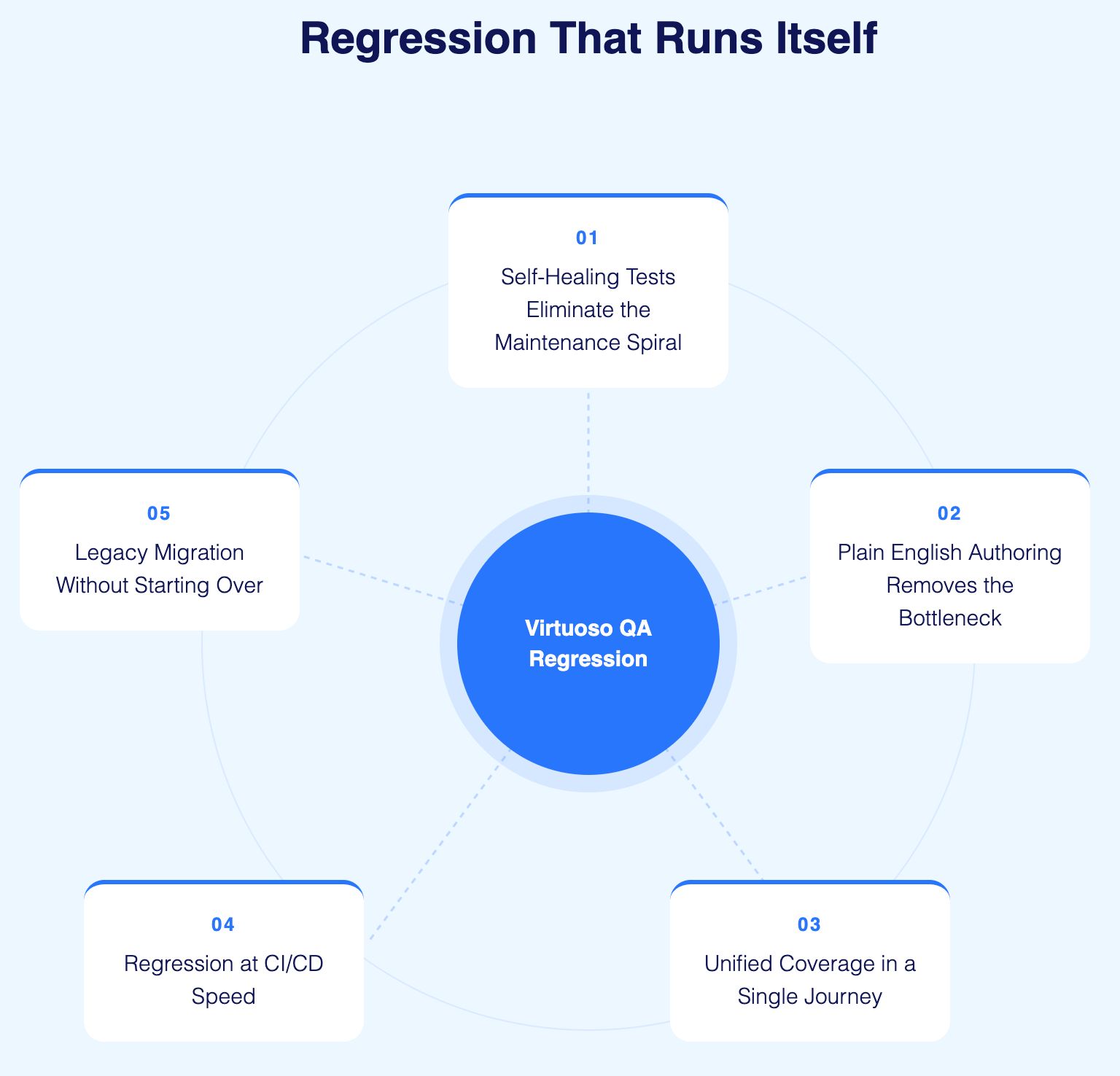
Self-healing tests eliminate the maintenance spiral
When an application changes, Virtuoso QA's AI adapts tests automatically rather than breaking them. Element identification uses a combination of visual analysis, DOM structure, and contextual data rather than fixed locators, which means UI restructuring does not cascade into hours of test updates. Across enterprise implementations this has produced an 88% reduction in test maintenance effort. For teams where maintenance currently consumes the majority of automation capacity, this directly translates to time that can be redirected toward coverage expansion.
Plain English authoring removes the bottleneck
Conventional regression automation bottlenecks around engineering availability. Business analysts who understand the application workflows cannot contribute to automation. Product owners who define acceptance criteria cannot author regression scenarios. Virtuoso QA's Natural Language Programming allows anyone who can describe expected behaviour in plain English to create executable regression tests.
Unified coverage in a single journey
Many regression programmes run separate suites for UI, API, and database validation and manually correlate the results when investigating failures. A single Virtuoso QA journey validates UI behaviour, API responses, and database state together. When a failure occurs, AI Root Cause Analysis surfaces the screenshots, network requests, and DOM comparisons at the point of failure in one report rather than requiring engineers to cross-reference multiple tools.
Regression at CI/CD speed
Virtuoso QA integrates with Jenkins, Azure DevOps, GitHub Actions, CircleCI, and Bamboo. Regression suites run automatically on code changes and complete significantly faster than equivalent Selenium-based suites.
Legacy migration without starting over
Teams with existing regression investment in Selenium, Tosca, or TestComplete do not need to abandon that work to benefit from AI-native regression. GENerator converts existing test assets into Virtuoso QA journeys, preserving coverage while removing the maintenance burden that makes large legacy suites unsustainable.

Related Reads
Frequently Asked Questions
How do you select tests for regression testing?
How do you reduce regression testing time?
What is self healing regression testing?
What metrics should you track for regression testing?
What is the role of AI in regression testing?
How do you handle regression testing for microservices?